
Do you sometimes wonder why some teams are so quick to come up with creative ideas, while others cling to rigid routines and hardly develop new impulses?
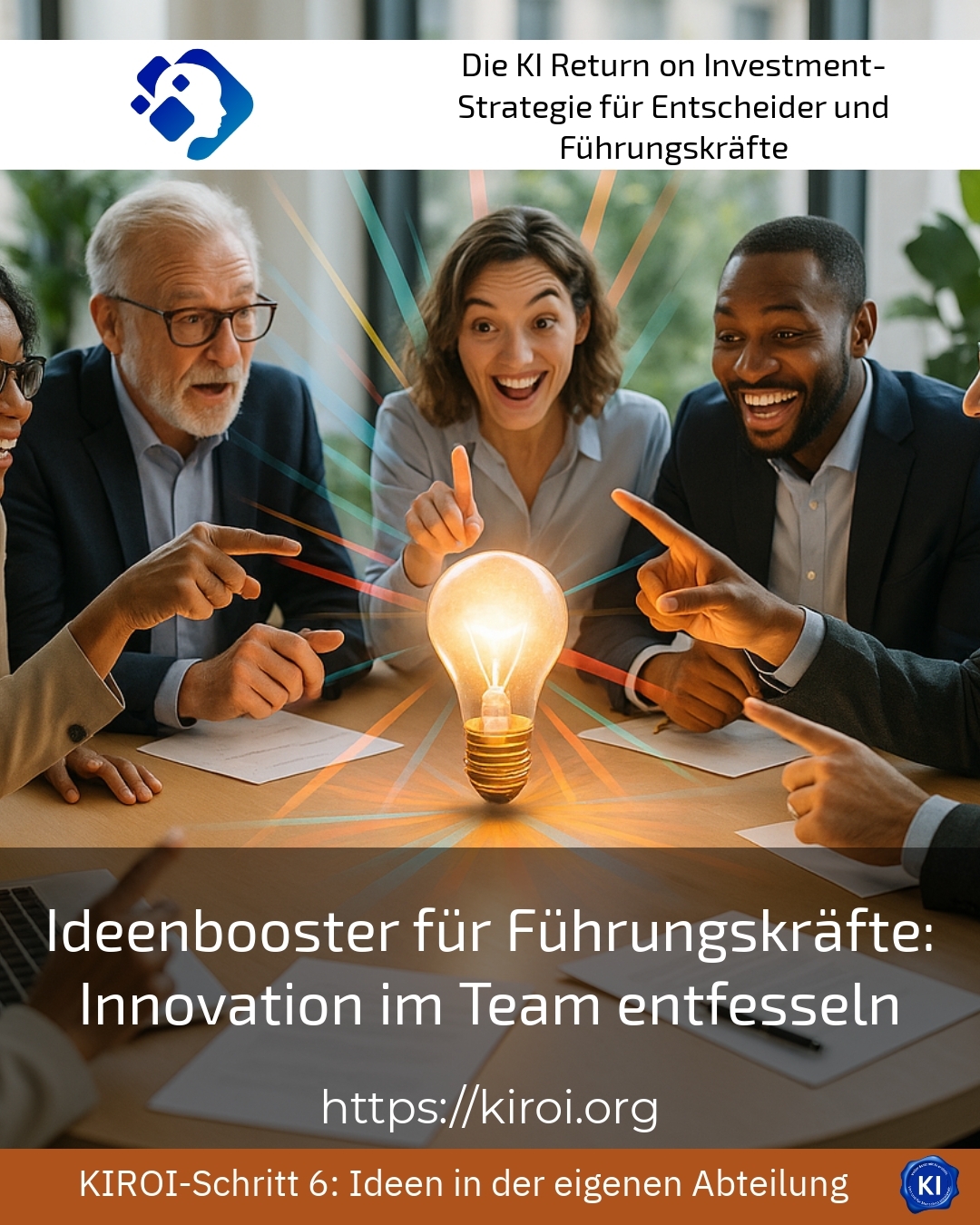
This question concerns numerous executives in a wide variety of industries, because competition for the best innovations today determines a company's long-term success. Ideas booster for leaders It represents a crucial lever for unleashing creative potential within teams and driving sustainable change. In a time when disruptive business models are transforming entire markets, companies need more than ever leadership figures who create spaces for unconventional thinking and encourage their employees to come up with bold ideas. Transruptions coaching closely accompanies leaders in this transformation by providing impulses for new ways of thinking and questioning structures that hinder the creative flow.
Why traditional leadership approaches are reaching their limits
In many companies, the image of the leader still prevails, one who knows all the answers and gives clear instructions. This hierarchical model dates back to a time when markets were more stable and changes were more predictable. Today, however, we are experiencing a completely different reality. Technological breakthroughs, changing customer expectations, and global connectivity require flexible responses. A car manufacturer recently reported that its engineers developed innovative powertrain concepts because management created the freedom to experiment [1]. In the pharmaceutical industry, groundbreaking active ingredients often emerge when research teams are allowed to work across departmental boundaries. In retail as well, it is often the employees on the front line who have the best ideas for service improvements when you listen to them.
The difficulty lies in the fact that many leaders have never learned how to manage creative processes and systematically promote ideas. They were trained to increase efficiency and minimize errors, but innovation requires a different leadership style. This is where Transruptive Coaching comes in, which helps leadership personalities develop new competencies and redefine their role.
The idea booster for executives in practice
An effective idea booster for leaders begins with the realization that innovation is not a coincidence but can be actively managed. This first requires an honest assessment of the current team dynamics and the existing structures. Leaders who come to me for coaching often report similar challenges: Their teams work reliably, but there is no genuine enthusiasm for new projects. Sometimes unspoken rules stifle creativity without anyone being aware of it.
In the financial sector, for example, we observe that strict compliance requirements can lead employees to shy away from any risk, even when it comes to creative proposals. One insurance company subsequently developed separate innovation formats in which ideas could be conceived without regulatory restrictions [2]. In the logistics sector, the best optimization ideas often emerge from the collaboration between warehouse workers and IT specialists. And in healthcare, hospitals report that interprofessional case discussions not only improve patient care but also generate innovative treatment approaches.
Best practice with a AIROI customer
A medium-sized manufacturing company approached us because management realized that despite high technical expertise, innovative product ideas were no longer coming from the company. The workforce was feeling demotivated and reacted with skepticism to change proposals. As part of our disruption coaching, we first analyzed the existing communication structures and quickly realized that a strong silo mentality hindered collaboration between development, production, and sales. Together with the management level, we developed a concept for regular cross-departmental innovation workshops in which employees of all hierarchical levels could contribute ideas equally. The introduction of a digital idea platform, where suggestions could be submitted anonymously and evaluated by colleagues, proved particularly effective. Within six months, three promising product concepts emerged from this, one of which was already successfully introduced on the market. Employee satisfaction increased measurably, and the executives reported on a noticeably more open-minded culture of conversation within their teams.
Psychological safety as a foundation for innovation
Research results clearly show that teams are most innovative when they feel psychologically safe [3]. This means that employees do not have to fear negative consequences if they express unusual ideas or make mistakes. This security does not come naturally; it must be actively fostered by leaders. In the consulting industry, for example, some companies have introduced so-called fail forward rituals, in which failed projects are analyzed to learn from them rather than looking for blame. Technology companies in Silicon Valley regularly conduct retrospectives in which critical voices are explicitly welcome. And in the trades, master craftsmen report that apprentices often make surprising improvement suggestions when their perspective is taken seriously.
Creating psychological safety requires self-reflection from leaders and a willingness to question their own behaviors. Transruptive coaching accompanies this process and provides impulses for concrete changes in leadership practice. Clients often report that even small adjustments in their communication can have significant effects.
Using creative methods as ideas boosters for leaders
In addition to the cultural dimension, concrete methods also play an important role in promoting innovation. The Ideas Booster for Leaders therefore includes a repertoire of tools that can be used depending on the situation and the team composition. Design Thinking, for example, has proven to be an effective approach in many industries for developing user-oriented solutions [4]. A telecommunications company used this method to design new tariff models that were better tailored to customer needs. In the construction industry, design thinking workshops resulted in innovative housing concepts for urban spaces. And a media house developed new digital formats using this method to appeal to younger target groups.
Methods such as SCAMPER, which systematically examines existing products or processes, or the Walt Disney method, which uses different thinking roles, can also lead teams to unexpected insights. However, it is crucial that leaders do not use these methods as a self-serving goal, but adapt them to the specific needs of their team.
The role of diversity and different perspectives
Homogeneous teams tend to produce similar ideas, while diverse teams develop a broader range of solutions. This finding has far-reaching consequences for the composition of innovation teams and the way in which executives assign projects. In the advertising industry, creative agencies consciously rely on interdisciplinary teams where copywriters, designers, and strategists work together. Pharmaceutical companies bring together scientists from different disciplines to address complex research questions. And banks increasingly recognize the value of lateral entry because non-industry perspectives can break through established mindsets.
Leaders who want to foster innovation should therefore actively seek different perspectives and consciously include uncomfortable opinions. This requires openness and the ability to use tensions productively rather than suppressing them.
Best practice with a AIROI customer
A B2B service company faced the challenge of adapting its business model to changing market conditions. The management of the various business units worked largely in isolation from each other and sometimes pursued contradictory strategies. In the coaching process, we initially organized a series of moderated dialogue formats in which the department managers openly shared their respective perspectives and challenges. Not only conflicts were made visible, but also surprising synergies emerged. For example, one department manager recognized that a problem that his team had been dealing with for months had already been resolved in another department. Based on these insights, the leadership team developed together a new structure for regular knowledge exchange. We supported the implementation of this structure over several months and helped the management team shape their new role as a connector. The result was significantly improved collaboration and several innovative service offerings that emerged from the combined expertise of various departments.
Idea boosters for executives through continuous learning
Innovation requires the willingness to continuously learn and to address new developments. Leaders who remain curious and regularly upskill are better able to inspire their teams and recognize relevant trends. In the real estate industry, for example, we observe that successful companies have early on focused on sustainability issues because their leaders were attentive to societal changes. In mechanical engineering, competitive advantages often arise from the fact that leadership teams anticipate technological developments and prepare their teams accordingly. And in tourism, those companies have best managed the crisis that have quickly built up digital competencies among their leadership teams.
Transruptions coaching supports leaders in developing a lifelong learning mindset and creating learning spaces for their teams. This includes both formal training and informal learning formats such as peer learning or job rotation.
From resistance to enthusiasm: Designing successful change
Every innovation brings changes with it, and changes naturally evoke resistance. Leaders must learn to deal with these resistances constructively and accompany their teams through transitional phases. It is important to understand that resistance often stems from legitimate concerns and contains valuable information. For example, an energy provider had to identify that older employees initially reacted skeptically to the introduction of new digital processes, but provided valuable insights into practical problems [5]. In the restaurant industry, restaurant owners report that the integration of service staff in the development of new concepts significantly increases acceptance. And in the public sector, administrative reforms are more likely to succeed when those involved are actively included.
Therefore, leaders should not view resistance as a hindrance but as a resource that must be utilized. Open communication, transparency about goals and backgrounds, and genuine opportunities for participation help clear up concerns and gain support.
My AIROI Analysis
Based on years of experience in guiding leaders and teams through innovation projects, it can be concluded that the decisive success factor lies not in individual methods or tools, but in the attitude of the leadership itself. Those who authentically show curiosity as a leader, view mistakes as learning opportunities, and have genuine interest in the ideas of their employees automatically create an environment where creativity can flourish. The AIROI perspective clarifies that innovation is always a combination of people, processes, and technologies, and that leaders must work on all three dimensions.
What seems particularly relevant to me is the realization that ideation alone is not enough. Many companies collect ideas but fail to systematically implement them. This requires clear processes that run from idea to implementation, as well as resources that are made available for experimental projects. Leaders must have the courage to try out incomplete concepts and learn from failure.
Transruptions coaching accompanies leaders and their teams along this path by creating spaces for reflection, bringing new perspectives, and supporting the development of tailored innovation strategies. Experience shows that just a few months of intensive coaching can already bring about lasting changes in the innovation culture. The key is the leader’s willingness to see themselves as part of the system and to critically question their own role.
Further links from the text above:
[1] McKinsey: The eight essentials of innovation
[2] Harvard Business Review: Why Innovation Labs Fail
[3] Google Re:Work: Guide to team effectiveness
[5] Forbes: How to overcome resistance to change
For more information and if you have any questions, please contact Contact us or read more blog posts on the topic Artificial intelligence here.









 Deutsch
 English (UK)