
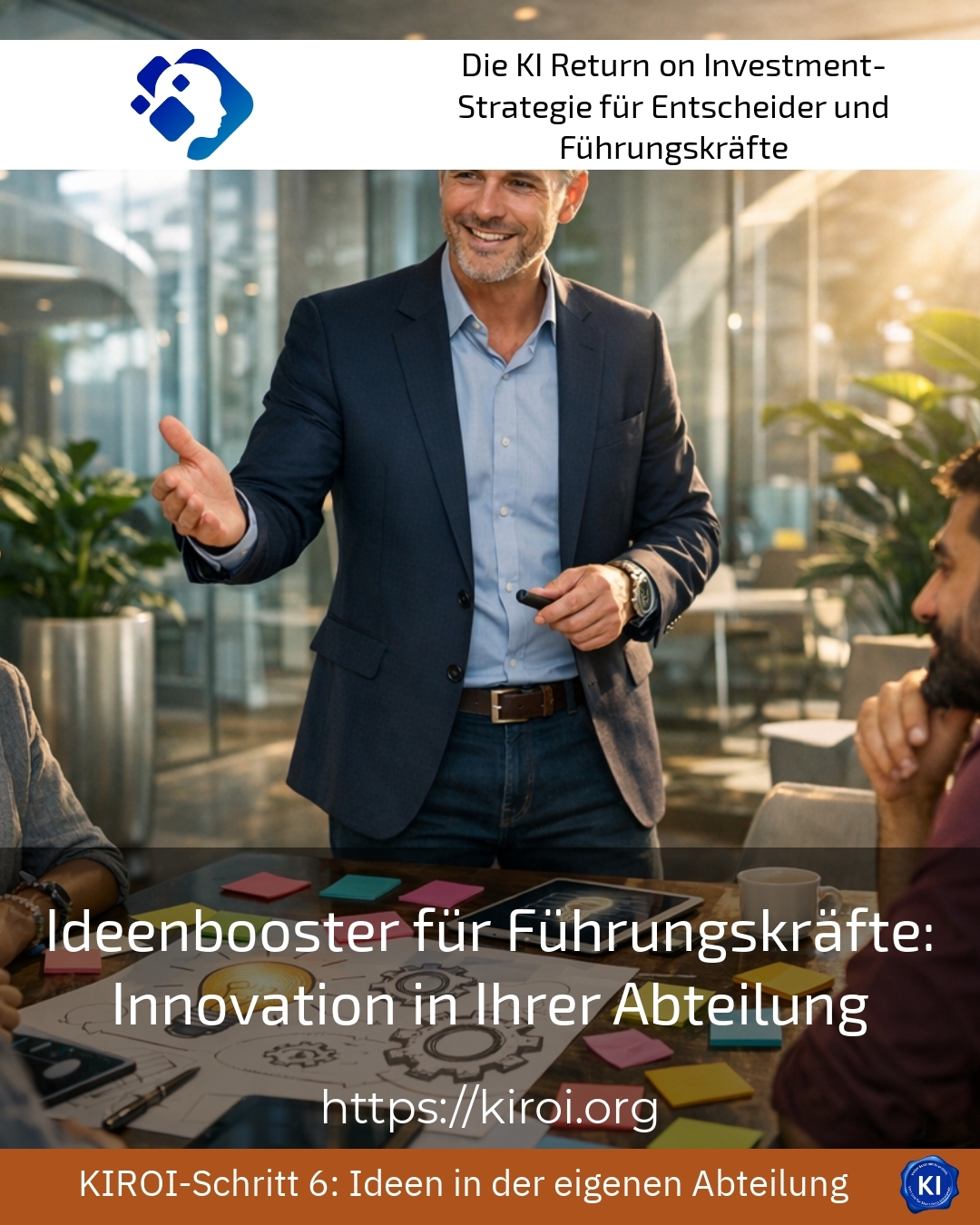
Have you ever wondered why some departments seemingly develop groundbreaking concepts effortlessly, while others falter despite enormous efforts? The answer often lies not in a lack of resources or talent, but rather in the way in which leaders stimulate and support creative processes. Idea booster for managers: Innovation in your department In transruptive coaching, we understand exactly these challenges that teams and their leaders face daily. Many clients report feeling stuck and seeking fresh impulses. Therefore, in this article we would like to present concrete approaches that can help you unleash creative energy.
Understand the fundamentals of creative leadership
Before we delve into practical tools, it is worth taking a look at the fundamental principles that distinguish creative leadership. First of all, it is important to understand that creativity is not an innate trait that only a few people possess. Rather, it is a skill that can be nurtured through targeted support and appropriate frameworks in almost every team member. Studies by the Harvard Business Review show that psychological safety is a crucial factor in the development of new concepts [1]. People who are not afraid of negative consequences share their thoughts more openly and dare to make bolder proposals.
In the field of corporate consulting, for example, we see that advisory teams, under enormous time pressure, often develop surprisingly creative solutions. This is because clear deadlines can paradoxically have a liberating effect. Another example can be found in the technology industry, where companies like Google deliberately grant their employees leeway for their own projects. In the healthcare sector, too, interdisciplinary teams often achieve better results than homogeneous groups.
Best practice with a AIROI customer
A medium-sized company from the manufacturing sector came to us with a specific challenge. The management reported that despite qualified professionals, hardly any new product ideas had emerged. As part of our collaboration, we first analyzed the existing communication structures and found that hierarchical barriers massively hindered the free exchange of ideas. Together, we developed a format for weekly creative sessions in which no superiors were present intentionally. The results of these sessions were then presented anonymously to the management level. Within six months, the number of submitted improvement suggestions tripled, and three of them led to concrete product developments. The CEO later reported that the overall mood within the team had also significantly improved. The employees felt included and valued, which had a positive impact on the overall corporate culture.
Idea booster for managers: Innovation in your department through structured methods
Many leaders underestimate the importance of structured approaches for creative processes. The widespread assumption that creativity must emerge spontaneously and unplanned rarely corresponds to reality. In fact, most teams benefit from clear frameworks within which they can move freely. The SCAMPER model, for example, provides a proven framework for systematic lateral thinking [2]. This method calls for replacing, combining, adapting, modifying, using in other ways, eliminating, or reversing existing products or processes.
In the financial sector, progressive banks are using this technology to rethink traditional services. A classic example is the development of mobile banking apps, which emerged through a systematic questioning of existing processes. In retail, companies have created entirely new customer experiences by combining online and offline experiences. The logistics industry also impressively demonstrates how established processes can be reversed to create more efficient supply chains.
Design Thinking as a tool for customer-oriented development
Over the past few years, Design Thinking has established itself as a particularly effective approach that consistently puts people at the center. This method begins with a deep understanding of the needs of those for whom solutions are to be developed. Ideas are then generated, quick prototypes are created, and these are iteratively improved. The charm of this approach lies in its action-oriented approach and the acceptance of mistakes as learning opportunities.
In the automotive industry, for example, design thinking has led to the development of entirely new mobility concepts. Manufacturers have recognized that customers do not necessarily want to own a car but rather want to move flexibly from A to B. The media industry, in turn, is using this approach to develop content that actually meets the interests of target audiences. Innovative learning formats are also emerging in the education sector through design thinking, which better reaches students and graduates.
The role of the leader as a creative catalyst
As Idea booster for managers: Innovation in your department It is crucial to understand that you yourself do not have to be the most creative person in the room. Your task is rather to create an environment in which others can develop their creativity. This requires a change in mindset among many leaders who have traditionally been socialized as decision-makers and problem solvers. Instead, the goal is to ask the right questions and open up space for experimentation.
Clients often report feeling uncertain when it comes to handing over control. This concern is understandable, because ultimately, leaders bear the responsibility for results. Transruptive coaching can help you gradually grant more autonomy, without completely relinquishing control. It’s about finding a balance between leadership and freedom, which must be individually tailored to each team.
Best practice with a AIROI customer
A department head from the insurance industry approached us with the question of how she could motivate her experienced employees to be more proactive. The colleagues were highly skilled in their field, but showed little interest in changes or new approaches. In our joint work, we identified that the manager unconsciously interpreted any dissenting opinion as criticism of her person. Through targeted reflection exercises, she was able to recognize and change these patterns. We developed together discussion formats in which she consciously asked for dissenting perspectives and responded to them appreciatively. After about three months, she reported that for the first time, employees had spontaneously submitted suggestions for improvement to her. The quality of team work improved noticeably, and the turnover in the department decreased significantly. She had not achieved this change through new processes, but solely through the transformation of her own leadership behavior.
Communication as the key to creative success
The way leaders communicate significantly influences the creative climate in their department. Open-ended questions that encourage thought are far more effective than closed questions that only allow yes-or-no answers. Instead of asking „Does this work?“ you could ask „What are the possibilities to improve this process?“ This small linguistic change can make a significant difference in the quality of the answers.
In the advertising industry, this form of communication has long been established, as creative campaigns can only be created through open exchange. Agencies deliberately use formats such as brainstorming sessions, where all ideas are collected first before a review takes place. Software development has adapted similar principles with agile methods, which provide regular retrospectives and open feedback. In the hospitality industry, too, teams that communicate openly can create better guest experiences.
Practical tips for everyday work
In addition to the methods already mentioned, there are numerous smaller interventions that you can immediately integrate into your leadership routine. One of them is the so-called „Yes, and…“ technique, which originated in improvisation theater [3]. In this technique, each idea is initially accepted and continued, rather than being immediately evaluated or rejected. This attitude can work wonders when it comes to creating a safe space for unusual suggestions.
In the pharmaceutical industry, some research departments have started organizing regular „Failure Parties“ where failed experiments are celebrated. The idea behind it is that each failure yields valuable insights and paves the way for success. In mechanical engineering, innovative companies use „reverse mentoring,“ where younger employees share their knowledge of digital technologies with experienced colleagues. The tourism industry, in turn, is experimenting with „job rotation“ to bring fresh perspectives into different departments.
Idea booster for executives: Innovation in your department through external impulses
Sometimes it takes an outside perspective to break through stuck patterns of thinking. Transruptive coaching offers exactly this external perspective, which can reveal blind spots and open up new paths. We help leaders recognize their own patterns and consciously change them. We rely on a combination of proven coaching methods and innovative approaches from organizational development.
Many of our clients come to us feeling that despite all their efforts, they are unable to move forward. They have already attended training sessions, read books, and tried various techniques. What they lack, however, is a customized approach that takes into account their specific situation. This is where we come in and develop strategies that are tailored to your team and your company culture.
My AIROI Analysis
The ability to initiate and support creative processes is becoming increasingly important for leaders as markets and technologies change at a rapid pace. Our experience from numerous coaching projects shows that the decisive factor lies not in spectacular methods, but in the willingness to continuously develop personally. Leaders who question their own mindsets and are willing to relinquish control create sustainably innovative cultures within their departments.
Particularly noteworthy is the realization that small changes can often have large effects. A different way of asking questions, more room for experimentation, or the conscious appreciation of failed attempts can significantly increase a team’s creative potential. It is important to understand that this change takes time and does not happen overnight. Patience and consistency are essential virtues on this path.
Transruptions coaching can accompany you on this journey and provide the impulses that are tailored to your specific situation. We firmly believe that there is enormous creative potential in every team that is just waiting to be awakened. The role of the leader as facilitator and catalyst is of central importance. If you are ready to embark on this journey, we are happy to support you.
Further links from the text above:
[1] Harvard Business Review – Psychological Safety in Teams
[2] MindTools – SCAMPER Technique
[3] Second City – The Yes And Principle
For more information and if you have any questions, please contact Contact us or read more blog posts on the topic Artificial intelligence here.









 Deutsch
 English (UK)