
Have you ever wondered why some teams seem to develop groundbreaking ideas effortlessly, while others remain in creative stasis despite all their efforts?
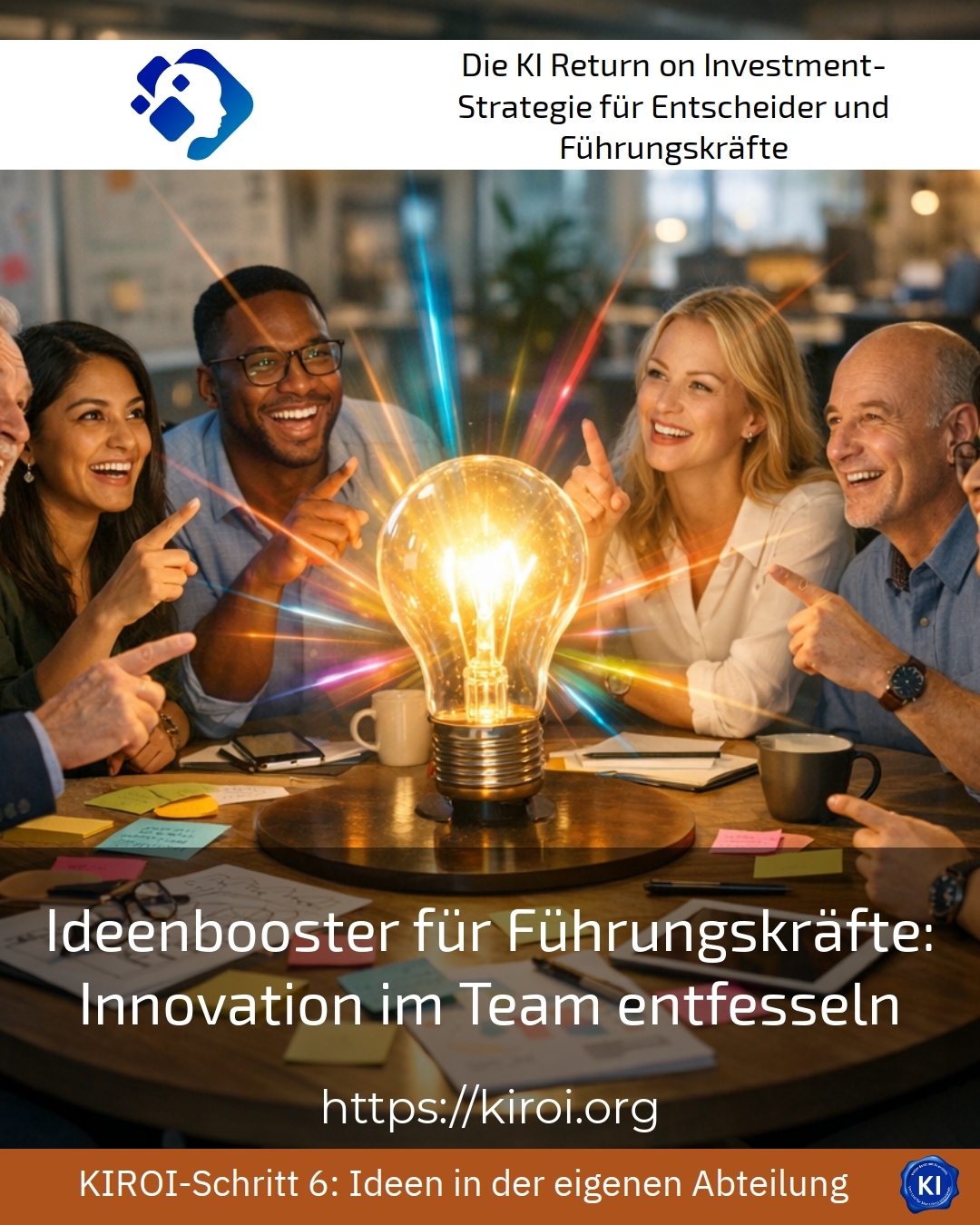
This question concerns executives in almost every organization, because the ability to continuously innovate is more crucial today than ever before for long-term success and sustainable growth. Ideas booster for leaders It’s not expensive technologies or complex strategy papers that are at play here; rather, it’s the right framework conditions that first enable and encourage creative thinking. In my long-standing work as a transruptions coach, I help leadership figures create exactly these conditions and empower their teams to achieve real innovation.
Unleash the hidden power of collective creativity
In today’s business world, leaders often face a paradoxical situation. They have highly skilled employees with enormous potential. At the same time, many ideas remain unspoken or get lost in bureaucratic structures. The reasons for this often lie deeper than they appear at first glance. They stem from corporate cultures that sanction mistakes rather than perceiving them as learning opportunities. They manifest themselves in hierarchies that inhibit the free exchange of ideas. They are also reflected in a sense of time pressure that makes reflexive thinking impossible.
A technology company in software development faced exactly this challenge. The developers worked in isolation on their projects. The exchange between the departments was hardly taking place. Innovative solutions remained trapped in silos. A mechanical engineering company experienced a similar situation in its product development. The engineers had brilliant ideas for process optimization. However, they did not dare to openly discuss them. A financial services provider, on the other hand, struggled with the inertia of established structures. New employees brought fresh perspectives. However, these quickly faded under the pressure of conformist expectations.
Best practice with a AIROI customer
A medium-sized company from the automotive supplier industry approached me with a clear request. The management noticed that despite highly motivated staff, hardly any new product ideas were being generated. In our joint coaching sessions, we first analyzed the existing communication structures and identified several obstacles. The weekly meetings were dominated by status reports and left no room for creative discussions. In addition, there was a subtle fear of presenting underdeveloped ideas. Together, we developed a new format called the „Ideas Workshop,“ which took place once a month and was deliberately designed without hierarchy. The executives learned to first refrain from speaking and actively listen. After about six months, the participants reported a noticeably changed atmosphere. The employees now made their own suggestions for improvement, and three of them were already successfully implemented, which led to measurable efficiency improvements in production.
Idea boosters for leaders: Psychological safety as the foundation
Research clearly shows that psychological safety is the most important factor for creative team performance [1]. People need to feel safe to express unconventional ideas. They need the certainty that mistakes will not be punished. This safety does not come naturally; it must be actively cultivated by leaders.
In the pharmaceutical industry, I often experience that regulatory requirements stifle creative thinking. The fear of compliance violations paralyzes innovative approaches. There is certainly room for creative solutions in this area. In retail, on the other hand, operational pressure often dominates day-to-day business. Employees have little time to think. Ideas for customer engagement thus do not arise. The media industry faces similar challenges. The pressure to continuously produce content leaves little room for strategic thinking. Innovative formats are therefore less frequently developed.
Executives often come to me with exactly these issues. They feel that their teams could do more. But they don’t know how to solve the obstacles. Some have already tried various methods. Brainstorming sessions remained fruitless. Design-Thinking workshops failed to produce lasting results. Transruptive coaching helps these executives understand the underlying causes. We work together on individual solutions.
Practical ideas for everyday management
The transformation into an innovation-friendly culture begins with small but consistent steps. Leaders can immediately start by being more active in listening. They can consciously ask questions instead of giving answers. They can make their own uncertainties transparent. This signals to the team that vulnerability is not a weakness.
For example, a logistics company introduced „mistake celebrations.“ Once a quarter, failed experiments were recognized. The learning effects were identified and shared. This fundamentally changed the attitude towards risks. An energy provider established „reverse mentoring“ programs. Younger employees coached experienced executives in digital topics. The respect for different perspectives grew as a result. An insurance company created „innovation free spaces.“ Employees were given time for their own projects. The results exceeded all expectations.
Re-defining the role of the leader as an enabler
Traditional leadership models emphasize control and direction. They view the leader as the decision-maker and the guide. This understanding is no longer relevant. Modern leadership means opening up spaces. It means creating connections. It means recognizing and fostering potential. As Ideas booster for leaders In this case, the individual's own attitude plays a major role.
The telecommunications industry is undergoing a fundamental transformation. Leaders must learn to deal with uncertainty. They must empower teams instead of directing them. The construction industry faces similar challenges. Traditional hierarchies are slowly giving way to more autonomous working methods. In healthcare, leadership understanding is also changing. Interdisciplinary teams require new forms of coordination. The classic hierarchical structure of management is being questioned.
Best practice with a AIROI customer
A senior executive from the food industry contacted me with a very personal request. She felt increasingly overwhelmed by the expectation of always having the best solution ready. Employees waited for decisions from above. Initiative was almost non-existent. In transruptive coaching, we worked intensively on the inner attitude of this senior executive. We reflected together on their own beliefs about leadership and authority. It became clear that a deeply rooted pursuit of perfection was blocking the change. We developed strategies for the senior executive to gradually relinquish control without feeling uncomfortable. She began to consciously share her uncertainties in meetings and to ask for input. The initial irritation within the team soon gave way to a new dynamic. Employees began to come up with their own solutions, and the quality of the decisions improved measurably because different perspectives were now able to be taken into account.
Establish structures for sustainable idea development
Creativity requires both freedom and structure. This may at first seem contradictory. However, upon closer examination, it makes sense. Clear framework conditions provide certainty. They enable one to experiment freely within these limits. The challenge lies in finding the right balance.
The chemical industry has recognized this and is increasingly establishing innovation labs. These operate consciously outside established structures. They can experiment faster and make mistakes. The aerospace industry uses similar approaches for its future projects. Skunkworks teams develop disruptive concepts. They are largely free from bureaucratic processes. The consumer goods industry relies on cross-functional innovation teams. Representatives from different departments work together on new products. The different perspectives greatly enrich the process.
Idea boosters for leaders: Using diversity as an innovation driver
Homogeneous teams think similarly and therefore overlook blind spots. On the other hand, diverse teams bring different experiences and perspectives [2]. This leads to richer discussions and better solutions. The leadership task is to orchestrate this diversity in a productive way.
The fashion industry benefits greatly from cultural diversity. International teams understand different markets better. They develop more relevant products for global target groups. The IT industry increasingly recognizes the value of neurodiversity. People with different thinking styles complement each other excellently. Autistic programmers often bring exceptional skills. The sportswear industry consciously integrates different generations. Experienced developers work together with young talent. The knowledge transfer works in both directions.
Clients often report tensions within various teams. The different communication styles lead to misunderstandings. The different working methods generate frustration. Transruptive coaching supports leaders in overcoming these challenges. Together we develop strategies for inclusive teamwork.
My AIROI Analysis
The ability to unleash innovations in a team is not an innate trait; it can be developed and cultivated. As Ideas booster for leaders In this process, the most important factors are one’s own attitude, the willingness to reflect on oneself, and the courage to question established patterns. In my work as a transruptions coach, I repeatedly observe how small changes in leadership behavior can have a profound impact.
The examples from different industries show that there is no universal solution. Each organization must find its own path. However, the principles remain the same. Psychological safety forms the foundation for creative thinking. Structured spaces for freedom allow for experimentation without fear of consequences. Diversity in teams leads to richer perspectives and better results.
Leaders who internalize these insights can empower their teams to perform at their best. They create environments where ideas flourish. They enable innovation that arises from within the team itself. This requires patience and perseverance. Transforming a corporate culture does not happen overnight. However, the investment is worthwhile in the long run. Organizations with an innovative culture are more resilient. They adapt more quickly to changing market conditions. They attract and retain talented employees.
Further links from the text above:
[1] Harvard Business Review – High-Performing Teams Need Psychological Safety
[2] McKinsey – Why Diversity Matters
For more information and if you have any questions, please contact Contact us or read more blog posts on the topic Artificial intelligence here.








 Deutsch
 English (UK)