
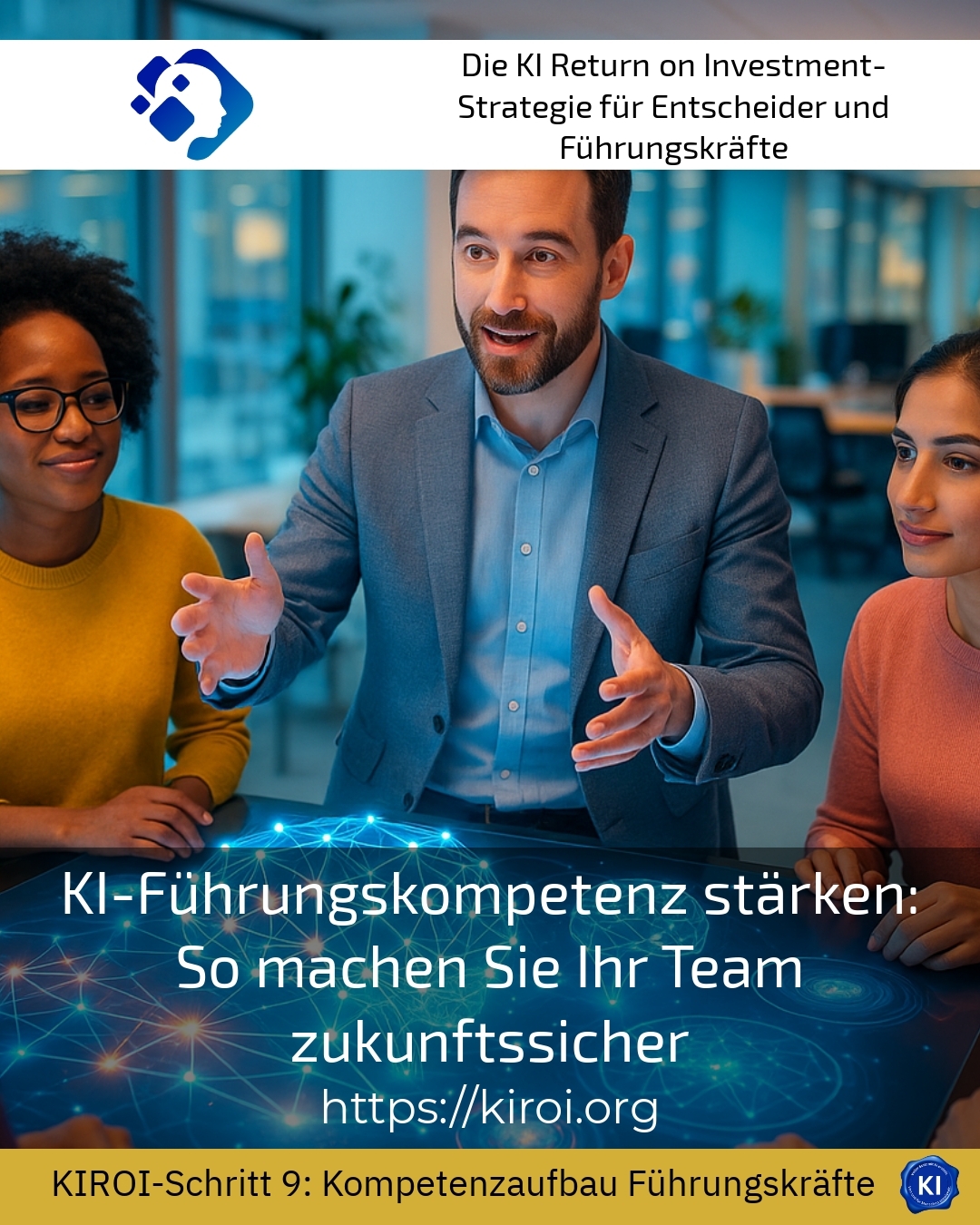
Will you still be relevant in five years if your team does not master the new digital tools? This question is currently troubling many leaders, and rightly so, because technological transformation is changing not only work processes, but also the way we lead, develop and support people. The ability to prepare teams for these changes is increasingly becoming the decisive success factor for modern organisations. Strengthening AI leadership competence means much more than imparting technical understanding. Rather, it is about establishing a culture of continuous learning that empowers employees to view change as an opportunity and actively help shape it.
Recognising and accepting the new reality
The working world is currently undergoing a fundamental transformation that affects almost every professional field and has profound impacts on leadership roles. Many leaders report uncertainty in dealing with automated systems. They are asking themselves which tasks should still be carried out by humans. At the same time, they feel the pressure to prepare their team for changes. This situation requires a new understanding of leadership that reconciles technological developments with human needs.
Studies show that companies with digitally competent leadership teams frequently achieve better results [1]. The reasons for this are obvious. Such teams can adopt and implement innovations more quickly. They also create an environment in which experimentation is welcome. Employees are thus encouraged to try out new tools. The fear of mistakes gives way to a constructive culture of learning.
A manufacturing company was faced with the challenge of modernising its quality control. The employees were unsettled. Would machines take over their work? The management team realised that technical training alone would not be enough. Comprehensive support for the transformation process was needed. The managers were trained themselves first in order to then act as multipliers.
Best practice with a AIROI customer
A medium-sized logistics company with over three hundred employees realised that digital transformation cannot succeed through technology alone. The management team decided to undergo comprehensive support through transruptions coaching in order to systematically prepare their leaders for their new roles. As part of the AIROI master plan, the individual strengths and areas for development of each leader were initially analysed. The coaches worked closely with the management team to create tailor-made development paths. The integration of practical exercises, where leaders worked through concrete situations from their everyday work, was particularly important. After six months, the participants reported significantly more confidence in dealing with new systems. Staff turnover in the company decreased because employees felt better supported. The leaders had learned to communicate changes not as a threat, but as a task to be shaped. This change in perspective had a positive effect on the entire corporate culture.
Strengthening AI leadership skills through targeted development programmes
The development of future-proof leaders requires a holistic approach that goes far beyond traditional management training. Today, leaders must understand how automated decision-making systems work. They should be able to assess where human judgment remains irreplaceable. And they need tools to navigate their teams through phases of uncertainty. These competencies can be built systematically.
For example, a retail company integrated analytics tools into its purchasing process. The managers had to learn how to deal with forecasts and recommendations. Some trusted the systems blindly, while others ignored them completely. Only through targeted training did they develop a balanced judgement. They understood when they should follow the recommendations and when they should not.
In a healthcare provider, on the other hand, it was about the introduction of staff shift planning systems. The team leaders initially felt disempowered because a system was now making decisions that they had previously made themselves. Through mentoring, they learned to see the system as support and to redefine their role. From then on, they concentrated more strongly on the individual development of their team members.
Similar patterns are also emerging in the financial sector. Advisors are increasingly using automated analysis tools for client portfolios. Executives had to learn to support their teams through this transition. It was about combining technical competence with emotional intelligence [2]. After all, clients still expect human contact persons for complex decisions.
The role of trust in the transformation process
Trust forms the foundation of any successful change, and this trust must be actively built and nurtured. Employees who trust their leaders often show a greater willingness to adopt new ways of working. They voice concerns openly and constructively. They contribute their own ideas. And they support colleagues who are still hesitant.
An engineering company experienced this vividly. Following the introduction of a predictive maintenance system, the technicians were initially sceptical. They felt their expertise was not being appreciated. The management responded by establishing regular discussion formats. In these, the technicians were able to contribute their experiences. As a result, the system was continuously improved.
At a media company, the editorial team was faced with the question of how automated content suggestions should be integrated. The journalists feared a standardisation of their work. The editor-in-chief addressed these concerns with transparency. They explained precisely how the system works. They emphasised that creative decisions would continue to lie with humans. This open communication created trust.
Future-proofing teams through continuous learning
The speed of technological change makes continuous learning an essential core competence for all team members. Leaders who want to strengthen AI leadership skills must create learning spaces and enable development. This means scheduling time for experiments. It also means appreciating mistakes as learning opportunities. And it requires the willingness to keep learning continuously oneself.
A retail company introduced so-called innovation hours. Every week, employees could use two hours to try out new tools. The managers participated themselves, thereby setting a good example. The threshold for experimentation dropped significantly. Employees developed their own suggestions for improvement for everyday work.
An internal learning community was formed within an insurance company. Employees who had familiarised themselves early on with new systems shared their knowledge with others. Managers actively supported these initiatives. They provided rooms and time. They publicly recognised the commitment. In this way, a positive learning culture emerged from the bottom up.
Best practice with a AIROI customer
An internationally active consultancy wanted to prepare its executives specifically for the integration of intelligent analytics systems. The challenge was to win over experienced partners, some of whom were sceptical, for new ways of working. The transruptions coaching addressed individual concerns and provided a safe space for open discussions. In individual sessions, the executives were able to express their worries without fear of losing face. The coaches provided impetus on how technological support could complement their own expertise. At the same time, best practices from other industries were presented in group workshops. The participants jointly developed strategies for their specific challenges. After completing the programme, they reported feeling more at ease when dealing with change. They had learned to lead their teams through uncertainty without having to have all the answers themselves. This new attitude had a positive impact on project work with clients.
Focusing on human strengths
The more routine tasks are automated, the more important genuinely human skills such as empathy, creativity and critical thinking become. Leaders should purposefully foster these strengths and put them at the heart of their talent development. That requires a rethink in many organisations. For traditionally, technical skills were often valued more highly than social competencies.
A pharmaceutical company realised that its sales representatives would need different qualities in the future. Automated systems can convey product information more efficiently. The added value of human consultants lies in relationship building [3]. The managers adapted their development programmes accordingly. They invested more heavily in communication training and coaching skills.
A similar development took place in a technology company. The development department increasingly used automated programming support. As a result, the focus of the work shifted. Creative problem-solving and collaboration became more important. The managers specifically promoted interdisciplinary projects. They created spaces for creative collaboration.
Ethical Responsibility as a Leadership Task
With the increasing integration of automated decision-making systems, the ethical responsibility of leaders is growing significantly. They must ensure that systems are used fairly and transparently. They must question which values are embedded in algorithms. And they must ensure that human control is maintained.
An employment agency faced precisely this challenge. Automated pre-selection of applications promised efficiency gains. However, there was a risk of unconscious discrimination. The executives opted for a hybrid approach. Every automated recommendation is reviewed by humans. Regular audits ensure fairness.
At an energy utility company, the focus was on automated customer interactions. The management defined clear boundaries. For sensitive concerns, customers are always connected to humans. Transparency regarding the use of automated systems is mandatory. These ethical guidelines were developed together with the team.
My AIROI Analysis
An examination of numerous transformation projects clearly shows that technological changes only succeed when the human dimension is consistently taken into account. Organisations that want to strengthen AI leadership skills should start with their managers, as they significantly shape the culture of change. The AIROI approach has proven to be a valuable guide because it systematically combines technological, organisational and human aspects.
Particularly important is the realisation that leadership in times of transformation is primarily about relationship-building. Employees need orientation and security. They need the feeling that their expertise is still valued. And they need leaders who are themselves willing to learn and to endure uncertainty. Transruption coaching can effectively support this development.
The examples from various industries illustrate that there is no one-size-fits-all solution. Every organisation must find its own way. But certain principles apply across the board. Transparent communication is indispensable. Learning spaces must be actively created. And ethical issues must not be ignored. Leaders who have internalised these principles can successfully navigate their teams through the transformation.
Finally, it must be emphasised that the development of leadership skills for the digital future represents an ongoing task. Technological change is not concluded with a single project. It requires continuous attention and a willingness to adapt. Organisations that invest in the development of their leaders today are thereby creating the foundation for long-term success.
Further links from the text above:
[1] McKinsey: Leadership in the Age of AI
[2] Harvard Business Review: AI and Machine Learning
[3] World Economic Forum: Future of Work
For more information and if you have any questions, please contact Contact us or read more blog posts on the topic Artificial intelligence here.







 Deutsch
 English (UK)