
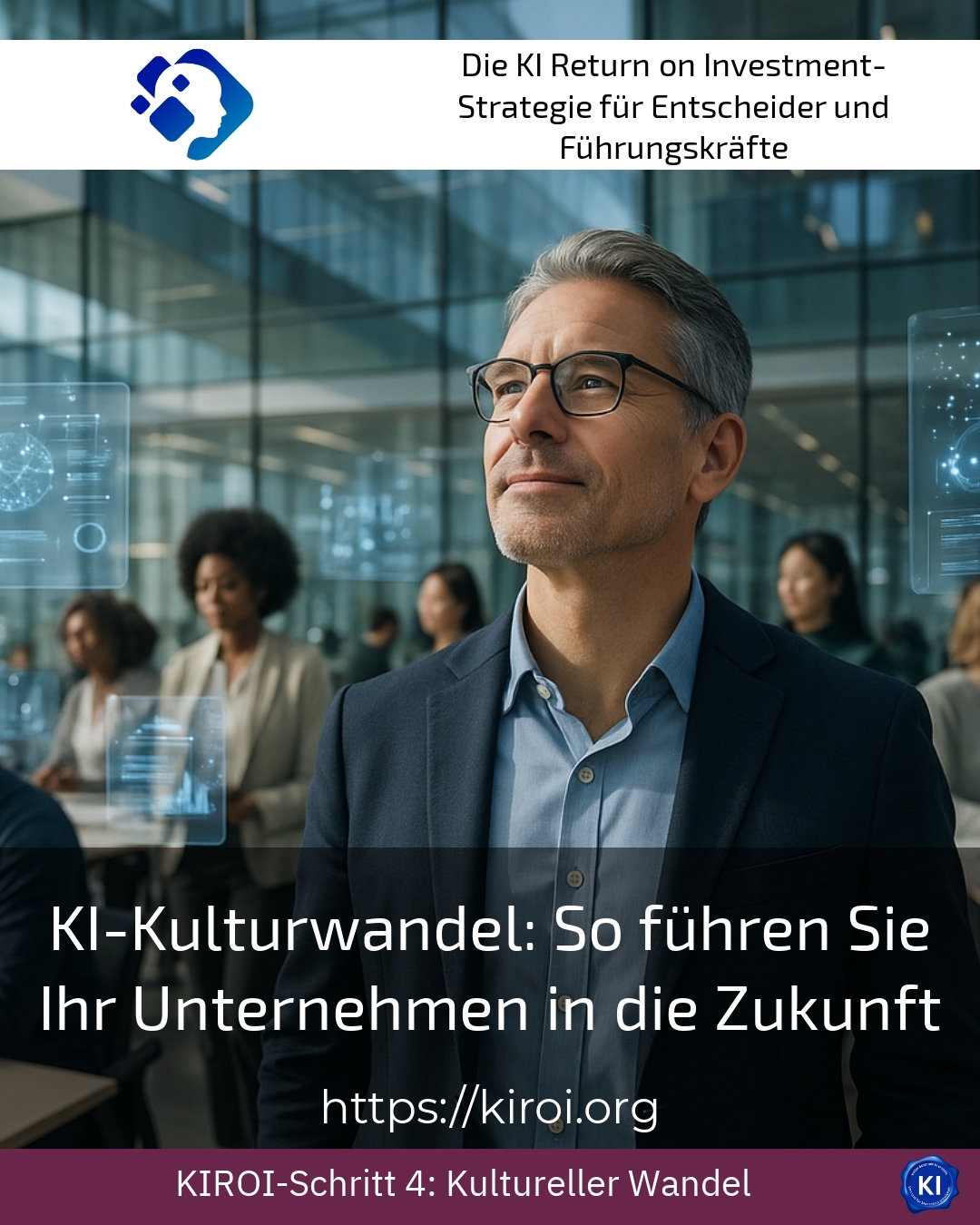
Imagine your company could establish a completely new way of working within just a few months, boosting productivity while simultaneously increasing employee satisfaction. The AI cultural change makes precisely that possible, but it requires far more than just technological investments. Many leaders underestimate how profound the changes must be for intelligent systems to unfold their full potential. In this article, you will learn which specific steps are necessary and how other companies have successfully mastered this transformation.
Why the AI culture shift requires more than just technology
The introduction of intelligent systems frequently does not fail because of the technology itself. It fails because of people, processes and ingrained mindsets. Many organisations invest significant sums in modern software. But they neglect cultural transformation. This leads to frustration at all levels. Employees feel overwhelmed or threatened. Managers do not see measurable results. Resistance arises in this way, blocking the entire change.
For example, a manufacturing company implemented an intelligent quality management system. The technology worked perfectly. Yet the employees scarcely used it, because no one had explained to them what personal benefit they would get from it. A logistics service provider introduced predictive analytics for route planning. However, the dispatchers systematically ignored the suggestions, trusting their experience more than the system. A retail company fully automated inventory planning, but the buyers constantly intervened manually because they did not understand the system's basis for decision-making.
These examples show a common pattern. Technological excellence alone is not enough. Success depends on how well people embrace and support change. That is why we speak of a comprehensive AI cultural change, which permeates all levels of the business.
Understanding the psychological dimension of change
Change creates uncertainty. That is a fundamental human reaction. When intelligent systems take over tasks, many employees feel their competence is threatened. They wonder whether their expertise is still needed. These fears are real and legitimate. Simply dismissing them would be a grave mistake. Instead, leaders must actively address these emotions.
In an insurance company, automated claims processing procedures caused massive uncertainty. The claims handlers feared becoming redundant. It was only when the management communicated transparently that the mood changed. They explained that employees would process more complex cases in future. In a bank, the introduction of a chatbot triggered similar reactions. The customer advisors saw their roles as being under threat. The management responded with training programmes. It demonstrated concretely how the job profile would evolve. A pharmaceutical company experienced resistance to automated documentation systems. The researchers perceived the requirements as a restriction on their creativity. Only intensive workshops were able to dispel these concerns.
Best practice with a AIROI customer
A medium-sized mechanical engineering company faced the challenge of introducing intelligent maintenance systems while simultaneously having to win over a sceptical workforce. The service technicians possessed decades of experience and viewed the new systems as an attack on their expertise. transruptions coaching accompanied the entire transformation process over several months, relying on a combination of one-on-one discussions with key individuals and team workshops for the entire service department. Together, we developed a communication strategy that emphasised the value of human experience while conveying the benefits of technological support. The technicians were involved in the implementation from the outset and were able to incorporate their practical experience into the system, making them feel like valuable co-creators rather than passive recipients. After six months, over eighty percent of employees reported a positive attitude towards the new tools, and the acceptance rate significantly exceeded all management expectations.
Leaders as drivers of AI cultural change
The attitude of the management team is a decisive factor in success or failure. If supervisors are sceptical themselves, this rubs off on their teams. Conversely, authentic enthusiasm is infectious. Leaders must therefore first reflect on their own mindset. They need to understand the opportunities that the transformation offers. Only then can they convince others.
A retail group initially trained all department heads intensively. They learned the basics of smart systems. They tried out applications themselves. This enabled them to speak credibly with their employees later. An energy supplier established a mentoring programme for managers. Experienced managers accompanied their colleagues through the change. They shared best practices and helped with obstacles. A telecommunications company introduced monthly leadership dialogues. There, managers openly discussed their experiences. They learned from each other and developed joint approaches to solutions.
Practical steps for a sustainable transformation
Change doesn't happen overnight. It requires a structured approach with clear milestones. First, organisations must honestly assess their current position. What skills are present? What resistance exists? Where do the greatest opportunities lie? This analysis forms the foundation for all further steps.
An automotive supplier started with a comprehensive stocktaking. It surveyed employees at all levels about their expectations and fears. The results partly surprised management. They showed unexpected potential and hidden resistance. A media company carried out pilot projects in selected departments. These served as learning fields for the entire organisation. Successes and failures were shared transparently. A chemical group established a change team from various areas. These ambassadors carried the transformation into their respective departments. They collected feedback and reported back obstacles.
Communication as a key factor in the AI culture shift
Transparent communication forms the foundation of any successful change. Employees need to understand why the change is necessary. They must know what lies ahead. And they need to find out how they can personally benefit from it. Regular updates keep all participants informed. Different channels reach different target audiences.
A healthcare provider used internal podcasts for its transformation communication. Employees could listen to them flexibly while working. The response was exceptionally positive. A financial services provider set up a digital question platform. Employees could anonymously express concerns there. The answers were published visibly for everyone. An industrial company organised regular town hall meetings. The executive board reported personally on progress. It answered questions directly and authentically.
Best practice with a AIROI customer
An international logistics group approached us because the introduction of intelligent dispatch systems met with considerable resistance and the planned efficiency gains failed to materialise. The dispatchers, with their many years of experience, felt patronised and bypassed by the technology, which led to passive non-cooperation. As part of the transruption coaching, we first developed a deep understanding of the specific concerns of the various employee groups through structured interviews and moderated group discussions. Building on this, we designed a multi-stage participation format in which the dispatchers were able to actively contribute their expertise to system optimisation, thus transforming from passive users into active co-creators. The establishment of a feedback circle, in which system improvements based on practical experience were regularly discussed, proved particularly effective. The employees realised that their competence remained indispensable and that the system merely relieved them of routine tasks. Following the intervention, system usage increased by over sixty percent and employee satisfaction returned to its pre-introduction level.
Systematically design competence development
New technologies require new skills. Organisations must systematically upskill their staff. This applies to technical competencies as well as transferable skills. Critical thinking is becoming more important than ever. The ability to evaluate the results of intelligent systems is indispensable. Creativity and problem-solving skills are gaining in importance.
A consultancy developed a phased learning programme for all employees. The foundation level imparted basic knowledge for all. Specialisation courses deepened relevant topics. A technology corporation established a learning time quota for every employee. Ten percent of working time was reserved for further training. Managers were measured on whether their teams used this quota. A retail company cooperated with higher education institutions for tailored programmes. The courses combined academic depth with practical applicability. Participants worked on real company projects.
Adjust structures and processes
The AI cultural change also requires structural adjustments. Decision-making processes must be reviewed. Responsibilities may shift. Collaboration across departmental boundaries becomes more important. Hierarchical structures can become an obstacle. More agile working methods enable faster adjustments.
An insurance group reorganised its teams according to the squad model. Interdisciplinary groups worked on specific products. They were able to respond more quickly to changes. A manufacturing company introduced regular cross-functional meetings. Representatives from various departments discussed shared challenges. Silo mentality was thus gradually broken down. A service company established new roles for human-machine interaction. These specialists optimised collaboration between employees and systems. They identified potential for improvement and implemented it.
My AIROI Analysis
The AI cultural change represents one of the greatest challenges for businesses at the present time because it goes far beyond technological issues and touches upon the entire self-image of an organisation. My experience from numerous support projects shows that successful transformations always succeed when leaders place the human factor at the centre and view technological implementation as a secondary aspect of a profound cultural shift. The most common issues with which companies come to us in coaching concern resistance at middle management level, a lack of acceptance among long-standing employees, and a lack of clarity regarding the desired target culture.
Transruptions coaching can provide valuable impetus for such projects by addressing both the strategic level and the emotional dimensions of change [1]. Many clients report that it was only through external support that they were able to recognise blind spots and break out of entrenched patterns. The AIROI methodology helps organisations to develop a holistic approach that takes equal account of technology, people and processes [2]. The combination of strategic consultancy and individual leadership development has proved particularly effective. Change is most successful when it is understood as a learning journey, in which setbacks serve as opportunities for development and successes are celebrated together [3]. Companies that consistently follow this path not only lay the foundations for the successful use of technology, but also develop a sustainable organisational culture that will confidently master future changes.
Further links from the text above:
[1] Transruptions Coaching Methodology and Approaches
[2] AIROI Masterclass for Leaders
[3] AIROI blog featuring the latest posts on digital transformation
For more information and if you have any questions, please contact Contact us or read more blog posts on the topic Artificial intelligence here.










 Deutsch
  English (UK)