
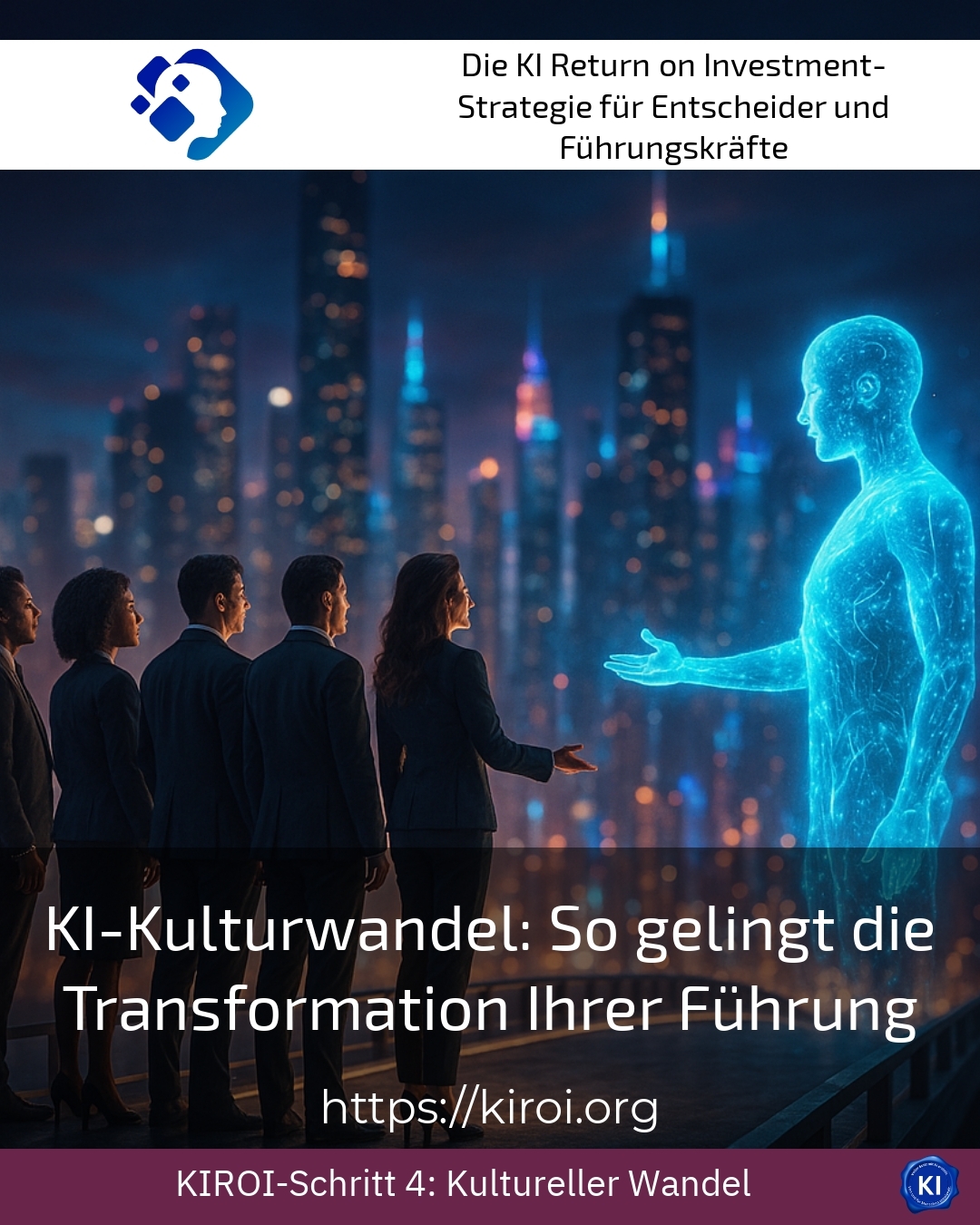
Have you ever wondered why some companies seemingly master digital transformation with ease, while others, despite enormous investments, fail and their executives increasingly seem overwhelmed? The answer lies not in the technology itself, but in the AI cultural change, which must permeate the entire organization. In a time when intelligent systems increasingly support decision-making processes, the ability to transform culture becomes the decisive competitive advantage. Many executives come to us with this very issue: they feel the pressure, need to realign their teams, and are looking for guidance. Traditional leadership models are reaching their limits. New competencies are needed. At the same time, employee expectations for modern work environments are growing. In this article, you will learn how to successfully navigate this fundamental change in your organization.
The fundamental realignment of leadership understanding in the cultural transformation of AI
The first and most important step is to fundamentally question one's own leadership understanding. Leaders in manufacturing companies experience this challenge particularly intensely. A production manager must understand today how predictive maintenance systems work. At the same time, he or she must motivate his or her employees to accept these systems. In the logistics industry, a similar picture emerges. Warehouse managers work with automated picking systems. They must accompany their teams in finding new roles. A similar transformation is taking place in the healthcare sector. Chief physicians are integrating diagnostic support systems into their work. Acceptance among nursing staff requires sensitive leadership.
The transformation begins with honest self-reflection by management. They must acknowledge their own fears and uncertainties. Only then can they move forward authentically. In the financial sector, management often reports feeling overwhelmed. Algorithm-based investment decisions are fundamentally changing their professional image. Insurance managers face similar challenges. Automated claims processing reduces traditional areas of responsibility. The manager becomes the designer of new processes. In retail, the store management is also undergoing dramatic changes. Personalizing customer interactions through intelligent systems requires new skills.
Best practice with a AIROI customer
A medium-sized engineering company with around 450 employees faced the challenge of fundamentally transforming its leadership culture. The management had realized that introducing intelligent production systems was doomed to fail without cultural change. As part of the transruptive coaching, we supported the company over a period of eighteen months. Initially, we conducted intensive one-on-one discussions with all the first- and second-level managers. It became apparent that many of them held significant reservations about the new technologies. These concerns were openly discussed and addressed. In joint workshops, the management developed a new understanding of their role. They learned to see themselves as facilitators and companions, rather than as all-knowing decision-makers. The results were impressive: The acceptance of the new systems among employees increased significantly, because the leaders themselves acted as authentic advocates while also allowing for critical questions. The company today reports a significantly improved innovation culture and increased employee satisfaction.
Communication as a key competence in the digital transformation
The way leaders communicate about change decisively determines its success. This is particularly evident in the automotive industry. Plant managers must explain to their teams why robots do not pose a threat. Instead, they emphasize the opportunities for more skilled jobs. In the banking sector, successful leaders communicate openly about changes. They do not hide that job profiles will change. At the same time, they offer perspectives for further development. In the pharmaceutical industry, leaders guide their research teams through similar transformations. Laboratory automation fundamentally changes daily work.
Transparency forms the foundation of any successful transformation. Leaders in the telecommunications industry practice this exemplarily. They also share unpleasant truths with their teams. Customer service managers openly explain how chatbots will handle simple requests. At the same time, they point out which more demanding tasks this will create. In the energy industry, leaders communicate in a similarly transparent manner. Smart grid technologies significantly change the work of grid technicians. Open communication about this creates trust. In the transportation sector, fleet managers face comparable challenges. Autonomous vehicles will transform the professional image of drivers.
The transformation of AI culture requires new forms of dialogue
Traditional communication structures are no longer sufficient. Executives in the media industry are experimenting with new formats. Editorial directors lead regular innovation dialogues with their teams. In the advertising industry, creative directors establish open discussion rounds. There, experiences with generative systems are exchanged. In the publishing industry, proofreaders organize collaborative consultation formats. Fears and hopes find equal space there. The tourism industry is also developing innovative communication approaches. Travel agency managers use peer-learning formats for the exchange of experiences.
Best practice with a AIROI customer
A large retail company with several hundred stores was looking for ways to empower its store managers for digital transformation. The headquarters had already made extensive investments in intelligent cash register systems and inventory management, but the acceptance on the ground remained far behind expectations. As part of the transruptive coaching, we developed together with the company a multi-stage communication strategy that we implemented over several months. First, we trained the regional managers in empathic change communication and taught them techniques for dealing constructively with resistance. Subsequently, we established regional exchange formats where store managers could share their experiences; both positive and negative aspects were discussed. The introduction of mentoring teams, in which technology-savvy branch managers accompanied and supported their more skeptical colleagues, proved particularly effective. The transformation went much more smoothly as a result than in comparison projects without this communicative support, and the company was actually able to realize the planned efficiency gains.
Promoting skills development and lifelong learning
Executives must become learners themselves. They cannot watch the transformation from the sidelines. In the chemical industry, production managers demonstrate exemplary behavior. They participate in the same training as their teams. This signals: Learning is not a weakness. In the food industry, quality managers adopt similar approaches. They learn together with laboratory technicians how to use new analysis systems. The construction industry is also developing innovative learning formats. Project managers train their teams together on digital planning tools.
Promoting a culture of learning requires structural changes. In the hotel industry, directors create space for experimentation. Employees are allowed to try new systems without fear of mistakes. In the restaurant industry, chefs establish similar learning spaces. Digital ordering systems are playfully explored. The textile industry is also investing in learning time. Purchasing managers enable their teams to understand trend forecasting systems. In the craft industry, master companies are investing in innovative training approaches. Young apprentices are teaching digital skills to experienced colleagues.
Error culture as the foundation of the AI culture transformation
A positive culture of error significantly supports transformation. In the aviation industry, this is considered a given. Pilots and engineers systematically learn from mistakes. This attitude must be transferred to other areas. In hospital management, similar approaches are established. Morbidity and mortality conferences serve organizational learning. The software industry practices a pronounced tolerance for error. Retrospective reviews after project phases are standard practice. In mechanical engineering, this culture develops more slowly. But increasingly, management recognizes its importance.
Best practice with a AIROI customer
A professional services firm approached us with a specific challenge: The firm’s partners wanted to introduce intelligent systems for standard tasks, but encountered significant resistance from experienced employees who saw their expertise threatened and feared the devaluation of their long-standing experience. As part of the transruptive coaching, we developed an approach that valued existing expertise while building new competencies, placing a special emphasis on the emotional dimension of change. We supported the leadership in establishing a learning culture where mistakes were viewed as valuable learning opportunities and not as signs of incompetence or a lack of adaptability. The experienced employees were positioned as experts for quality assurance and were given the important task of critically reviewing and refining the results of the automated systems. This approach led to a significantly higher acceptance of the new technologies and simultaneously enabled quality improvement, because the combination of machine efficiency and human expertise produced optimal results.
Ethical leadership in times of algorithmic decision-making
The ethical dimension of transformation deserves special attention. Executives bear responsibility for the impact of algorithmic systems. This is particularly evident in the human resources sector. Recruiters must ensure that selection systems do not discriminate. Bank managers face similar challenges. Credit decisions made by algorithms require human oversight. In the judiciary, executives are intensely discussing ethical boundaries. Risk assessments by systems must not violate fundamental rights.
The development of ethical guidelines becomes a leadership task. In the insurance industry, board members establish appropriate committees. They examine algorithmic decisions for fairness. In healthcare, ethics committees are emerging for digital issues. Hospital directors are actively addressing these issues. The advertising industry is also developing ethical standards. Creative directors are questioning the use of manipulative algorithms. In journalism, editors debate similar issues. Automated news production requires clear ethical boundaries.
My AIROI Analysis
After my intensive involvement in numerous transformation projects in a wide variety of industries, I come to a clear assessment: The success of AI cultural change It depends much more on leadership quality than on the technological maturity of the systems used. Leaders who are willing to fundamentally question their own role create the conditions for successful transformations. They understand that they do not have all the answers and show vulnerability. This authenticity creates trust among employees.
What particularly impressed me was the realization that technical excellence alone is not enough. Companies with the most modern systems regularly fail due to cultural resistance. At the same time, other organizations with more modest technical resources achieve an impressive transformation. The decisive difference lies in the quality of leadership and the way people are guided through the change [1].
Transruptions coaching provides valuable insights for leaders. It helps them navigate their teams through uncertain times. The support helps them identify blind spots and develop new options for action. Often, clients report that this external perspective has enabled crucial breakthroughs. The AI cultural change This is achieved not by top-down ordering, but by authentic leadership that involves people and takes fears seriously [2]. Those who consistently follow this path not only survive the transformation but emerge strengthened from it and unlock new opportunities for their company [3].
Further links from the text above:
[1] McKinsey: Culture – Why It Matters
[2] Harvard Business Review: Change Management
[3] World Economic Forum: Future of Work
For more information and if you have any questions, please contact Contact us or read more blog posts on the topic Artificial intelligence here.








 Deutsch
 English (UK)