
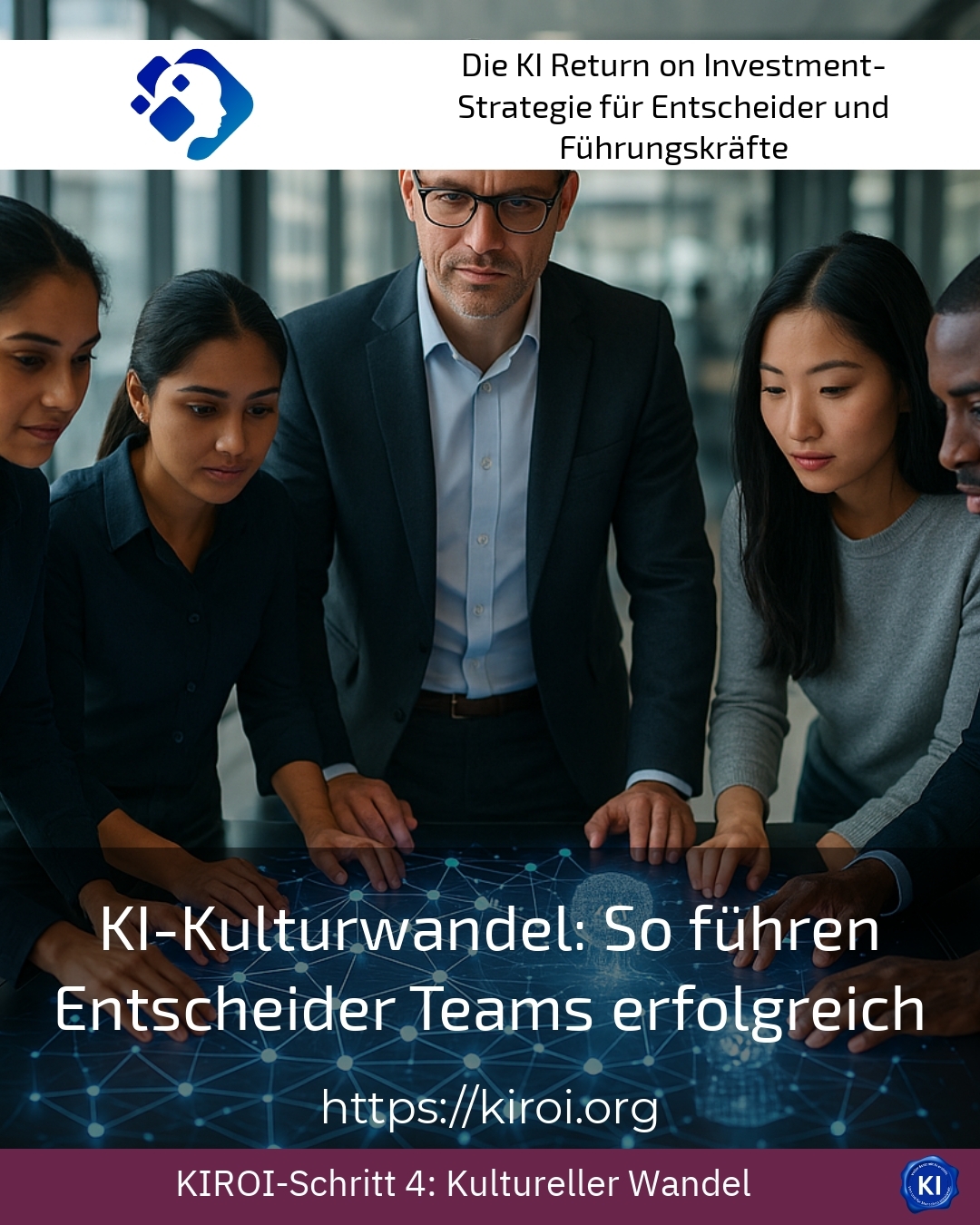
The workplace is facing a turning point that fundamentally challenges current leadership concepts, and many decision-makers are currently wondering how they can navigate their teams through this profound transformation without losing trust, motivation, and cohesion. AI cultural change It now covers all areas of the organization and demands completely new competencies from leaders that go far beyond technical understanding and reach deep into human psychology as well as the dynamics of group processes. While automated systems are taking on more and more tasks, there is simultaneously a tremendous need for empathetic, value-based leadership that gets people where they are and provides them with guidance in uncertain times.
Understand and actively shape the transformation
Executives must first understand that the current transformation is not a temporary phase. It marks a fundamental paradigm shift in the way work is organized and value is created. Companies that actively shape this change gain significant competitive advantages. Those that hesitate or wait risk losing their edge.
For example, a medium-sized machine engineering company had to restructure its entire quality control system because intelligent systems were able to detect errors more quickly and reliably than the previous manual inspection procedures. The management level faced the challenge of showing long-standing employees new perspectives without devaluing their expertise. In the logistics industry, executives often report similar situations when route optimization and warehouse management are increasingly automated. This pattern is also evident in the financial sector as algorithms take on complex analyses that were previously performed by experienced specialists.
The AI cultural change Therefore, they demand a high level of communicative competence and emotional intelligence from decision-makers. They must take fears seriously without amplifying them. At the same time, they should present realistic perspectives that motivate and create confidence.
Best practice with a AIROI customer
An international automotive supplier turned to transruptive coaching because the introduction of intelligent manufacturing systems caused massive resistance within the workforce. Plant management reported a decline in motivation and an increase in sick leave, while at the same time the pressure from corporate management grew to accelerate the transformation. As part of the coaching, the leadership developed a multi-stage communication plan that initially focused on intensive listening and genuine understanding of the employees’ concerns. Dialog formats were established in which production workers could express their concerns without evaluation. In parallel, the teams jointly identified areas where human expertise remained indispensable and even enhanced. After six months, a significantly improved acceptance of the new technologies was evident. The sick leave rates fell back to the previous level, and first employees voluntarily signed up for further training opportunities. The executives gained valuable insights from this experience, which they were able to successfully apply in other change projects.
Understanding AI cultural change as a leadership task
Many decision-makers initially underestimate the cultural aspect of technological changes. They focus on implementation plans, budgets, and technical specifications. The human dimension often remains sidelined. Yet it is precisely they who ultimately determine the success or failure of any transformation project.
This is particularly evident in healthcare when caregivers fear being monitored through documentation systems. Retail companies experience similar dynamics once personnel planning algorithms are introduced. And in consulting firms tensions arise when analytical tools take on tasks that previously served as learning fields for junior consultants.
In this context, leaders often report feeling overwhelmed. On the one hand, they are supposed to drive the transformation, and on the other hand, they are supposed to keep their team together. This tension cannot be resolved; it must be managed productively. Transruptions coaching supports decision-makers in finding this balance and staying authentic.
Trust as the foundation of successful transformation
Without trust, any change initiative fails. This insight is not new, but in the current context it gains new relevance. Employees must be able to trust that their leaders also have their interests in mind. They need the certainty that transparency and honesty are not empty promises.
For example, an energy provider openly communicated that certain activities would be phased out in the medium term, but at the same time offered concrete development paths for all those affected. An insurance company established an internal job board that gave employees from areas threatened by automation preferential access to new positions. And a technology company established a mentoring program in which experienced professionals shared their knowledge with younger colleagues, thus gaining new appreciation.
Accompanying AI cultural change in practice
Concrete implementation requires a systematic approach and at the same time high flexibility. Leaders must be able to adapt their strategy as the framework changes. They need a sensitive sense of the moods in their teams and the courage to address even uncomfortable topics.
In the pharmaceutical industry [1], this challenge is evident in the introduction of automated research processes. Scientists sometimes feel constrained in their creativity when algorithms suggest experiments. In the construction industry, resistance arises as digital planning tools seem to challenge the traditional expertise of construction managers. And in media companies, journalists struggle with the question of how much automated text production threatens their professional identity.
Best practice with a AIROI customer
A large audit firm sought support in integrating intelligent audit software into its established work processes. The partners feared that the implementation would fundamentally change the business model and could endanger long-standing customer relationships. At the same time, they recognized the need to remain competitive and work more efficiently. Within the framework of transruptive coaching, the executives developed a narrative that positioned the new tools as an extension rather than a substitute for human expertise. They trained their teams not only technically but also in communicating with clients to convincingly convey the changed services. A crucial success factor was the early involvement of skeptical opinion leaders who, after initial reluctance, became important ambassadors for change. The company was able to not only maintain but also expand its market position because it used the transformation as an opportunity to differentiate itself. Employee satisfaction stabilized, and turnover even fell below the level before the start of the project.
Developing competencies for the new leadership reality
The requirements for leaders are changing fundamentally, and this requires continuous personal development. Traditional management competencies do not completely lose their importance, but are complemented by new skills. Emotional intelligence, systemic thinking, and the ability to handle ambiguity constructively are gaining great importance.
Executives in the chemical industry, for example, report that they are increasingly in demand as coaches and moderators. In commercial enterprises, there is a need to bring together different generations with very different technical affinities. And in the tourism industry, leaders must help their teams understand and defend the value of personal customer relationships in an increasingly digitized world.
The AI cultural change This therefore also places the leaders themselves in the position of needing to develop further and let go of old certainties. Many decision-makers turn to transruptive coaching because they feel that their previous success formulas are no longer sufficient.
Using resistance as a resource
Resistance to change is natural and contains valuable information. Wise leaders do not suppress it; they use it as a diagnostic tool. They ask about the causes and take concerns seriously without losing their direction in the process.
A telecommunications company discovered vulnerabilities in its implementation strategy through systematic resistance analysis [2]. A food manufacturer recognized that the resistance of its production workers contained legitimate safety concerns. And a software company discovered that the skepticism of its developers was due to a lack of quality in the tools to be implemented.
My AIROI Analysis
Accompanying numerous organizations through profound transformation processes has revealed key success factors that are valid across industries and can serve as guidance for leaders. Cultural change in the context of intelligent technologies is then successful when decision-makers consistently place the human dimension at the center of their strategy and understand technical aspects as serving elements.
Successful leaders are characterized by their ability to convey confidence without offering unrealistic guarantees. They communicate honestly about challenges and risks. At the same time, they offer concrete ways for employees to take advantage of the transformation. This balance requires high communicative competence and an authentic interest in the well-being of people.
The AIROI-methodology provides a structured framework for this process, which however must always be adapted to the specific circumstances of the respective organization. There are no universal solutions. However, there are proven principles and practices that often lead to good results. The most important insight from numerous projects is that cultural change takes time and cannot be forced, but can be significantly accelerated and steered in productive directions through smart leadership.
Further links from the text above:
[2] Bitkom – Digital Transformation in German Companies
For more information and if you have any questions, please contact Contact us or read more blog posts on the topic Artificial intelligence here.










 Deutsch
  English (UK)