
Why do so many companies fail at introducing intelligent technologies, even though they are actually doing everything right?
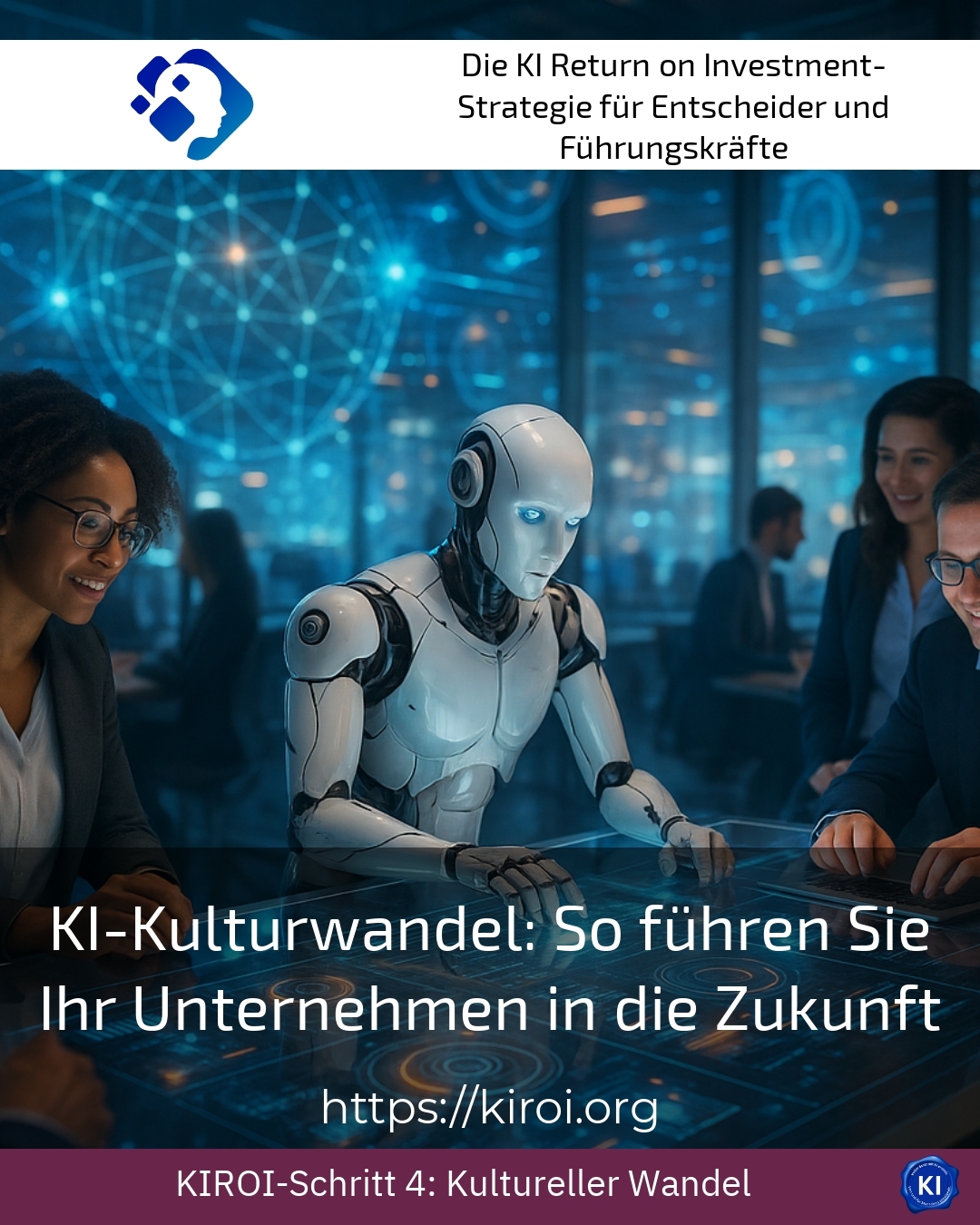
The answer rarely lies in the technology itself. The AI cultural change does not begin in the data centre, but in the minds of the people who make decisions and shape processes every day. Many organisations invest significant sums in state-of-the-art systems and then wonder why the hoped-for results fail to materialise. The problem is almost always the same: the technical infrastructure has been updated, but the corporate culture has remained unchanged. This is precisely where sustainable transformation comes in, because it places people at the centre and views technology as a tool that only unfolds its true value through competent application.
The invisible barrier: why technology alone isn't enough
Imagine a medium-sized company that has modernised its accounting. The new software can automatically capture and categorise invoices. Nevertheless, employees continue to print out every receipt and file it in lever-arch folders. This behaviour is not stubbornness. Rather, it shows that no one has explained why the old habits are no longer necessary. Similar patterns can be found everywhere: sales teams ignore recommendation systems and prefer to trust their gut instinct. Production managers overrule automated planning proposals on principle. HR professionals do not use intelligent pre-selection features because they do not trust them.
These examples clearly show that the AI cultural change is above all a question of mindset. People need an understanding of the new. They also require trust in the reliability of the systems. Above all, however, they must lose the fear of being replaced by machines. Transruption coaching accompanies companies precisely in this challenge. It provides impulses and creates spaces for open discussions.
Best practice with a AIROI customer
A long-established family-run business in the industrial manufacturing sector was facing a fundamental reorganisation of its business processes. The management had already invested in predictive maintenance systems designed to forecast machine breakdowns. However, the experienced technicians did not trust these forecasts at all and continued to carry out their routine inspections according to the old system. As part of the AIROI support programme, in-depth discussions were first held with all those involved. It emerged that the technicians were not fundamentally opposed to the new technology. However, they felt sidelined and insufficiently informed about how the system worked. The coaching team subsequently developed a training programme that combined technical knowledge with practical exercises. The technicians learnt how the algorithms arrived at their recommendations. At the same time, their decades of experience were documented and recognised as a valuable complement to the automated analyses. After six months, attitudes had changed fundamentally. The technicians frequently reported that they were now able to work more quickly and with greater precision. Unplanned downtime fell by more than forty per cent.
Leaders as pioneers of AI cultural change
Every transformation succeeds or fails based on the mindset of the management level. If superiors themselves appear sceptical towards new technologies, this scepticism is transferred to the entire workforce. Conversely, committed leaders can act as role models. Through their own behaviour, they demonstrate that change is possible and desirable.
A logistics company introduced intelligent route planning. The managing director demonstratively used the system for his own business trips. He spoke openly about initial errors and how the system learned. This transparency created trust. A similar thing happened at a retail company that implemented automated inventory forecasting. The purchasing management involved employees in decision-making processes. They explained when they followed the recommendations and when they deviated from them. This is the only way true acceptance is created in organisations.
A third example shows the importance of patience: An insurance company automated its claims processing. The responsible claims handlers initially feared for their jobs. The company management took time for individual discussions. They explained that routine tasks would decrease. At the same time, however, new tasks would arise in quality assurance. This open communication significantly eased the concerns.
Communication as the key to transformation
The AI cultural change requires a completely new approach to internal communication. Traditional circulars and presentations are not enough. Instead, what is needed is continuous dialogue at all levels. Employees must have the opportunity to ask questions and voice concerns. This is the only way resistance can be identified and addressed early on.
An engineering company set up regular discussion sessions where employees could anonymously ask questions to the project management. The answers were documented and made accessible to everyone. An energy supplier went a step further. It appointed so-called technology ambassadors in every department. These individuals were not IT experts, but ordinary employees with a special interest in the subject matter. They acted as bridge-builders between the technical and the human side. A financial services provider, in turn, relied on storytelling. Success stories from various departments were shared in monthly newsletters. These authentic reports proved more convincing than any management presentation.
Capacity building: More than just technical knowledge
The introduction of intelligent systems requires new skills. However, this is not just about programming knowledge or data analysis. Critical thinking and the ability to collaborate between human and machine are at least as important. Employees must learn when they can trust automated recommendations. They also need to recognise when human judgement is required.
A pharmaceutical company developed a multi-stage qualification programme. First, all employees completed a foundational course on how learning systems function. This was followed by department-specific specialisations. The research department learned how automated analyses could support their work. Sales received training on interpreting customer forecasts. A telecommunications provider relied on learning by doing. Employees were initially able to try out new systems in a safe environment. Mistakes had no consequences there, which gradually lowered psychological barriers.
Best practice with a AIROI customer
A medium-sized company in the food industry approached the transruptions coaching team with a specific challenge. Quality assurance was to be supported by image recognition systems. However, the long-standing employees in this area felt threatened by the technology. They had developed decades of experience in the visual inspection of products. Now a machine was to take over this task. As part of the support process, the knowledge of the experienced inspectors was first systematically recorded and documented. This expertise flowed directly into the training of the automated system. Through this, the employees realised that their experience was not being replaced, but immortalised. At the same time, they were given new tasks in monitoring and further developing the system. They became guardians of the quality standards that they themselves had helped to develop. Their identification with the project increased enormously. After a year, those involved frequently reported increased job satisfaction. At the same time, the error rate in production fell to an all-time low. This example impressively demonstrates how cultural change involving AI can succeed when human expertise is valued and integrated.
The role of corporate culture in the AI cultural shift
Company culture does not arise through top-down decree. It grows organically from the daily interactions of everyone involved. That is why it is so important to consider cultural aspects from the very beginning. An organisation that punishes mistakes will never develop a willingness to experiment. Yet precisely this willingness to experiment is necessary to integrate new technologies successfully.
An automotive supplier introduced so-called learning weeks. During this time, teams were allowed to experiment with new tools. The results were not evaluated. Instead, insights were gathered and shared. A media company established an innovation prize. Recognition was given not only to successful projects. Clever failures also received acknowledgment if valuable lessons were learned from them. A construction company created interdisciplinary working groups. There, employees from different generations and departments came together. The exchange of knowledge between digitally savvy younger staff and experienced older staff enriched both sides.
Understanding and constructively using resistance
Resistance to change is normal and, in a way, even healthy. It shows that people are thinking things through and take their work seriously. The art lies in not breaking this resistance, but in understanding and redirecting it. Behind rejection, there are often legitimate concerns that want to be heard.
A retail company wanted to introduce automated price adjustments. The store managers resisted fiercely. They feared the loss of their decision-making authority. Dialogue revealed that above all, they wanted local particularities to be taken into account. The system was adapted accordingly. It now provided suggestions, but the final decision remained with the human. A healthcare provider encountered resistance when introducing diagnostic aids [1]. The doctors saw their professional authority being called into question. The company reacted wisely. It expressly positioned the systems as a second opinion. The doctors kept the final say.
My AIROI Analysis
Accompanying numerous transformation projects has shown me that success always depends on the same factors. Firstly, you need a genuine commitment from senior management. Secondly, employees must be involved from the very beginning. Thirdly, continuous communication is essential. The technical side is often the easier part in this process.
I regularly observe that companies underestimate the cultural dimension. They purchase high-performance systems and are then surprised when they fail to gain acceptance. This is precisely where the AIROI methodology comes in. It never views technology in isolation. Instead, people are at the heart of all considerations.
Clients particularly frequently report anxieties among their employees. These anxieties are understandable and must be taken seriously. However, through open discussions and transparent information, they can usually be dispelled. Transruptions coaching offers valuable support here. It creates safe spaces for dialogue.
My experience also shows that patience is crucial. Cultural changes take time. Anyone who expects too much too quickly will be disappointed. But those who have staying power will be rewarded with an organisation that is ready for the future. The AI cultural change it is not a sprint, but a marathon. And that is precisely why it is worth enlisting professional guidance to walk the path together with you.
Further links from the text above:
[1] German Medical Association: digitalisation in healthcare
For more information and if you have any questions, please contact Contact us or read more blog posts on the topic Artificial intelligence here.










 Deutsch
 English (UK)