
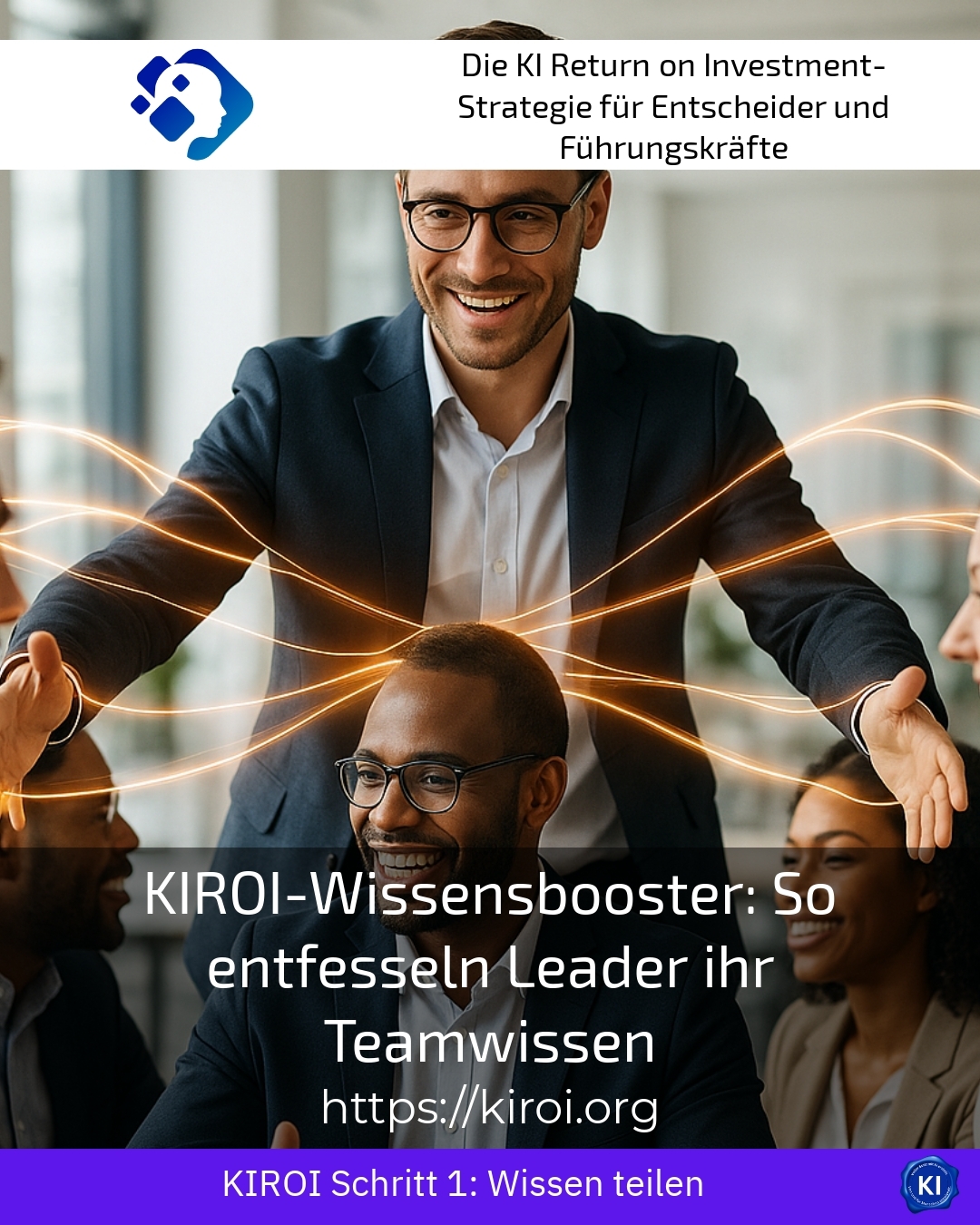
Imagine your team's collective knowledge lying fallow like an unused field, while you search for external solutions. This is precisely where the KIROI Knowledge Booster and enables leaders to gain systematic access to hidden competencies. Many leaders report that they fail daily with challenges, even though the answers already exist within their own company. The art lies in identifying and specifically releasing this potential. In the following sections, you will learn how modern leaders can activate their team knowledge and achieve sustainable success.
The hidden resource: Why team knowledge often remains untapped
Almost every company has enormous untapped potential for knowledge that is often overlooked. Employees possess years of experience and specific expertise. However, this know-how often remains trapped in silos and never reaches the relevant decision-makers. A medium-sized manufacturing company, for example, realised that machine operators had long been aware of optimisation potential. However, no one had systematically asked them about it or documented their observations.
The causes of dormant team knowledge are diverse and range from hierarchical structures to a lack of communication culture. In a financial services company, it was found that customer advisors possessed valuable market information. However, these insights never reached the strategy department because formal communication channels were lacking. Another example can be seen in healthcare, where nursing staff identify opportunities for improvement on a daily basis. Without structured feedback systems, however, these impulses regularly get lost in the daily grind.
The KIROI Knowledge Booster addresses this challenge precisely and offers a methodological framework. It supports leaders in establishing systematic knowledge flows and unleashing creative potential. This is not about technical solutions alone, but about a fundamental change in leadership culture.
Best practice with a KIROI customer
An internationally operating logistics service provider faced the challenge of making its route planning more efficient, despite significant investments already having been made in external consulting. As part of a transruption coaching process, it became clear that the drivers themselves possessed extensive practical knowledge that had previously remained untapped. These long-serving employees knew route-specific details, seasonal traffic patterns, and customer-specific requirements from their daily work. Through the introduction of structured knowledge-sharing sessions, over two hundred concrete suggestions for improvement were gathered within a few months. The implementation of these ideas led to a noticeable reduction in driving times and a significant increase in customer satisfaction. Particularly noteworthy was the increased motivation of the workforce, because their expertise finally received appreciation. Management recognised that external knowledge is valuable, but internal know-how is often underestimated. This insight has since shaped the entire corporate culture and led to far-reaching changes in leadership practices.
The KIROI knowledge booster as a catalyst for leadership excellence
Modern leadership requires more than classic management skills and traditional hierarchy models. Leaders today must act as enablers and create the conditions for knowledge exchange. The KIROI Knowledge Booster offers a structured approach that is successfully used in various industries. In retail, leaders use this methodology to systematically capture sales experiences. This results in valuable insights into customer needs and market trends.
An essential element is the creation of psychological safety within the team. Employees will only willingly share their knowledge if they do not have to fear negative consequences. This is particularly evident in the automotive industry, where quality problems are often identified early by production employees. However, without an open culture of admitting mistakes, these observations remain unspoken and later lead to costly recalls. A technology company in the software sector implemented regular retrospectives to overcome such hurdles. Developers then began to proactively address weaknesses and develop solutions together.
The role of the leader is changing from an all-knowing decision-maker to a curious questioner. This requires humility and the willingness to admit one's own knowledge gaps. In the banking sector, leaders often report that this change in attitude initially seems challenging. However, the results are convincing because teams work more engaged and develop better solutions.
Practical Methods for Knowledge Activation with the KIROI Knowledge Booster
Implementation requires concrete tools and structured procedures for day-to-day management. A tried-and-tested method is so-called knowledge mapping, which visualises team competencies. In the pharmaceutical industry, research managers use this technique to make interdisciplinary expertise visible. This creates new opportunities for cooperation between departments that previously worked in isolation from each other. An energy supplier used this method to specifically pool technical expertise for the energy transition.
Another effective practice is structured knowledge dialogues that go beyond classic meetings. In the insurance sector, team leaders conduct regular case discussions where claims experiences are shared. These formats allow for an intensive exchange of experiences and promote joint learning. In the construction industry, project managers systematically organise lessons learned workshops after major construction projects. The insights gained are then incorporated into future projects, avoiding repeated mistakes.
Digital tools can further support and accelerate knowledge transfer. A mechanical engineering company implemented an internal knowledge base that is maintained by its employees. In the hospitality sector, hotel chains use digital platforms to share best practices between locations. It remains important that technology complements human interaction rather than replacing it.
Best practice with a KIROI customer
A medium-sized engineering firm in the renewable energy sector approached the transruptions coaching team with a specific concern. Management observed that similar problems regularly occurred during the commissioning of complex systems. Experienced service technicians resolved these difficulties routinely, while newer colleagues took significantly longer. During the coaching process, a systematic mentoring programme was developed that structured the transfer of expert knowledge. The experienced technicians documented typical error patterns and, together with junior staff, developed solutions. Additionally, short video tutorials were created for frequently occurring problems, which could be accessed on mobile devices. As a result, the onboarding time for new employees was reduced by almost forty percent. At the same time, experienced technicians felt valued because their expertise was actively sought after. Since then, the company has reported improved employee retention and strengthened team cohesion. This development shows how knowledge transfer can bring both operational and cultural benefits.
Cultural Transformation: From Knowledge Protection to Knowledge Sharing
Many organisations struggle with a culture where knowledge is seen as a power factor. Employees withhold information because they wish to strengthen their position by doing so. KIROI Knowledge Booster addresses this dynamic and incentivises active sharing. In the media industry, one publisher introduced new evaluation criteria that reward knowledge sharing. Editors have since received recognition for supporting colleagues, not just for their own publications.
Change always begins with the leaders themselves and their role model function. In the telecommunications sector, a department head started by openly discussing their own mistakes. This transparency encouraged other team members to also report on failures. A chemical company established regular "fuck-up" sessions where failed experiments are discussed. This resulted in a learning culture that encourages innovation and reduces the fear of making mistakes.
The value of an open culture is particularly evident in knowledge-intensive industries. Management consultancies rely on the wealth of experience and continuous exchange of their consultants. An auditing firm implemented industry-specific competency groups that regularly exchange ideas. Similar formats are emerging in the legal sector, where lawyers discuss case studies anonymously.
Overcoming obstacles and establishing sustainable structures
The implementation of systematic knowledge management regularly encounters resistance of various kinds. A lack of time is often cited as an argument against additional exchange formats. In the healthcare sector, clinic management therefore developed short, focused handover rituals. These only last a few minutes, but reliably secure critical information. A logistics company integrated knowledge exchange directly into existing shift handovers.
Technical hurdles can also hinder the flow of knowledge and require pragmatic solutions. In the manufacturing industry, suitable documentation methods for process knowledge were often lacking. Consequently, an automotive supplier introduced simple checklists that were attached directly to machines. In the trades, companies are increasingly using smartphone apps to document work steps. These low-threshold solutions enable knowledge capture without extensive training.
Long-term success requires the integration of knowledge management into existing processes. A real estate company linked knowledge sharing with regular employee reviews and goal agreements. In the food industry, insights from quality control are systematically incorporated into product development processes. This anchoring ensures sustainability and prevents initiatives from fizzling out.
My KIROI Analysis
The systematic activation of team knowledge is one of the underestimated leadership tasks of our time. Companies invest considerable sums in external knowledge, while internal expertise remains untapped. The KIROI Knowledge Booster provides a structured framework for specifically unlocking this potential. My experience from numerous support projects shows that success is crucially dependent on the attitude of management.
Leaders who develop genuine curiosity for their employees' knowledge achieve remarkable results. They create spaces for exchange and establish structures that reward knowledge sharing. At the same time, they must be patient, because cultural changes take time and cannot be forced. Technical implementation plays a supporting, but not dominant, role.
I find the impact particularly impressive in organisations that utilise transruption coaching as support. The external perspective helps to identify blind spots and break down ingrained patterns. The goal is not to provide ready-made solutions, but rather to empower individuals and teams to develop independently. Teams that have experienced how valuable their collective knowledge is rarely revert to old patterns.
The coming years will show which organisations consistently harness this potential. Those that invest in a culture of knowledge will achieve competitive advantages and be more attractive to talent. The methodological foundations are ready, and implementation lies with bold leaders.
Further links from the text above:
[1] Harvard Business Review – Leadership Insights
[2] McKinsey – People and Organisational Performance
[3] Gallup Workplace Insights
[4] MIT Sloan Management Review – Leadership
For more information and if you have any questions, please contact Contact us or read more blog posts on the topic Artificial intelligence here.











 Deutsch
  English (UK)