
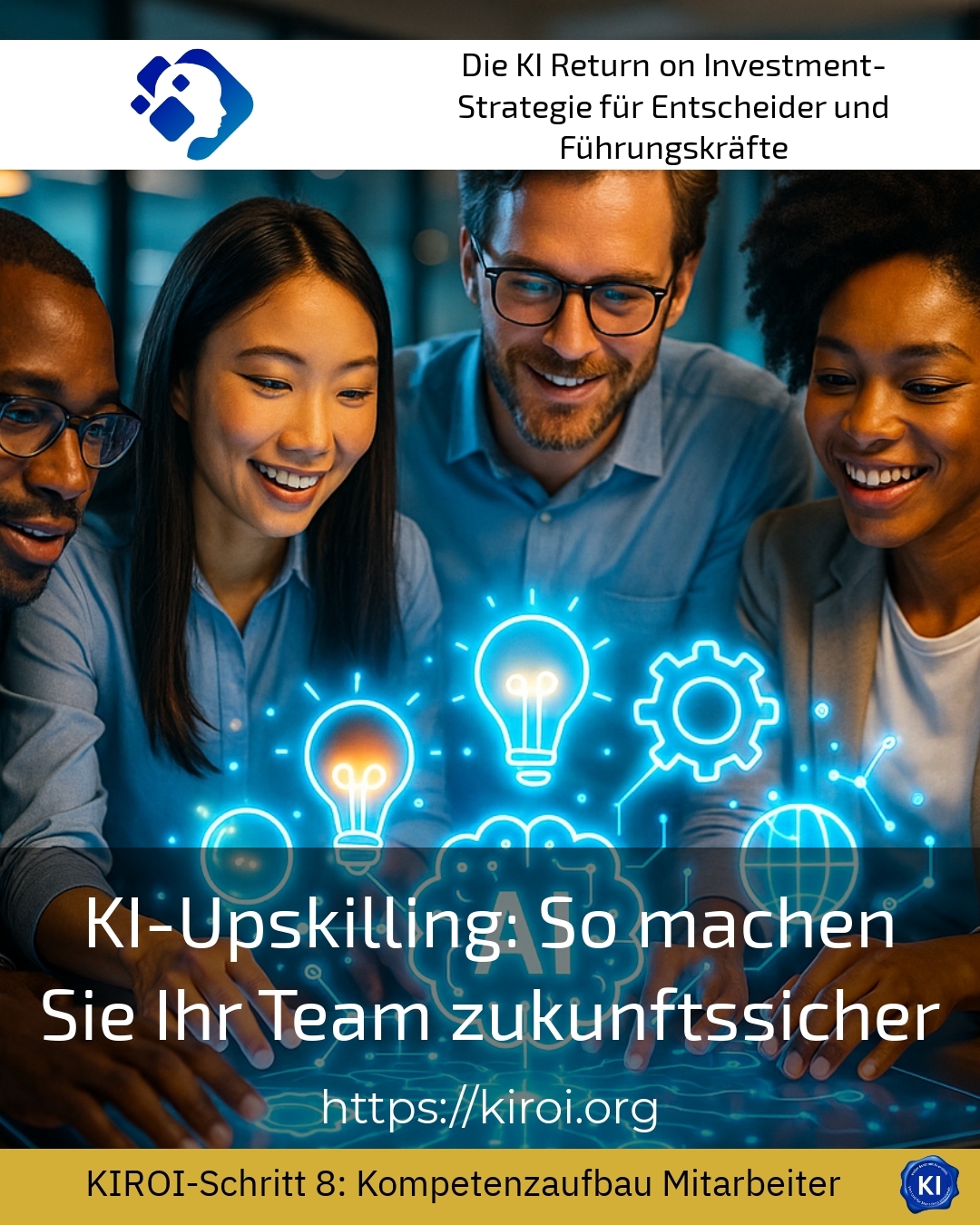
The world of work is changing at a pace that presents many companies with enormous challenges. Those who don't act today risk losing out tomorrow. AI Upskilling: How to Future-Proof Your Team – this question is currently occupying managers in almost all industries. But how can employees be prepared for the demands of digital transformation? How can companies ensure that their teams not only keep up, but actively shape it? In this article, you will learn which strategies have proven successful and how you can sustainably strengthen your workforce.
Why competence development has become indispensable today
The integration of intelligent systems into operational processes has long since begun. Routine tasks are being automated, and decision-making processes are supported by data-based analyses. At the same time, entirely new fields of activity are emerging. This development affects all economic sectors equally. Companies that invest in further training at an early stage gain a decisive competitive advantage. The question is no longer whether changes will come, but how quickly they will be implemented [1].
This dynamic is particularly evident in the financial sector. Banks use intelligent algorithms for credit checks. Insurance companies use automated claims processing. Financial advisors work with predictive analysis tools. Those who don't understand these tools quickly lose their bearings. Therefore, leading institutions are investing heavily in training programmes. New demands are also emerging in the healthcare sector. Radiologists work with imaging systems supported by machine learning. Nurses use digital documentation systems. Pharmacies rely on automated warehouse management.
The manufacturing industry is also undergoing a fundamental transformation. Production lines are increasingly controlled by interconnected systems. Quality control is carried out using automated image recognition. Maintenance intervals are optimised by predictive models. Skilled workers therefore require completely new competencies. They must understand how these systems work. Only in this way can they recognise and rectify errors.
Best practice with a KIROI customer
A medium-sized mechanical engineering company from Southern Germany faced the challenge of preparing its workforce for the introduction of intelligent production control. Management recognised early on that mere technical implementation would not be sufficient. Together with transruptions-coaching, a comprehensive support programme was developed that considered both technical and emotional aspects. In weekly workshops, employees first learned the basic principles. In parallel, one-on-one meetings were held to address individual concerns. The exchange between departments proved particularly valuable. Experienced colleagues supported younger team members. Conversely, digitally savvy junior staff brought fresh perspectives. After six months, participants reported significantly increased confidence in handling the new systems. The error rate in production dropped by considerable amounts. At the same time, collaboration between teams improved sustainably.
AI Upskilling as a Strategic Investment in Your Workforce
Successful further training programmes start with an honest assessment. What skills are already present? Where are there gaps? What skills will be needed in the future? These questions require careful analysis. Structured assessments and open discussions are equally helpful here [2]. Clients often report that they are unsure where to start. This is precisely where professional guidance comes in.
In retail, the requirements are particularly diverse. Sales assistants need to be able to handle intelligent checkout systems. Branch managers use data-based forecasts for staff planning. Buyers work with automated ordering systems. The challenge is to bring all employees along. No one must be left behind. That's why successful retail companies rely on tiered learning paths. Beginners receive basic training. Advanced learners deepen their knowledge in specialist courses.
The logistics industry offers further impressive examples. Warehouse workers cooperate with autonomous transport systems. Dispatchers optimise routes using intelligent algorithms. Customer service teams use automated request processing. Each of these tasks requires specific knowledge. At the same time, employees must understand how all systems work together. Only in this way can they independently solve problems.
Practical steps for successful AI upskilling in your business
The first step is to gain clarity on the objectives. What exactly needs to be achieved? Which processes will change? Which roles are particularly affected? These questions should be addressed together with those involved. Transparency builds trust and reduces anxiety. Many employees have concerns about change. These concerns must be taken seriously.
In the second step, suitable learning formats are selected. Not everyone learns in the same way. Some prefer in-person training with direct interaction. Others value the flexibility of online courses. Still others learn best through hands-on experience. A good mix of different formats has proven effective. The individual needs of the participants should be taken into account [3].
The tourism industry provides interesting insights into successful implementations. Hotels use intelligent booking systems with dynamic pricing. Tour operators rely on personalised recommendations. Airlines optimise their in-flight catering through demand forecasts. In all these areas, employees require new skills. Reservation agents must understand the logic behind pricing algorithms. Only then can they competently advise guests. Travel consultants learn to use recommendation systems effectively.
Best practice with a KIROI customer
An international hotel chain with locations in several European countries decided to undertake a comprehensive transformation process. The introduction of an intelligent revenue management system required fundamental changes to daily work. The reservations departments had to develop entirely new ways of working. transruptions-Coaching supported this process over several months. Initially, multipliers were trained at each hotel. These later took on the role of internal ambassadors. Difficulties could be identified early on in regular feedback sessions. The close integration of technical training and personal support was particularly helpful. Employees who were initially sceptical became increasingly interested. They realised that the new tools could make their work easier. At the end of the process, acceptance had significantly improved. Booking occupancy increased noticeably. At the same time, the teams reported less stress with pricing.
Overcoming obstacles and enabling sustainable change
Every transformation brings resistance. This is normal and even valuable. It shows where special attention is needed. Concerns often arise from a lack of information. Negative past experiences can also play a role. In other cases, there is simply a lack of time for further training. Successful companies take these objections seriously. They create space for open discussions.
The construction industry shows how different starting situations can be. Architects have been using computer-aided planning tools for a long time. For them, the integration of intelligent systems is often a natural next step. Tradespeople on the construction site face different challenges. They need to learn to work with digital measurement systems. Site managers use networked project management platforms. Each professional group therefore requires tailored solutions.
The energy sector is also undergoing fundamental changes. Grid operators manage complex systems with intelligent load balancing. Wind farm operators optimise their plants through predictive maintenance. Energy consultants use automated analysis tools for efficiency recommendations. New skill requirements are emerging in all these areas. Employees need support in adapting. Training alone is often not sufficient. Personal coaching can make the difference [4].
The role of leaders in the AI upskilling of teams
Leaders play a crucial role in change processes. They set priorities and provide direction. Their behaviour signals how important the topic is being taken. When superiors themselves learn, it also motivates team members. Conversely, a lack of commitment is demotivating. Therefore, successful programmes often begin at the leadership level.
This can be observed well in the media sector. Editorial managers need to understand how automated content creation works. Marketing managers rely on personalised advertising. Publishing managers use data-based decision-making tools for their portfolio. When these managers understand the technology, they can better support their teams. They can set realistic expectations. They can plan resources sensibly.
The pharmaceutical industry offers further insightful examples. Research leads work with intelligent systems for molecular analysis. Production managers control automated production lines. Sales managers use predictive models for their planning. In each of these areas, leaders must first learn themselves. Only then can they credibly support others. Clients often report that this is precisely the aspect that was underestimated.
Best practice with a KIROI customer
A publishing house with a long tradition faced the task of preparing its editorial teams for new ways of working. The introduction of automated research tools and intelligent text analysis required a fundamental rethink. Many experienced editors initially met the changes with scepticism. They feared that their journalistic expertise might be devalued. transruptions-Coaching was brought in to sensitively support this process. Fears could be openly expressed in confidential one-on-one discussions. Together, strategies were developed to understand the new tools as a supplement. The involvement of respected colleagues as advocates was particularly effective. These individuals demonstrated with concrete examples how technology can enrich journalistic work. Research became faster and more thorough. Fact-checking could be supported automatically. At the end of the process, attitudes within the editorial team had fundamentally changed. The quality of reporting noticeably improved.
Developing long-term perspectives for continuous learning
One-off training courses are no longer sufficient today. Development is progressing too quickly. What is learned today can already be obsolete tomorrow. Therefore, companies need structures for continuous learning. This requires a cultural change. Learning must be understood as an integral part of work [5].
The importance of this cultural shift is evident in the education sector. Teachers must become lifelong learners themselves. Only in this way can they prepare their pupils for a changing world. Universities are continuously revising their curricula. Further education providers are constantly developing new formats. Those who work in this environment experience change as the norm.
The legal sector is also adapting. Law firms are using intelligent systems for document analysis. Legal departments in companies are relying on automated contract review. Notaries are working with digital archiving solutions. For legal professionals, this means that technical understanding is becoming increasingly important. At the same time, human skills such as judgment and empathy remain indispensable. The challenge lies in combining both.
My KIROI Analysis
The transformation through intelligent technologies is not a temporary phenomenon, but a fundamental shift in the world of work. Companies that invest in the skills development of their workforce today will secure their competitiveness for decades to come. This is not just about technical knowledge, but also about the ability to constructively deal with change. AI Upskilling: How to Future-Proof Your Team requires a holistic approach that considers both professional and emotional aspects.
The numerous examples from various industries show that successful transformation always has a human dimension. Technology alone does not create progress. It is people who use and develop tools meaningfully. Therefore, the support of change processes deserves special attention. Transruptions coaching can provide valuable impetus here and support teams on their journey. The experiences of KIROI customers show that professional support can make the difference between superficial implementation and sustainable transformation. Companies that combine both dimensions will be the winners of the digital transformation. They manage to bring their employees along and open up new opportunities together.
Further links from the text above:
[1] McKinsey – Future of Work
[2] World Economic Forum – Future of Jobs Report
[3] LinkedIn Learning – Online courses for professional development
[4] Bitkom – Digital Transformation
[5] PwC Germany – Digital Transformation
For more information and if you have any questions, please contact Contact us or read more blog posts on the topic Artificial intelligence here.






 Deutsch
  English (UK)