
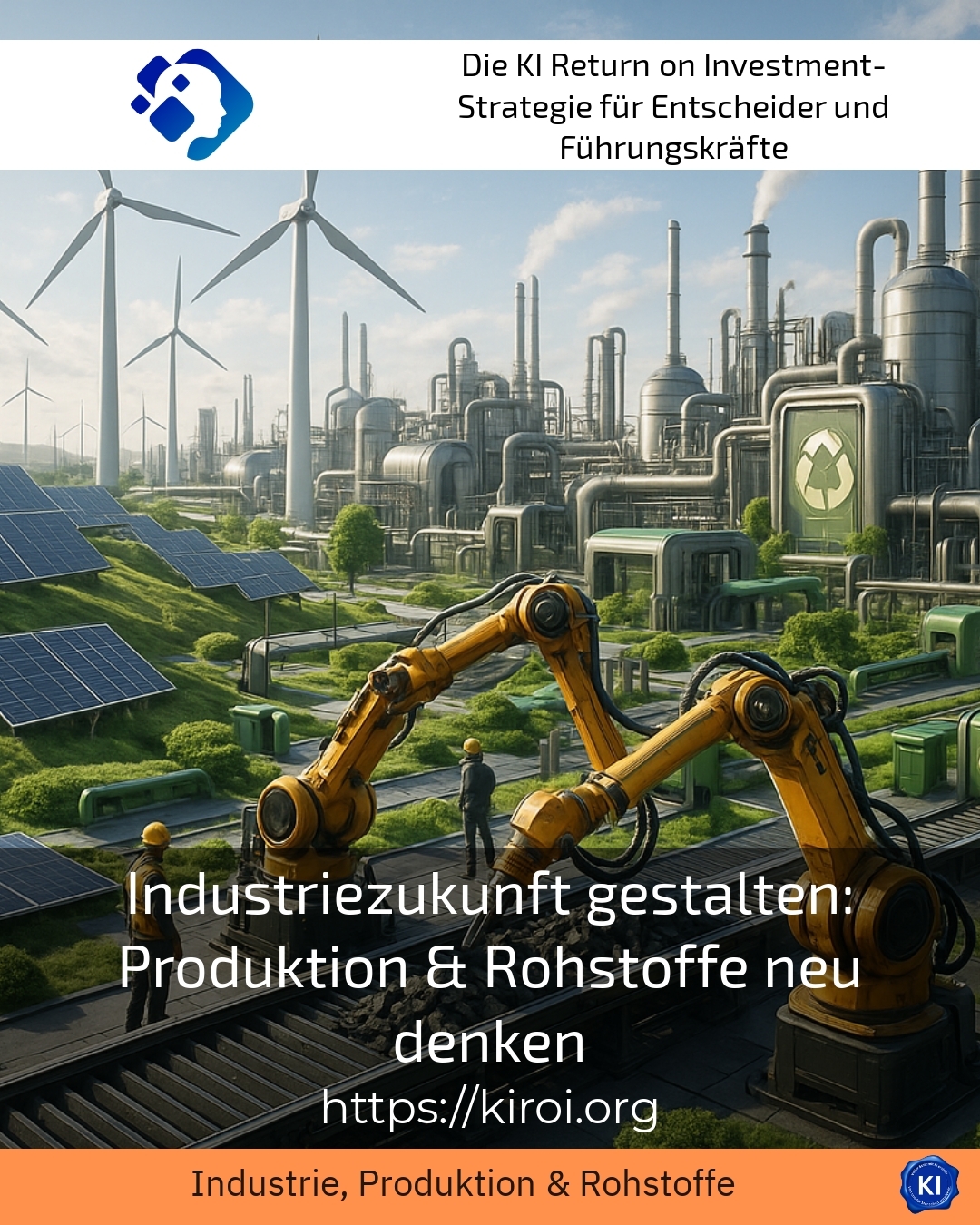
What if the factories of tomorrow were to operate completely differently from how we can imagine today, while simultaneously working in a more resource-efficient, effective and sustainable manner?
This question is currently occupying decision-makers in all sectors of the economy. The challenges of our time demand a radical rethinking. Rising raw material prices, disrupted supply chains and climate change are forcing companies to take action. The concept Shaping the future of industry: rethinking production and raw materials is becoming increasingly important in the process. Intelligent technologies are already fundamentally changing how materials are extracted, processed and used. Transruptions Coaching supports companies through this profound transformation and provides important impetus for change. Clients often report initial uncertainty, which turns into confidence through structured guidance.
The digital transformation in manufacturing
The merging of the physical and digital worlds is revolutionising established manufacturing processes. Sensors continuously capture data in real time. This information feeds into learning systems. Machines communicate autonomously with one another and optimise processes independently. An automotive supplier was able to reduce its scrap rate by thirty percent through networked production systems. The steel manufacturer has significantly reduced energy consumption through intelligent smelting furnace control. A chemical company uses algorithmic process optimisation for more precise formulations with lower material usage.
The challenges involved in implementing such systems are varied and complex. Employees require new skills and must actively help shape the change. Existing infrastructure often requires extensive modernisation. This is where transruptions coaching comes in, providing support with strategic planning. The guidance encompasses both the technological and the human aspects of the transformation.
Best practice with a AIROI customer
A mid-sized mechanical engineering company faced the challenge of modernising its traditional manufacturing processes without disrupting ongoing operations. Management recognised that isolated silo solutions were no longer up to date and that a holistic strategy was required. As part of the AIROI support, we first analysed all processes and identified optimisation potentials in the value chain. Together, we developed a phased plan that provided for the gradual integration of networked systems. Employees were involved from the very beginning and received needs-based training. Creating a culture of continuous improvement was particularly important. After eighteen months, the company had not only increased its productivity but also boosted employee satisfaction. Throughput times were reduced by a quarter. Material usage was optimised through more precise control. Today, the company is considered a pioneer in its industry and regularly receives requests for plant tours.
Shaping the circular economy as the key to the industrial future
The linear economic model is reaching its limits. The idea of extracting raw materials, manufacturing and disposing of them is no longer viable. Circular approaches offer a promising alternative. An electronics manufacturer has established a take-back system that recovers valuable metals. The fashion group recycles old garments into new fibres. A construction company uses demolition materials as aggregates for concrete.
The shift towards circular business models requires profound changes. Product design must take recyclability into account right from the start. Supply chains are becoming more complex, yet also more resilient. New partnerships are emerging between previously unconnected actors. During these transformation projects, transruptions-Coaching accompanies companies with proven methods and provides structured impetus.
material innovations and alternative materials
The search for sustainable materials is driving innovation. Bio-based plastics are increasingly replacing petroleum-based polymers. A packaging manufacturer is relying on algae as a raw material source. The furniture producer is successfully experimenting with fungal mycelium as a structural material. An automotive group is using natural fibres for interior trim, thereby significantly reducing vehicle weight.
High-performance ceramics and composite materials are opening up new application possibilities. These materials are lighter, more stable and more durable than conventional materials. The aircraft manufacturer saves fuel by using carbon fibre components. A medical technology company develops biocompatible implants from innovative alloys. The machine tool manufacturer significantly extends tool life through coated cutting tools.
Rethinking production & raw materials through intelligent networking
The horizontal and vertical integration of value chains creates new opportunities. Suppliers, manufacturers and customers share data in real time. Demand forecasts become more precise and inventory levels fall. A pharmaceutical group has drastically reduced bottlenecks through transparent supply chains. The food producer tracks raw materials seamlessly from the field to the supermarket shelf. An electronics manufacturer automatically coordinates its production planning with component suppliers.
Platform-based business models enable new forms of collaboration. Companies share production capacities and utilise resources more efficiently. The mechanical engineering company rents out instead of selling and takes on the maintenance. A chemical supplier no longer delivers products, but chemical services. The logistics group optimises transport through shared load spaces and reduces empty runs.
Best practice with a AIROI customer
A long-standing family-run metal processing business approached us with the desire to make its raw material procurement more resilient to crises. Dependency on individual suppliers and volatile markets had led to significant production disruptions in the past. The management team was concerned about the future viability of the business model. In the AIROI process, we jointly developed a multi-pillar diversified procurement strategy. We identified alternative sources of material and evaluated recycling options for production waste. At the same time, we implemented an early warning system for market changes. The company built strategic partnerships with secondary raw material traders and integrated them into planning. Training the purchasing department in new negotiation strategies proved particularly valuable. Upon completion of the project, the company had halved its dependency on critical suppliers. Material costs stabilised despite volatile global market prices. Executives report a heightened sense of security and greater entrepreneurial freedom of action.
Energy efficiency as a competitive advantage
Energy consumption significantly determines the cost situation of manufacturing companies. Intelligent energy management systems automatically identify potential savings. A glassworks uses waste heat from melting processes to generate electricity. The paper manufacturer has optimised its steam cycle, thereby reducing its fuel requirement. An aluminium smelter coordinates energy-intensive processes with periods of cheap electricity prices.
Decentralised energy generation is gaining in importance for manufacturing companies. Photovoltaic systems on factory roofs provide climate-friendly electricity. Wind turbines on company premises complement the supply. A chemical park operates its own combined heat and power plant with maximum efficiency. The automotive supplier stores excess energy in battery systems and uses it during peak loads.
Shaping human factors in the industrial future
Technology alone does not guarantee successful change. People must understand, accept and help shape changes. Managers bear the responsibility for a supportive corporate culture. A plant manufacturer has established innovation circles in which employees develop ideas for improvement. The consumer goods manufacturer promotes cross-functional project teams with a budget and freedom to make decisions. A pharmaceutical company rewards sustainable action through corresponding incentive systems.
Upskilling the workforce requires long-term investment and strategic planning. New skills in data analysis, process automation and sustainability management are needed. The machine tool manufacturer is cooperating with universities for practical further training. A chemical company has established its own academy for digital skills. The automotive supplier uses virtual learning environments for safe experimentation.
Topics that clients frequently come to us with include uncertainty about the right transformation path, resistance within the workforce, a lack of a clear vision for the future, and difficulties in prioritising investments. Transruption coaching supports all these challenges through structured methods and experienced guidance [1].
My AIROI Analysis
The transformation of industrial value creation is at a turning point. Companies that act now will secure crucial competitive advantages for the coming decades. The integration of intelligent systems, circular business models and sustainable materials is no longer optional, but essential for survival. Our experience from numerous AIROI projects shows that people must be at the centre. Technology is a tool, not an end in itself. Successful transformations are characterised by a clear vision, consistent implementation and continuous adaptation. Networking along the value chain creates resilience against external shocks. Material innovations reduce dependencies and open up new markets. Energy efficiency cuts costs and improves the climate footprint at the same time. Companies should not wait for the perfect solution, but start with initial steps [2]. Pilot projects enable rapid learning with manageable risk. Involving all stakeholders creates acceptance and mobilises valuable knowledge. Partnerships with research institutions, start-ups and other companies accelerate development. The AIROI methodology provides a proven framework for these complex change processes [3]. Decision-makers who set bold courses today are actively shaping the future of their industries.
Further links from the text above:
[1] Business Transruption Coaching
[2] Federal Ministry for Economic Affairs – Industry 4.0
[3] The AIROI Methodology at a Glance
For more information and if you have any questions, please contact Contact us or read more blog posts on the topic Artificial intelligence here.








 Deutsch
 English (UK)