
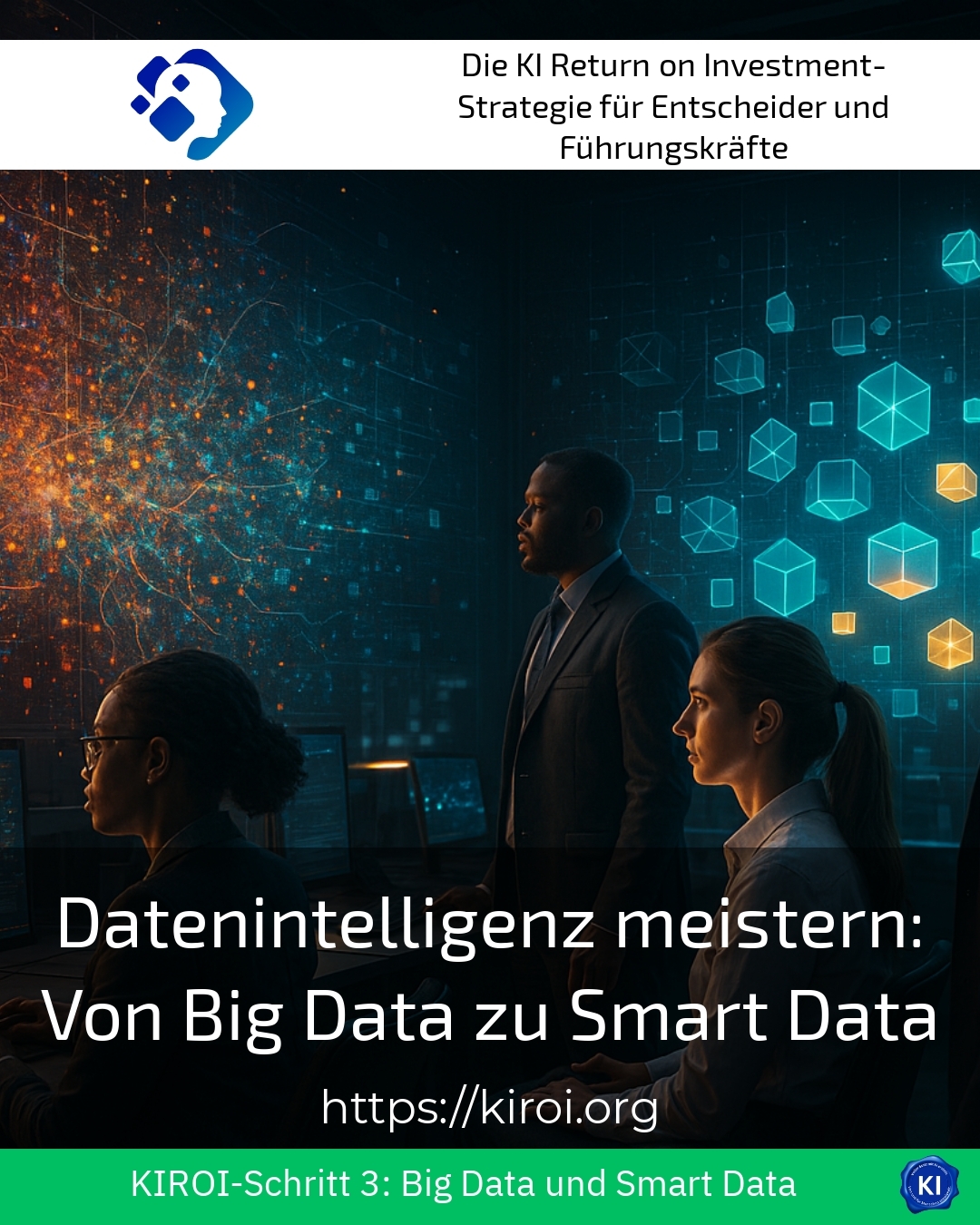
Imagine your company sitting on a mountain of information, yet no one knows how to truly unlock this treasure. This is precisely where the journey from Big Data to Smart Data begins, marking a crucial turning point for many organisations. While the sheer volume of collected data grows exponentially, the ability to extract meaningful insights from it often lags far behind expectations. The transformation into intelligent, actionable information requires not only technological expertise but, above all, a new mindset, which we will explore together today.
The fundamental shift in information processing
The challenge is no longer about collecting enough information. Rather, companies are struggling to filter out the relevant signals from the noise. In manufacturing plants, terabytes of sensor data are generated daily. Logistics companies track millions of movements in real time. Retail groups analyse the purchasing behaviour of countless customers. However, this flood of raw material remains worthless if it is not intelligently processed. The path from Big Data to Smart Data describes exactly this refinement from quantity to quality.
Many organisations invest significant sums in storage capacity and data capture systems. They frequently neglect the crucial question of usability. For example, a medium-sized mechanical engineering company collected production logs over many years. Only through targeted analysis were recurring error patterns identified. The resulting optimisations reduced downtime by considerable percentages. This example illustrates how dormant information assets can suddenly deliver business-critical insights.
From Big Data to Smart Data: The Quality Dimension
Intelligent data usage is fundamentally different from the mere accumulation of large volumes. It's about relevance, contextualisation and actionability. An energy supplier doesn't simply analyse consumption patterns. It combines these with weather forecasts, grid loads and price signals. It is this linking that enables precise predictions and optimised control. The quality of the insight, in turn, depends heavily on the connections that are made.
Companies often report initial feelings of being overwhelmed by the complexity. Transruption coaching can provide valuable impetus and create orientation in this regard. Support during such transformation projects helps to set clear priorities. This gradually builds the skills for independent further development. The journey becomes manageable because it is divided into comprehensible stages.
Best practice with a AIROI customer
An internationally operating automotive supplier faced the challenge of fundamentally modernising its quality assurance. The company possessed extensive historical test data from several production sites, but this was scattered across different formats and systems. As part of the AIROI support, the team first developed a unified data model. Subsequently, correlations between manufacturing parameters and scrap rates were systematically investigated. The findings led to surprising insights regarding optimal machine settings. Certain parameter combinations, previously considered equivalent, showed significant quality differences. The implementation of the optimised settings considerably reduced scrap. At the same time, production stability improved noticeably. During the support process, the project team learned to conduct further analyses independently. The established infrastructure now serves as the basis for continuous improvement processes. The sustainable knowledge building within the company was a key objective of the collaboration.
Strategic approaches to intelligent information utilisation
The transition to a data-driven organisation requires more than technological investment. Cultural changes play an equally significant role as the selection of appropriate tools. Employees must be empowered to make informed decisions. Leaders need new competencies in interpreting analytical results. The entire organisation undergoes a learning process that requires time and patience.
A pharmaceutical company reorganised its research department according to these principles. Instead of isolated analyses, networked knowledge platforms emerged. Scientists from various disciplines now systematically share their observations. Patterns that would have gone unnoticed individually become visible through this networking. The acceleration of development cycles is a direct consequence of this new way of working. Companies in the chemical and financial sectors report similar successes.
The path from Big Data to Smart Data in practice
Practical implementations typically begin with an inventory of existing information sources [1]. Many organisations underestimate the wealth that already exists. Sales systems, production facilities and customer service continuously generate valuable signals. Intelligently connecting these sources often creates more benefit than new data capture systems. The consolidation of existing assets therefore deserves the highest attention.
For example, a telecommunications provider linked network data with customer service enquiries. The correlation revealed precise connections between technical events and customer satisfaction. Proactive measures based on certain network patterns significantly reduced complaints. The return on investment from this initiative exceeded all expectations. The relatively low initial investment stood in impressive contrast to the benefits achieved.
Best practice with a AIROI customer
A long-established trading company was looking for ways to manage its goods flows more efficiently. While the existing systems provided extensive transaction data, they offered no actionable forecasts. As part of the transruption support, a pilot project was initially defined for a selected product category. The team combined historical sales data with external factors such as weather data and local events. The developed forecasting models achieved impressive hit rates in demand forecasting. Overstocking and stockouts were significantly reduced in the pilot stores. Employees gained confidence in the data-driven recommendations. Following the successful pilot phase, a gradual rollout to other product ranges was implemented. Internal analysis expertise grew continuously alongside the expansion of the system. Today, the company has a high-performing team that independently develops new application areas. The initial skepticism of some employees turned into genuine enthusiasm for the new possibilities.
Technological Enablers and Human Factors
Modern analytical tools and algorithms today enable insights that were unthinkable just a few years ago [2]. Machine learning automatically discovers patterns in complex contexts. Natural language processing opens up unstructured text holdings for systematic evaluations. Visualisation technologies make abstract correlations tangible for human decision-makers. These technological advances form the basis for the transformation.
Nevertheless, the human factor remains crucial for success. An insurance company implemented sophisticated fraud detection systems. The algorithms identified suspicious cases with impressive precision. However, only experienced claims handlers could distinguish genuine fraud cases from exceptional situations. The combination of machine pre-selection and human expertise proved to be optimal. Companies are having similar experiences in many fields of application.
A healthcare provider is using intelligent analytics for facility capacity planning. Historical utilisation patterns are combined with epidemiological data. The quality of predictions supports significantly improved resource allocation. Staff shortages and overcapacity occur less frequently than before. Both employee and patient satisfaction have measurably increased.
From Big Data to Smart Data: Governance and Ethics
With increasing use, the demands for responsible handling also grow [3]. Data protection regulations set clear limits for certain analysis projects. Ethical considerations are gaining importance in automated decision-making processes. Transparency and traceability are becoming important quality criteria. Companies must build and maintain trust with customers and employees.
A personnel service provider developed selection algorithms with strict consideration of fairness criteria. Regular checks for unintended biases became an integral part of the process. This diligence paid off through increased trust among all stakeholders. The balance between increased efficiency and ethical responsibility increasingly shapes the company culture. Customers and applicants explicitly appreciate this responsible approach.
My AIROI Analysis
The transformation of raw quantities of information into actionably relevant insights represents one of the most significant challenges of our time. Companies that successfully navigate this path gain sustainable competitive advantages. The technological prerequisites are largely in place and accessible today. The real hurdle lies in the organisational and cultural transformation.
My experience from numerous accompanying projects repeatedly shows certain success patterns. Organisations that begin with manageable pilot projects achieve better results than those with oversized large programmes. The iterative build-up of competencies and infrastructure allows for continuous learning. Errors in early phases remain manageable and provide valuable insights. The involvement of affected employees from the beginning significantly reduces resistance.
The journey from Big Data to Smart Data is not a one-off project, but an ongoing development. Markets, technologies, and customer expectations are continuously changing. Successful organisations establish capabilities for permanent adaptation. They create structures that encourage experimentation and learning from results. Support from experienced partners can significantly accelerate and secure this process. Transruption coaching helps to ask the right questions and develop sustainable solutions.
Further links from the text above:
[1] Gartner Insights on Data Analytics
[2] McKinsey QuantumBlack Insights
[3] Bitkom Area of Focus Data Protection and Security
For more information and if you have any questions, please contact Contact us or read more blog posts on the topic Artificial intelligence here.







 Deutsch
  English (UK)