
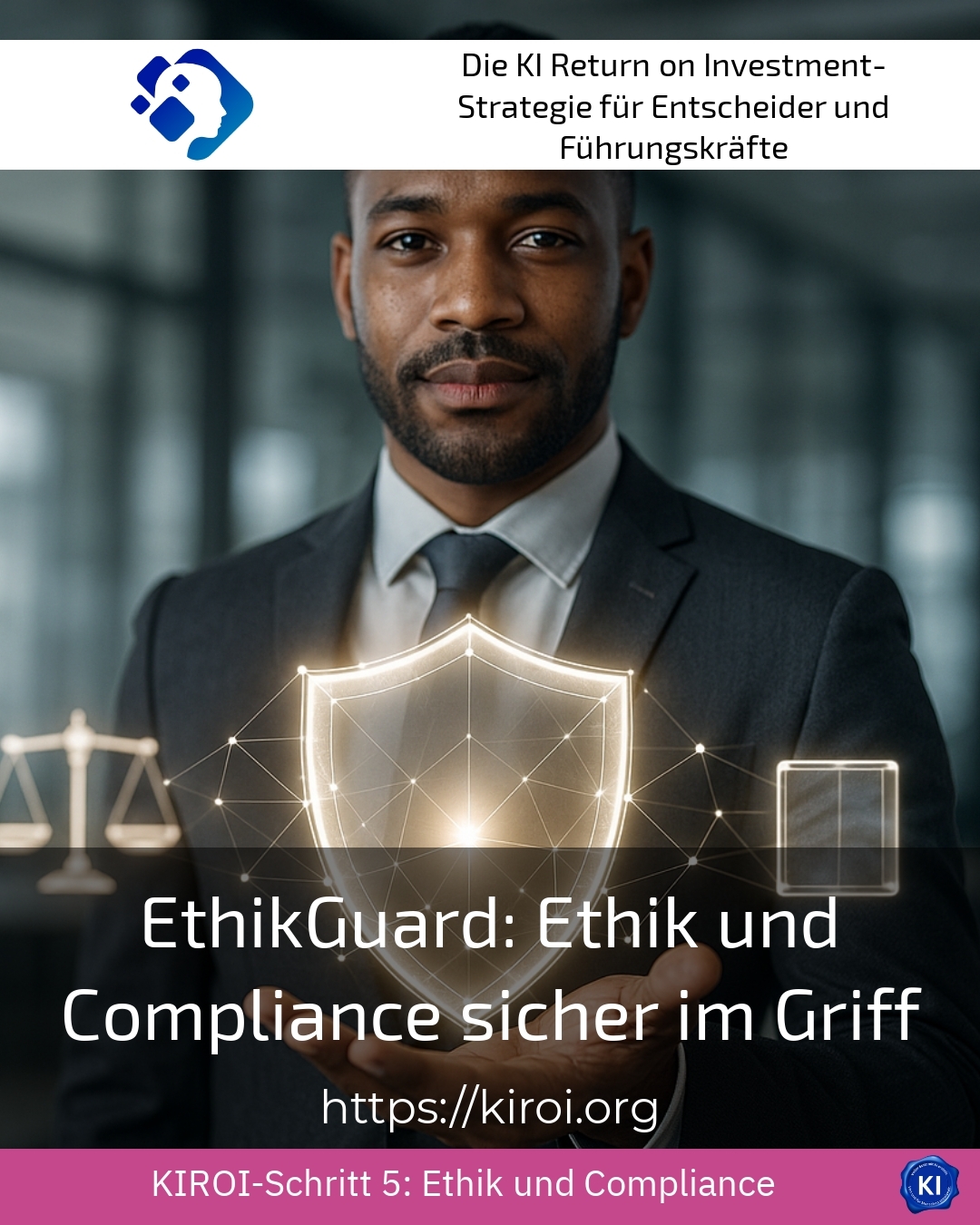
Imagine your organisation is facing a critical decision. At the same time, you have to reconcile legal requirements, moral principles and corporate responsibility. This is precisely where EthikGuard and helps companies to systematically navigate complex ethical issues. At a time when transparency and integrity determine long-term success, leaders need reliable instruments. This is not about theoretical concepts, but about practical tools for everyday use. This article shows you how modern compliance structures can create sustainable value.
The importance of ethical guardrails in modern organisations
Today, businesses find themselves confronted with a multitude of challenges. Regulatory requirements are becoming more complex and international. Stakeholders expect accountability and responsible action. Employees demand a corporate culture that not only proclaims values, but also lives by them. A manufacturing company, for example, has to review supply chains and ensure human rights standards. Banks and financial service providers are under constant observation regarding anti-money laundering prevention. Healthcare institutions must protect patient data while at the same time enabling research.
These diverse requirements demand structured approaches and clear processes, because arbitrary decisions lead to inconsistencies and a loss of trust. A retail company, for example, must both ensure fair working conditions at suppliers and comply with environmental standards. Energy suppliers balance economic efficiency with ecological responsibility. Technology companies navigate data protection laws across various jurisdictions.
This is why successful organisations establish systematic governance structures. These include codes of conduct, training programmes and whistleblowing systems. This creates a culture in which ethical behaviour becomes second nature.
EthikGuard as a strategic management instrument
The implementation of EthikGuard enables proactive management of ethical risks. Unlike reactive approaches, this system identifies potential problem areas at an early stage. Pharmaceutical companies use such structures to design clinical trials in an ethically sound manner. Automobile manufacturers rely on corresponding frameworks in the development of autonomous driving systems. Food corporations use them to evaluate sustainability initiatives.
Practical implementation begins with a comprehensive risk analysis. In doing so, experts assess various business areas with regard to ethical vulnerabilities. For example, a chemical company analyses production processes for environmental impacts. Insurance companies check algorithms for discriminatory patterns in tariff pricing. Media houses evaluate editorial guidelines with regard to journalistic integrity.
Subsequently, teams develop tailor-made guidelines and procedures. These take into account industry-specific characteristics and company-individual values. This creates a coherent system that provides orientation and creates certainty of action.
Best practice with a AIROI customer
An internationally active mechanical engineering group faced the challenge of harmonising its global compliance structures. The various sites in Europe, Asia and North America were working with different standards and processes. The transruptions coaching accompanied the company through the transformation over several months. Initially, the teams jointly analysed existing guidelines and identified gaps and contradictions. This revealed that local specifics had to be taken into account without compromising the overarching corporate values. The consultancy helped to develop a modular system that combined global minimum standards with regional flexibility. Employees from all hierarchical levels were involved in workshops to ensure acceptance and practical suitability. The result was a uniform governance structure that respected cultural differences while setting clear guard rails. Clients frequently report that such integrative approaches significantly increase job satisfaction. The managers were provided with concrete tools for ethical decision-making in everyday operations. The implemented feedback system proved to be particularly valuable, enabling continuous improvements.
Practical fields of application for EthikGuard in various sectors
The specific areas of application for ethical governance systems vary considerably depending on the sector [1]. In healthcare, issues of patient autonomy and data protection are paramount. Hospitals implement ethics committees that advise on difficult treatment decisions. Care facilities develop guidelines for the dignified treatment of vulnerable groups. Pharmaceutical companies establish independent monitoring bodies for research projects.
The financial sector uses corresponding structures to ensure fair business practices [2]. Banks regularly train employees in anti-corruption guidelines and money laundering prevention. Asset managers integrate ESG criteria into their investment decisions. Insurers review automated decision-making processes for fairness and freedom from discrimination.
In the technology sector, ethical frameworks are gaining increasing importance. Software companies are evaluating algorithms with regard to potential biases and patterns of discrimination. Platform operators are developing guidelines for dealing with user-generated content. Telecommunications providers are balancing data monetisation and the protection of their customers' privacy.
Implementation strategies for sustainable compliance cultures
The successful implementation of ethical governance systems requires a holistic approach. Isolated measures have no effect if they are not embedded in the corporate culture. A retail group, for example, must communicate values consistently from the board of directors down to branch management. Construction companies integrate ethical standards into tender procedures and supplier contracts. Logistics service providers train driving staff in responsible behaviour towards vulnerable road users.
The process typically begins with a commitment from top management [3]. Board members must act as role models and demonstrate ethical behaviour. Project teams then develop tailored concepts for the respective organisation. For example, a tourism company will take into account the protection of local communities. Agricultural companies integrate animal welfare and environmental protection into their guidelines. Textile manufacturers establish mechanisms to monitor working conditions in production facilities.
Training programmes subsequently impart the necessary knowledge to all employees. These programmes go beyond imparting theoretical knowledge and practise practical situations. Role-plays and case studies prepare staff for real challenges. In this way, teams develop the competence to manage ethical dilemmas independently.
Overcoming challenges in EthikGuard integration
The introduction of ethical governance structures often encounters resistance. Employees sometimes perceive new guidelines as bureaucratic hurdles. Leaders fear limitations on their freedom of decision-making. For example, a real estate company initially experienced scepticism when introducing stricter transparency guidelines. Mechanical engineering firms saw compliance requirements as a competitive disadvantage compared to less regulated competitors. Catering businesses perceived sustainability requirements as a costly additional burden.
These resistances can be overcome through transparent communication and participation. Affected employees should be involved in development processes at an early stage. For example, a chemical company formed interdisciplinary working groups with representatives from all levels of hierarchy. Energy suppliers organised dialogue forums where concerns could be openly addressed. Retail companies carried out pilot projects in selected branches before rolling out standards company-wide.
Furthermore, positive incentives help to increase acceptance. Companies can integrate ethical behaviour into performance appraisals and remuneration systems. By doing so, they signal that responsible conduct is not only expected, but also valued.
Best practice with a AIROI customer
A medium-sized family-owned business in the food industry wanted to fundamentally revise its sustainability strategy. Previous approaches appeared fragmented and had little impact. The transruptions coaching provided impetus for an integrated approach that combined economic and ethical goals. First, the team carried out a comprehensive stakeholder analysis to identify relevant interest groups. This revealed differing expectations from consumers, suppliers, employees, and the local community. The consultancy provided support with prioritisation and the development of realistic targets. Together, the teams drew up measurable key performance indicators to monitor success. A particular focus was placed on supply chain transparency and cooperation with partner agricultural farms. The company implemented a certification system for suppliers that checked social and environmental standards. Employees received training on sustainable business practices and became ambassadors for the new corporate philosophy. Clients frequently report that such holistic transformations also increase employer attractiveness. Following implementation, the family business recorded a significant rise in qualified applications. Customer satisfaction also improved measurably, as consumers rewarded the authentic sustainability efforts.
Technological support for ethical decision-making processes
Modern technologies can effectively support ethical governance structures [4]. Software solutions enable the systematic collection and evaluation of relevant data. For example, a logistics company uses this to monitor the carbon emissions of its vehicle fleet in real time. Financial service providers analyse transaction patterns to detect suspicious activities. Personnel service providers use algorithms to check job advertisements for discriminatory wording.
Whistleblowing systems form an important component of modern compliance architectures. These enable employees to report grievances confidentially. For example, a construction group implemented an anonymous whistleblowing platform for safety violations. Hospitals use corresponding systems to report treatment errors or hygiene deficiencies. Educational institutions create secure channels with them to report bullying or discrimination.
Artificial intelligence offers additional opportunities to support ethical decision-making. Algorithms can analyse large amounts of data for patterns that escape human observers. At the same time, these technologies themselves require ethical control to avoid unintended biases.
Measurement and continuous improvement of ethical standards
The effectiveness of EthikGuardSystems must be regularly reviewed and optimised. Indicator systems enable the objective evaluation of progress. For example, a trading company measures compliance with supplier standards through regular audits. Insurance companies analyse complaint rates as an indicator of customer satisfaction and fair treatment. Manufacturing companies record industrial accidents as a key performance indicator for occupational safety and employee wellbeing.
Regular employee surveys provide valuable insights into the corporate culture in practice. These capture whether ethical guidelines are actually applied in everyday work. For example, a telecommunications company carried out biannual ethics surveys. Retailers surveyed store teams on their perception of fairness and integrity. Consultancy firms evaluated satisfaction with internal conflict resolution mechanisms.
The insights gained are incorporated into continuous improvement processes. In this way, ethical governance structures evolve dynamically and adapt to changing requirements.
My AIROI Analysis
The systematic integration of ethical governance mechanisms is developing into a decisive competitive factor for modern organisations. Companies that view compliance and ethics as strategic opportunities position themselves for long-term success. The practical examples clearly show that EthikGuard-approaches are effective across all sectors. From healthcare and the financial sector to manufacturing, organisations benefit from clear structures. This is not about rigid sets of rules, but about living systems that adapt to changing conditions.
The biggest challenge often lies not in the technical implementation, but in cultural integration. Employees must understand ethical behaviour as part of their identity, not as an external requirement. Accompanying coaching programmes can provide valuable impetus here. Transruptions coaching supports organisations in successfully shaping such profound transformations. Leaders develop the necessary skills for value-based leadership.
Technological innovations will further expand the possibilities of ethical governance. At the same time, new challenges are emerging, for example in the fields of artificial intelligence and data usage. Organisations that build robust structures today will be better equipped for these developments. Investing in ethical excellence pays off in the long term, as it builds trust and minimises risks. Customers, employees and investors are increasingly rewarding responsible behaviour with loyalty and engagement.
Further links from the text above:
[1] Compliance Manager – Specialist magazine for compliance and governance
[2] BaFin – Federal Financial Supervisory Authority
[3] German Corporate Governance Code
[4] Bitkom – Federal Association for Information Technology, Telecommunications and New Media
For more information and if you have any questions, please contact Contact us or read more blog posts on the topic Artificial intelligence here.







 Deutsch
 English (UK)