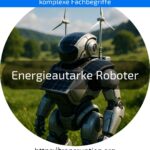
The term „energy-autonomous robots“ is particularly at home in the fields of robotics, automation, and sustainability and environment 4.0. It describes robots that can operate independently of external energy sources. This means these machines generate and use their own energy, for example, through solar cells, small wind turbines, or by converting kinetic energy.
Such robots are becoming increasingly important because they can be used in remote or hard-to-reach places where there is no power supply. An understandable example: an energy-independent robot could be deployed in a distant field to autonomously identify and remove weeds. It charges its batteries itself with solar energy during the day and can therefore work for longer periods without human assistance.
This makes this technology particularly interesting for industry, but also for agriculture and environmental protection. Energy-independent robots not only save costs for electricity and maintenance, but also reduce CO₂ emissions, as they do not require fossil fuels. This makes them an important step towards sustainable and efficient automation.






 Deutsch
  English (UK)