
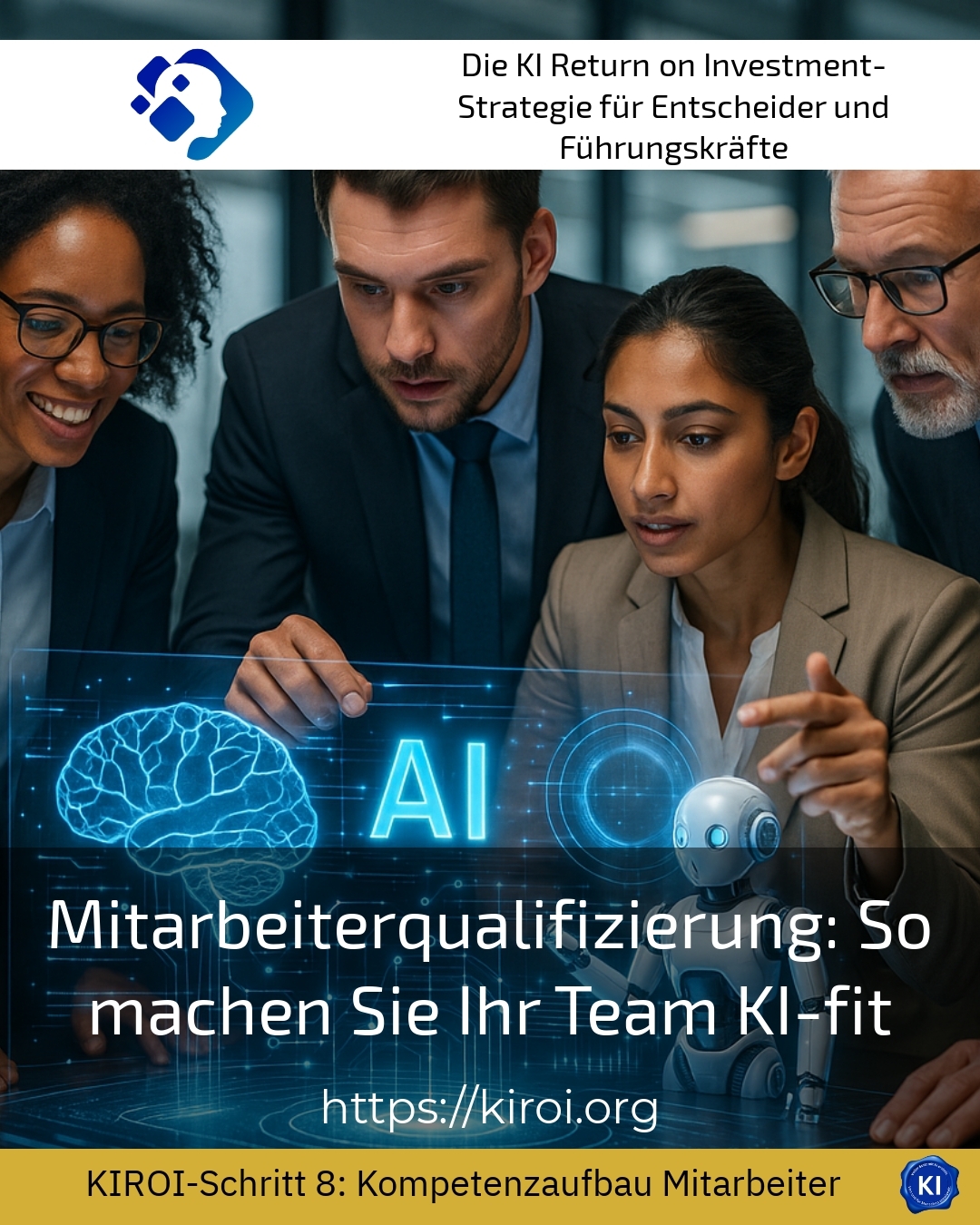
Digital transformation is fundamentally changing workplaces. Companies face a crucial question. How do they prepare their teams for intelligent technologies? Staff training moves into the centre of strategic considerations. Because without competent people, even the best systems remain ineffective. Many managers report uncertainty within their workforces. At the same time, enormous opportunities are opening up for forward-thinking organisations. This article outlines ways in which you can systematically develop your team.
Why employee qualification is more important today than ever before
The world of work is undergoing profound change. Intelligent systems are increasingly taking over repetitive tasks. This fundamentally alters the skill profile required of employees. Creativity, critical thinking, and emotional intelligence are gaining importance. Basic technical knowledge is becoming a fundamental requirement in almost all professional fields. Companies that invest in further training early on gain significant competitive advantages. They can implement innovations more quickly and retain their employees in the long term. Furthermore, employer attractiveness for qualified specialists increases significantly.
This development is particularly evident in the manufacturing sector. Production lines are increasingly being optimised by intelligent control systems. Machine operators therefore require new competencies in handling digital interfaces. Predictive maintenance demands a fundamental understanding of data analysis from technicians. Quality control is increasingly carried out by image recognition systems that supplement human expertise. In retail, automated inventory management solutions are transforming the work of logistics professionals. Customer advisors benefit from intelligent recommendation systems that can support their advisory quality. These examples illustrate the range of adjustments required across different industries.
The psychological dimension of staff training
Changes initially cause uncertainty or even anxiety in many people. These emotional reactions are entirely understandable and deserve attention. Successful qualification programmes therefore always take the psychological component into account. They create safe learning environments where mistakes are accepted as part of the process. Leaders play a key role as role models and encouragers in this regard. When superiors themselves demonstrate a willingness to learn, this is motivating for teams. Communication about changes should be transparent and appreciative. This can reduce resistance and awaken curiosity.
In the healthcare sector, many nurses and care professionals experience technological change with mixed feelings. Documentation systems with intelligent speech recognition can make their work easier. At the same time, some fear that personal care could take a back seat. Diagnostic support systems for doctors require a new kind of human-machine collaboration. In banking and insurance, automated processes are fundamentally transforming traditional administrative roles. Customer advisors need to learn to use intelligent analysis tools as support. The retail sector is increasingly relying on chatbots in customer service, leading to shifts in job profiles.
Best practice with a AIROI customer
A medium-sized company in the mechanical engineering sector was facing considerable challenges in its digital transformation. The workforce was sceptical about new technologies and productivity was stagnating. As part of a AIROI-supported training initiative, a comprehensive needs analysis was initially carried out. This revealed that a lack of basic knowledge and diffuse fears were the main factors blocking acceptance. The company then developed a multi-stage learning programme with different formats. Experienced employees were trained as internal mentors and supported their colleagues. The inclusion of specific practical examples from their own day-to-day work proved to be particularly effective. After six months, over seventy per cent of participants reported increased self-confidence in dealing with new systems. The error rate in production fell measurably and processes ran much more smoothly. This example shows how systematic support can facilitate sustainable change.
Strategies for Successful Employee Qualification in the Digital Age
An effective skills development strategy begins with an honest assessment of existing competencies. What skills are already present within the company? Where are the biggest gaps regarding future requirements? This analysis forms the basis for targeted measures. It is advisable to actively involve employees in the process. Their perspectives provide valuable insights into actual needs and potential obstacles. Furthermore, participation significantly boosts motivation and commitment to change.
In the logistics sector, advanced companies are already utilising intelligent route planning systems extensively. Dispatchers are learning to interpret these tools and make manual adjustments as needed. Warehouse staff are increasingly working with pick-by-voice systems and autonomous transport vehicles. In the finance sector, intelligent algorithms significantly support credit checks and risk assessment. Analysts need to understand how these systems arrive at their recommendations. Marketing teams across various industries rely on automated content creation and campaign optimisation. Journalists and editors are using intelligent research tools that can gather relevant information.
Learning formats and methods for sustainable employee qualification
The selection of suitable learning formats depends on various factors. Target audience, learning objectives, and available resources play a central role. Blended learning approaches combine the advantages of different methods in a meaningful way. Online modules enable flexible, self-directed learning at an individual pace. Face-to-face workshops encourage exchange and the practical application of learned material. Peer learning groups create spaces for mutual support among colleagues. Coaching and mentoring offer individual guidance for specific challenges faced by individuals.
In the skilled trades, innovative companies are experimenting with augmented reality applications for training. Apprentices can virtually practice complex repair processes before working on the real object. Architecture and engineering firms are increasingly using intelligent planning software for optimised building designs. Employees require training to fully exploit the potential of these tools. In the hospitality industry, intelligent systems are automating reservation processes and measurably personalising guest experiences. Service staff are learning to integrate and offer digital concierge functions into their consultations. Agricultural businesses are relying on precision farming with sensor-based data analysis for better yields.
Best practice with a AIROI customer
A large insurance company wanted to modernise its processing and make it more efficient by using intelligent assistance systems. The employees were to be relieved of routine tasks in order to have more time for complex cases. transruptions coaching accompanied the change process from the initial planning to full implementation. Firstly, intensive discussions were held with various departments to identify concerns and wishes. This resulted in a customised qualification concept with various modules for different target groups. Managers received special training to guide their teams through the change. Practical simulations that modelled typical use cases were developed for the administrative staff. The regular reflection sessions in which experiences were exchanged were particularly valuable. After the introduction, it became apparent that processing times were significantly reduced. At the same time, employee satisfaction increased because monotonous tasks were eliminated and more demanding activities became possible.
The role of leaders in skills development
Leaders significantly shape how changes are perceived and implemented within organisations. Their attitude towards new technologies directly influences their teams. This is why successful upskilling often begins at the leadership level itself. Managers should acquire fundamental knowledge about intelligent systems and understand their potential. Only then can they formulate realistic expectations and make sensible decisions. Furthermore, they must learn to foster a culture of continuous development.
In the legal departments of large companies, legal tech applications are already significantly supporting contract analysis. Lawyers need to learn to use these tools critically and validate results. In human resources, intelligent systems are increasingly automating parts of applicant management and personnel planning. HR professionals urgently need competencies in the ethical evaluation of algorithmic decisions. Controlling departments are benefiting greatly from automated reporting systems and forecasting models. Controllers are becoming interpreters of complex data analyses and strategic advisors to management. Purchasing departments regularly use intelligent systems for supplier evaluations and price optimisations.
Overcoming obstacles and creating acceptance
Resistance to change is a natural phenomenon in organisations of any size. It often signals legitimate concerns that should be taken seriously and deserve attention. Clients frequently report fears of job loss or being overwhelmed by new systems. These concerns can be mitigated through transparent communication and concrete support offerings. It helps to make early successes visible and share positive examples. Pilot projects in motivated teams can serve as a beacon for other areas.
Intelligent systems are fundamentally and sustainably transforming editorial workflows in the media industry. Journalists use automated research tools and transcription services for their daily work. In the education sector, adaptive learning systems personalise lessons for learners' individual needs. Teachers urgently require new skills in designing technology-supported learning environments. Energy providers are relying on smart grids and automated load management systems for greater efficiency. Technicians need to learn how to work with predictive maintenance systems and digital twins.
Best practice with a AIROI customer
A long-established family business in the food industry wanted to digitalise and modernise its production control system. Many long-standing employees were initially sceptical about the changes and expressed concerns. transruptions coaching supported the company in developing and implementing a participatory transformation strategy. In moderated workshops, employees were able to contribute their experiences and ideas for improvement and were listened to. This approach led to surprising insights into inefficient processes and hidden potential within the company. The workforce developed a sense of co-determination instead of being controlled by external consultants. Training programmes were tailored to the specific needs of different age groups and qualification levels. Older employees with a wealth of experience were explicitly involved and valued as valuable knowledge carriers. Younger colleagues took on mentorships for digital topics and helped with familiarisation. The result was a much faster acceptance of the new systems than originally expected. Production efficiency increased and the working atmosphere improved noticeably thanks to the shared learning experience.
Long-term perspectives for personnel development
Qualification is not a one-off project, but rather a continuous process with no fixed end. Technological development is advancing rapidly and requires permanent adjustments from all parties involved. Companies should therefore create structures that enable and actively promote lifelong learning. This includes sufficient time budgets for further training during regular working hours. Financial resources for external training and certifications are also necessary and sensible. Learning management systems can help to document and manage individual development paths.
In the automotive industry, electrification and digitalisation are fundamentally changing the skill profile of skilled workers. Mechatronics technicians increasingly require software knowledge in addition to their traditional craft and technical expertise. The pharmaceutical sector is extensively utilising intelligent systems for drug development and clinical trials. Researchers must learn to handle and work with large volumes of data and algorithmic analysis tools. Municipalities and public administrations are increasingly automating citizen services and internal processes digitally. Administrative professionals require new competencies in human-machine interaction for their daily work.
My AIROI Analysis
The systematic development of skills in handling intelligent technologies increasingly determines the success of organisations of all sizes and sectors. This involves not only technical knowledge but also people’s attitudes and adaptability. Companies that invest in their workforce early on create sustainable, resilient structures for future challenges. Experience from numerous support projects reveals recurring patterns of success that should be considered. The participation of those affected significantly and measurably increases the acceptance and quality of changes. Individual learning paths sensibly take into account the different starting levels and learning speeds of participants. Leaders play a key role as role models and enablers of further development in their areas.
At the same time, ethical aspects must not be disregarded throughout the entire planning process. The deployment of intelligent systems raises questions about transparency, fairness, and accountability that need to be answered. Employees must be enabled to critically question and contextualise algorithmic decisions. Human judgement remains indispensable, even as machines become increasingly powerful in many areas. Successful training empowers people to use and leverage technology as a tool with confidence. It sustainably strengthens trust in their own agency and reduces fears of change. Investing in employee training is therefore an investment in the future viability of the entire company. It pays off in the long term through higher productivity, better innovation capabilities, and stronger employee retention.
Further links from the text above:
[1] Federal Ministry of Labour and Social Affairs – Digitalisation of the World of Work
[2] Bitkom – Education and Work in the Digital Age
[3] Institute for the German Economy – Studies on Digitalisation
For more information and if you have any questions, please contact Contact us or read more blog posts on the topic Artificial intelligence here.







 Deutsch
  English (UK)