
The business landscape is changing rapidly. Digitisation, new working environments, and shifting employee expectations present organisations with significant challenges. Many companies are realising that a genuine culture change is necessary to remain fit for the future. But how can this profound transformation be achieved? The fourth step of the KIROI model offers a proven success factor here. transruptions-Coaching specifically guides organisations through this critical process of culture change and helps to anchor sustainable transformations.
Why culture change is more than just a change project
Many leaders confuse culture change with classic change management. However, the difference is considerable. While change management focuses on structural adjustments, culture change goes much deeper. It touches upon the values, beliefs and behaviours of the entire organisation[1].
Cultural change is the conscious process by which organisations systematically and purposefully transform their corporate culture[1]. It is not about superficial adjustments. Rather, profound changes need to be brought about in the way people work together, make decisions, and communicate with each other. This transformation requires time, patience, and strategic guidance.
A financial service provider was faced with the task of transforming its highly hierarchical culture into a more collaborative structure. Traditional change measures – new processes, new systems – had little effect. Only the deliberately initiated cultural change led to real behavioural changes and increased innovation among employees.
Cultural change in practice: When do organisations turn to coaching?
Our experience shows that organisations come to us with very different starting points. Some companies feel that their existing culture no longer fits their strategy. Others have undergone a merger and need to integrate two different cultures. Still others want to become more agile or work more digitally.
Clients frequently report the following challenges: Employees remain stuck in old patterns, even though new goals have been defined. Resistance to change is evident, either openly or covertly. The leadership level does not sufficiently embody the new values. Departments work in isolation instead of collaboratively. Communication follows old channels.
A technology company wanted to switch from command-and-control to self-organisation. However, the formally newly created teams did not function. People did not dare to act autonomously. The deep-seated belief that „the boss makes the decisions“ was still present. This is precisely where cultural change as genuine support comes into play.
The KIROI approach: Transforming culture step by step
The KIROI model offers a structured framework for successful culture change. Each step builds on the previous one, creating a secure foundation for deep transformation. The fourth step – consolidation – represents the critical success factor.
The first three steps prepare the ground: analysing the existing culture, defining the desired new culture, and mobilising the organisation. However, without the fourth step, these efforts often remain superficial. Cultures tend to fall back into their old patterns when attention wanes [3].
A large mechanical engineering firm underwent a culture change. Initially, everything went very motivationally. However, after six months, the employees reverted to their old behaviour. The new culture had not been embedded. Through systematic embedding work and clear consequences logic, the transformation was eventually stabilised and relapses prevented.
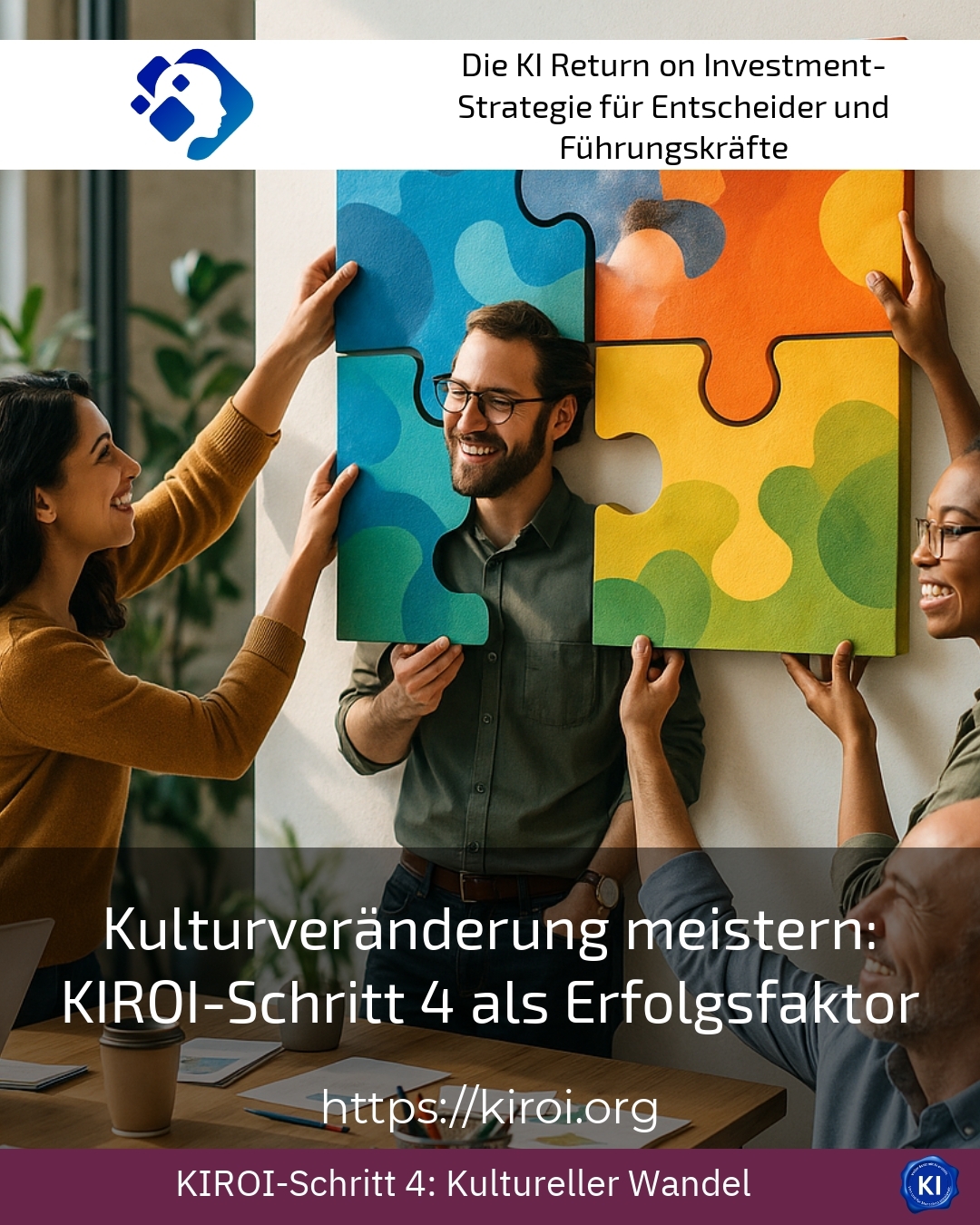
KIROI Step 4: Embedding Cultural Change
The fourth step focuses on embedding. This means weaving the new culture into the organisation so that it becomes the norm. This requires consistency, clarity, and coherence. The new culture must not exist alongside everyday life; it must become part of everyday life.
Concrete measures for embedding are diverse. Leaders must live the new values daily. Routines and rituals must be adapted. Communication must repeatedly convey the new messages. Systems and processes must be aligned with the new culture. The logic of consequences also plays a role: those who ignore the new rules must notice it[3].
A banking group worked to establish a culture of proactive thinking. This was achieved through: regular leadership roundtables, where the new values were reflected upon; recognition of employees who bravely made suggestions; and also discussions with those who showed resistance. After twelve months of consistent embedding, the culture had indeed taken root.
Practical Levers for Successful Culture Change
Cultural change requires several levers to act simultaneously. A single measure is not enough. Rather, routines, rituals, structures, processes, and governance must be aligned with each other[1].
Level 1: Leaders as Role Models for Cultural Change
The leadership level is the visible representative of the new culture. What leaders say and do shapes the organisation far more than formal statements. Therefore, it is crucial that leaders authentically embody the new values. They must show courage in innovation, allow for mistakes and communicate transparently[2].
An IT company wanted to become more error-friendly. The CTO led by example: she openly reported her own mistakes and what she had learned. This sent a clear signal. Soon, other managers and employees also felt confident enough to talk openly about failures. Culture changes from the top down and from the top outwards[2].
Lever 2: Realignment of structures and processes
The culture is embedded in the structures and processes. For example, if the new culture calls for collaboration but the organisation continues to work in silos, that is a contradiction. Structures must be adapted so that the new culture can be lived out. This can include flatter hierarchies, new team structures or cross-functional projects.
A pharmaceutical company is dismantling its strictly functional organisation. It introduced cross-departmental innovation teams. This structure enforced collaboration, thereby supporting the new culture of collaborative problem-solving. After a year, the new processes had become commonplace.
Section 3: Rituals and Symbols of Cultural Change
Rituals and symbols hold immense power in culture. They make abstract values concrete and tangible. This could be new meeting formats where employees are given a voice. It could be a changed office layout that makes flat hierarchies visible. It could also be new awards that recognise different achievements than before.
An insurance company introduced monthly exchange sessions where employees from all levels spoke directly with senior management. This ritual conveyed: „Your voice matters here.“ At the same time, employees showed that these new forms were being put into practice. The ritual became a symbol of the new, more open culture.
Lever 4: Winning People Over to Cultural Change
People need to support and help shape the cultural change. This does not happen through commands from above. Instead, it requires genuine participation. Employees should be able to contribute their ideas on how the new culture can be lived out. This creates genuine ownership.
A logistics company asked employees for suggestions on how to work more agilely. From over a hundred suggestions, the best were selected and implemented collaboratively. This involvement led to real co-responsibility. Suddenly, the culture change wasn't something „those in charge“ were doing, but something the teams themselves were creating.
The Role of Coaching in Cultural Change
Culture change is not a simple project that can be done „on the side“. Most transformations fail because they are not adequately supported [7]. Professional coaching helps organisations to successfully navigate this path.
transruptions-Coaching specifically supports organisations with projects concerning cultural change. We help to first truly understand the existing culture. Then, we assist in developing a clear target culture that aligns with the strategy. In the KIROI Step 4 – anchoring – we provide intensive support to ensure that the new culture does not revert to old patterns.
What coaching achieves in anchoring
Good coaching supports several critical tasks. Firstly, it helps leaders to truly fill their new roles. They learn to convey new values authentically. Secondly, coaching accompanies teams in truly changing their ways of working. Thirdly, coaching creates feedback mechanisms to recognise in good time when resistance or relapses are looming[7].
An energy group engaged transruptions-Coaching for the critical phase of embedding. We conducted group discussions with executives to train them in their role as role models. We worked with teams on new behavioural patterns. We appointed so-called culture champions – employees who actively ensured adherence to the new values and provided feedback. This intensive support ensured that the cultural change actually stuck.
Overcoming common challenges of culture change
Not every cultural change goes smoothly. There are typical hurdles that need to be overcome. Those who are aware of these can take more targeted action.
Challenge 1: The creeping relapse into old patterns
The greatest danger of a culture change is regression. People are used to their old patterns. When management's attention wanes, they unconsciously slip back. That's why consistency is so important. The new rules must not only be implemented but lived permanently.
A retail chain initiated a culture change towards greater customer focus. After six months, attention waned. Store managers quickly reverted to old management mechanisms. Only when top management visibly reaffirmed the new values and consistently followed up did the culture change stabilise.
Challenge 2: Resistance and Sabotage
Not everyone welcomes cultural change. Some perceive it as a threat to their existing position. They sabotage openly or covertly. This is normal and must be actively addressed. The question is not: How do we avoid resistance? The question is: How do we deal with it constructively?
A consulting company introduced a less hierarchical culture. Some senior consultants felt their authority was threatened. They withdrew or voiced doubts. Coaching helped management not to take these resistances personally, but to listen with empathy. Some senior consultants found a new role. Others left the company. Both developments were necessary for the cultural change.
Challenge 3: Senior Management Inconsistency
If the leadership level does not stand behind the new culture with one voice, it will not work. Different leaders send different signals. Employees immediately notice the contradictions. Therefore, alignment within the leadership level is a prerequisite.
An insurance group aimed for greater agility. However, the CFO continued to insist on rigid planning processes. The COO promoted experimentation and tolerance for errors. These contradictions confused the organisation. Coaching worked with management to get back on the same page. This was difficult, but necessary.
Measurement and monitoring of cultural change











 Deutsch
  English (UK)