
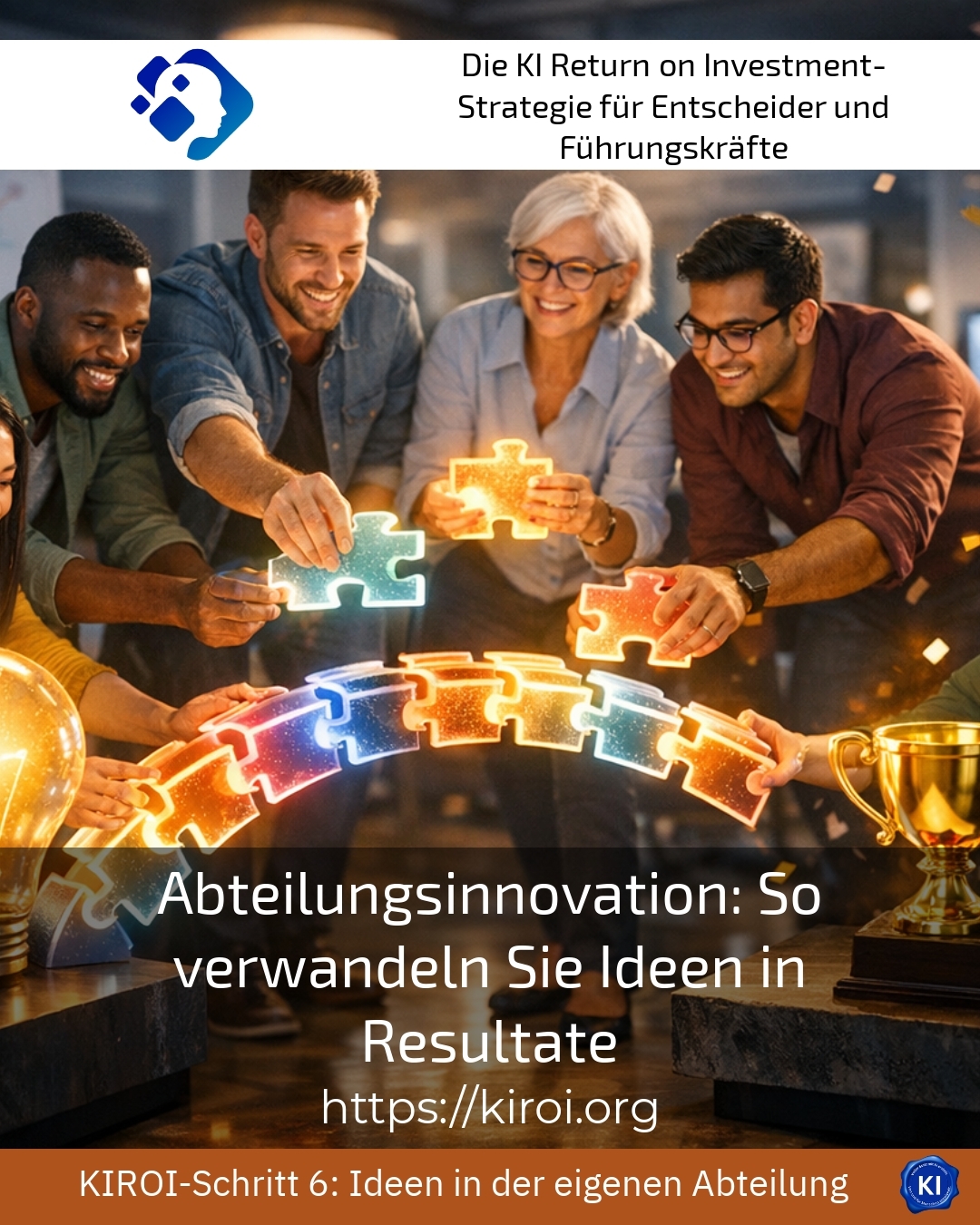
Have you ever wondered why some teams bring about groundbreaking innovations while others, despite brilliant ideas, remain stuck in everyday life and let their potential go untapped? Departmental Innovation It represents one of the biggest challenges today because it requires far more than just creative flashes of inspiration in brainstorming sessions; the actual success factor lies in the systematic transformation of concepts into measurable results that can provide a sustainable contribution to the overall value of the company.
Understanding the Fundamentals of Successful Departmental Innovation
Before teams can embark on the journey of change, they need a solid foundation that consists of several components and takes into account various dimensions of organizational learning. A study by the Harvard Business School [1] impressively shows that companies that have established structured processes for idea generation implement successful innovations three times more often than those that rely on spontaneous ideas. This finding highlights that creativity alone is not enough; it requires a framework that channels and makes it usable.
In practice, it is often the case that employees have many valuable ideas. However, these often go unused in day-to-day operations. For example, a marketing team develops new campaign concepts that could increase customer engagement. However, without clear processes, these approaches remain unused. Similarly, in product development, engineers propose technical improvements. Without resources and decision-making paths, these rarely reach implementation. Similarly, in customer service, valuable insights about customer needs arise daily. However, these valuable information is rarely systematically evaluated.
Best practice with a AIROI customer
A medium-sized company in the field of technical services approached transruptions coaching because the management realized that despite a dedicated workforce, hardly any innovations had emerged and the company’s competitiveness was in danger of declining. As part of the support, an initial assessment was conducted that revealed that there was a lack of clear structures for idea generation and that employees did not know whom to turn to with their suggestions. Transruptions coaching supported the company in introducing a simple digital system through which ideas could be submitted and evaluated, with an interdisciplinary panel meeting monthly to identify promising proposals and allocate resources. Within six months, the participants reported a noticeable change in the company culture, because employees felt encouraged to share their thoughts, and three process improvements were already successfully implemented that led to measurable efficiency improvements.
Create the cultural prerequisites for effective departmental innovation
Corporate culture plays a crucial role in whether innovations can thrive. An atmosphere of psychological safety enables people to express even unusual suggestions. The MIT Sloan Management Review [2] emphasizes in this context that leaders set the tone. They must view mistakes as learning opportunities and not as failures.
Many clients come to us with the complaint that their teams are capable of coming up with ideas, but they don’t share them. The reasons for this are varied and often deeply rooted. In some organizations, there is a culture of blame. Employees fear negative consequences if they fail. Other companies have rigid hierarchies that prevent suggestions from the bottom up from being heard. Still others suffer from a lack of time that makes creative exchange impossible.
For example, a sales team may develop innovative approaches to reaching customers. However, if the senior management does not listen, these ideas wither away. In accounting, ideas for process automation often arise. However, these are rarely taken seriously because the department is considered to be lacking in creativity. Even in the human resources department, innovation potential remains dormant. However, new recruiting strategies or employee retention concepts often remain undiscovered.
Leadership behavior as a catalyst for departmental innovation
Leaders have a significant influence on whether innovation takes place or not. They can either be promoters or blockers. Successful leaders create spaces for experimentation and accept temporary setbacks. They communicate clearly that new approaches are desired and appreciated.
Google’s research on high-performance teams [3] identified psychological safety as the most important success factor. Teams where members dare to take risks outperform others significantly. This finding has far-reaching implications for leadership practice. Managers should actively seek out different perspectives, include diverse perspectives, and admit their own uncertainties.
For example, a department manager in purchasing can establish weekly exchange sessions. Here, team members share observations about suppliers or market trends. In the IT department, executives can allocate dedicated innovation time. Developers then have the freedom to work on their own projects. In quality management, supervisors can publicly acknowledge improvement suggestions. This signals that commitment is seen and appreciated.
Establishing practical methods for ideation implementation
The transition from idea to result requires structured approaches that combine creativity with pragmatism and take into account the various stakeholders with their respective interests. Design-thinking approaches have proven themselves in many contexts because they put people at the center and promote iterative processes that enable early learning from mistakes, thereby avoiding costly late consequences.
The prototyping phase deserves special attention in this process. Fast, simple models enable early feedback. For example, a logistics team can initially simulate a new picking process. This allows weaknesses to be identified before major investments are made. In customer service, new conversation guidelines can be tested in a small scale first. The results provide valuable insights for optimization. In the finance department, new reporting formats can also be tested with a pilot group first.
Best practice with a AIROI customer
A production department of a large industrial company was looking for ways to reduce lead times while maintaining quality standards, which presented a complex challenge because various interfaces were involved and different departments had to be coordinated. The transruptions coaching team supported the team in developing a systematic approach, first by gathering all relevant perspectives and then in a workshop jointly developing solutions. Particularly valuable was the insight that many delays were due to communication breakdowns between shifts, which is why a simple digital handover protocol was developed that was designed by the employees themselves and thus received high acceptance. The guidance provided by the transruptions coaching helped the company identify and constructively manage resistance early on, allowing the new solution to be firmly established and the lead times, according to reports from the executives, to be reduced by about fifteen percent.
Ensure resource allocation for sustainable departmental innovation
Without adequate resources, even the best ideas remain pie in the sky. Time, budget, and expertise must be available. Executives face the challenge of balancing between day-to-day operations and future investments. This tension cannot be completely resolved, but it can be constructively managed.
A proven approach is to establish dedicated innovation budgets. These are separate from operational funds. This prevents any competition between ongoing requirements and new initiatives. For example, a small pot can be reserved in the human resources department for experimental recruiting methods. The marketing department can do the same and allocate funds for pilot projects. Even in the administration, small budgets can be allocated for process improvements.
The temporal component deserves special attention in resource planning. Employees need spaces to think creatively and try new things. Some companies hold innovation days where daily operations are suspended. Others allow employees to use a certain percentage of their working time for their own projects. Both approaches can be effective if they are lived authentically.
Ensure measurability and continuous improvement
Innovation must be measurable in order to succeed in a sustainable way and to maintain the necessary support from management. It is not always easy to identify the right metrics, because many effects do not occur until later and qualitative improvements are difficult to quantify. Nevertheless, there are various approaches that have proven themselves in practice and offer a good starting point for measuring success.
Input metrics measure the effort that flows into innovation. These include the number of submitted ideas or the hours invested. Output metrics capture the results, such as implemented projects or achieved savings. Outcome metrics look at the long-term effects, such as market share gains or employee satisfaction.
In practice, it is advisable to select a manageable number of metrics. Too many metrics lead to confusion and overload. For example, a project management team can track the time to market of new features. The human resources department can use the turnover rate as an indicator of successful onboarding efforts. In sales, the conversion rate can show whether new sales approaches are working.
Best practice with a AIROI customer
A service company in the consulting industry had difficulty measuring the success of its internal improvement initiatives and communicating it to management, which is why innovative projects were often perceived as unnecessary luxury and the motivation of employees suffered. The transruptions coaching supported the team in developing a simple metrics system that considered both quantitative and qualitative aspects and relied on already existing data sources to keep the collection effort to a minimum. Particularly helpful was the introduction of a monthly reporting format that informed management in a concise form about progress and challenges, while also sharing success stories from the teams, which led to a significantly higher appreciation of innovation work. The guidance provided by the transruptions coaching also helped the company set realistic expectations and understand that some initiatives take time to have an impact, while others can deliver quick results.
My AIROI Analysis
The systematic transformation of ideas into tangible results represents one of the most challenging tasks for modern organizations and requires a multifaceted approach that takes into account cultural, structural, and process dimensions alike. From my experience with numerous mentoring projects, it is repeatedly shown that the key to success lies not in spectacular individual actions but in the persistent work on the fundamentals that often appear unspectacular but make the crucial difference.
The Departmental Innovation It succeeds where leaders understand their role as facilitators. They create spaces where employees are allowed to experiment. They provide resources without expecting immediate success. They value commitment even when results are not forthcoming. This attitude is demanding and requires patience.
At the same time, innovation requires clear structures and processes. Creativity flourishes best within a defined framework. This framework provides orientation and reduces uncertainty. It makes it transparent how ideas are submitted, evaluated, and implemented. This increases motivation to contribute.
Measuring innovation remains a challenge that organizations must overcome. Without metrics, there is no basis for continuous improvement. However, metrics should be chosen carefully. They can also create counterproductive incentives. A balanced approach combines quantitative and qualitative indicators.
In conclusion, I would like to emphasize that each organization must find its own path. There is no blueprint that works everywhere. Transruptive coaching can provide impulses and accompany processes. However, the actual change work lies with the people within the organization itself.
Further links from the text above:
[1] Harvard Business School – Faculty Research on Innovation
[2] MIT Sloan Management Review – Leadership and Innovation
[3] Google re:Work – Understanding Team Effectiveness
For more information and if you have any questions, please contact Contact us or read more blog posts on the topic Artificial intelligence here.







 Deutsch
 English (UK)