
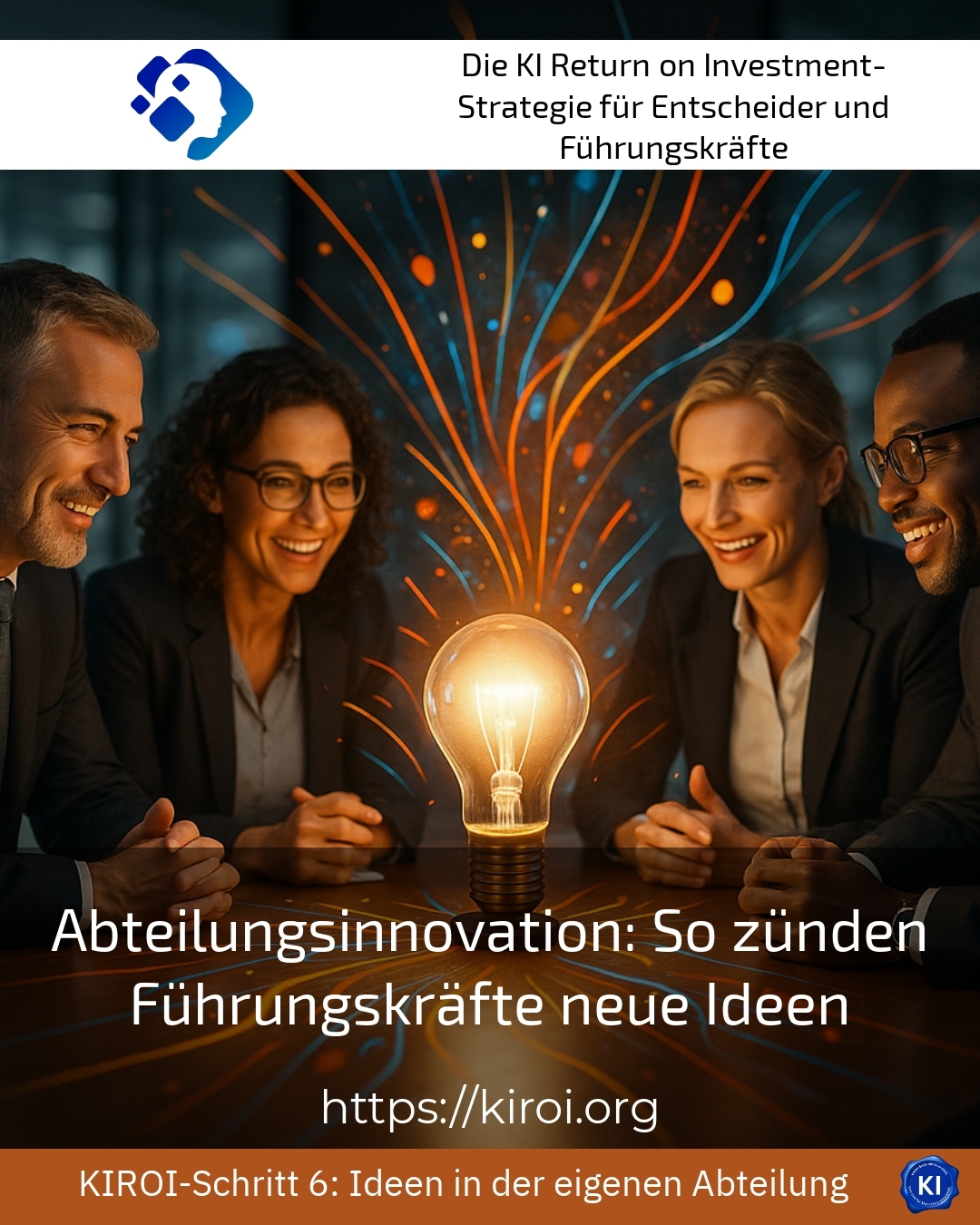
Imagine your department transforming within a few months into a vibrant ideas hub, continuously generating fresh concepts and driving the entire organisation forward as a result. Department Innovation: How Leaders Ignite New Ideas This is not just a buzzword, but a concrete approach that delivers measurable results. Many leaders report astonishing changes. They experience their teams suddenly flourishing and developing creative solutions that previously seemed unthinkable. But how is this transformation actually achieved? Which methods have proven effective? And why do some attempts fail while others are spectacularly successful?
The foundations of successful departmental innovation: How leaders systematically ignite new ideas
Successful innovation rarely begins with a brilliant flash of insight at one's desk. Instead, it arises from systematic processes and a culture that rewards a willingness to experiment. Leaders in the manufacturing industry have recognised that traditional hierarchies often act as a barrier. Therefore, they are increasingly establishing flat structures for creative processes. For example, a production manager at a medium-sized mechanical engineering firm introduced weekly innovation circles. Through these, employees from different departments contributed their perspectives. The results surprised everyone involved. Within a quarter, twelve patentable improvement suggestions were generated. At the same time, employee satisfaction increased significantly.
Another example comes from the automotive supplier industry. There, a department manager implemented so-called creative sprints. These lasted three days each and took place quarterly. Participants worked on concrete challenges from their day-to-day business. They developed prototypes and tested them immediately in the work environment. This method led to a significant reduction in the scrap rate by a considerable percentage. Furthermore, communication between shifts improved considerably.
The potential is particularly impressively demonstrated at an electronics manufacturer. Here, management established an in-house incubator programme. Employees could submit suggestions and, if positively evaluated, received resources for implementation. The best projects were subsequently integrated into regular processes. This approach created an atmosphere of innovation. Many employees volunteered their time in their free time. They wanted to advance their concepts and saw real opportunities for realisation.
Best practice with a AIROI customer A company with a long tradition in precision mechanics faced the challenge of fundamentally transforming its development department. The leadership had recognised that the existing structures were no longer contemporary and that fresh impetus was lacking. Together with transruptions-Coaching, we developed a multi-stage approach to guide this change. Firstly, we analysed the existing communication channels and identified blockages. Subsequently, we established a format for regular idea workshops, where all hierarchical levels participated as equals. Employees frequently reported a new sense of appreciation. They suddenly contributed suggestions they had previously kept to themselves. Within six months, several improvements were made to the manufacturing process. These led to measurable efficiency gains and a noticeably improved team dynamic. Of particular note was the change in leadership culture itself. The departmental management learned to relinquish control and to place trust. transruptions-Coaching continuously supported this development throughout the entire project duration.
Psychological Factors: Why People Become Creative
Human creativity follows certain patterns and conditions. Leaders can specifically foster and leverage these. Psychological safety plays a central role in this [1]. When employees are not afraid of negative consequences, they share their thoughts more openly. A plant manager from the plastics processing industry reported an interesting observation. After the introduction of anonymous suggestion boxes, the number of proposals tripled. Many employees only dared to express unconventional thoughts under this protection.
Equally important is the error culture within a department. A logistics service provider introduced explicit error celebrations. Failed experiments were recognised and lessons learned were highlighted. This practice fundamentally changed the entire atmosphere. Employees dared to do more and experimented more frequently. The innovation rate increased significantly because the fear of failure disappeared.
The physical environment also significantly influences creative processes. A chemical company completely redesigned its break rooms. It created flexible work areas with whiteboards and comfortable seating. The informal conversations in these rooms led to a surprising number of suggestions for improvement. The investment paid for itself within a short period through saved process costs.
Departmental Innovation: How Leaders Ignite New Ideas Through Targeted Communication
The type of communication significantly determines the success of change processes. Leaders must formulate their messages clearly and inspirationally [2]. A production manager in the food industry developed his own narrative for this purpose. He told the story of his department as a hero's journey. The employees became protagonists who overcame challenges together. This narrative style created identification and motivation.
Regular feedback loops further reinforce the effect. One pharmaceutical company established monthly innovation reviews. Teams presented their progress and received constructive feedback there. The visibility of the projects greatly motivated everyone involved. At the same time, valuable connections were made between different departments.
Storytelling as a leadership tool also shows impressive impact. A textile manufacturer systematically collected success stories from within the organisation. These were shared in internal media and presented at events. The examples inspired other departments to imitate them. A positive competition emerged for the most creative solutions.
Structural prerequisites for sustainable change
Without suitable structures, even the best intentions will fizzle out ineffectively. Leaders must therefore create organisational frameworks. Time off is one of the most important factors. A steelworks introduced a weekly innovation day. On this day, selected employees worked exclusively on future projects. The results significantly exceeded all expectations.
Resource allocation also plays an equally important role. A packaging manufacturer provided a budget for experiments. Teams could procure materials and build prototypes without having to go through lengthy approval processes. This autonomy significantly accelerated development cycles. Many improvements reached mass production more quickly.
Incentive systems also sustainably influence creative behaviour. An energy supplier established a bonus programme for implemented suggestions. The bonuses were based on the proven benefit of the improvement. This system motivated many employees to participate actively. The number of concepts submitted multiplied within a year.
Best practice with a AIROI customer A medium-sized supplier to the aviation industry approached us with a specific challenge. While the development department was producing solid results, groundbreaking innovations were lacking. The management wanted more dynamism and fresh impetus. Transruption Coaching supported the transformation process over a period of eight months. Initially, we conducted individual interviews with all team members to identify hidden potential. It became apparent that many employees had valuable ideas but were not communicating them. The reasons were varied, ranging from a lack of time to uncertainty about their relevance. We developed a structured format for regular creative sessions. These took place every two weeks and followed a clear procedure. Participants learned various creativity techniques and applied them to real problem scenarios. After a few months, the culture had noticeably changed. Employees actively contributed their suggestions and openly discussed possibilities for improvement. The department developed several innovative solutions that have since become standard.
The Role of External Impulses and Networks
Sometimes an external breath of fresh air is needed to break established patterns. Managers can make targeted use of this [3]. An electric motor manufacturer regularly invited external speakers. They reported on developments in other industries and opened up new perspectives. Employees transferred these insights to their own context. This led to original approaches to solutions.
Collaborations with universities also offer great potential. A machine tool manufacturer worked closely with a technical university. Students worked on project assignments related to the company's real-world challenges. The fresh perspective from the academic side led to surprising insights. At the same time, the company recruited promising talent.
Cross-industry exchange further broadens horizons. A beverage manufacturer regularly visited companies from completely different sectors. The executive organised these excursions for the entire team. Observations in unfamiliar work environments inspired new approaches. Many improvements arose through the creative transfer of foreign concepts.
Departmental Innovation: How Leaders Ignite New Ideas Through Digital Tools
Modern technologies support creative processes in a variety of ways. Leaders should actively utilise these opportunities. One semiconductor manufacturer introduced a digital ideas platform. All employees could submit and rate suggestions there. The transparent presentation fostered a motivating competition. The best concepts automatically received attention and resources.
Collaborative tools enable cross-location collaboration. An international mechanical engineering company digitally networked its development departments. Teams from different countries worked together on projects. Cultural diversity significantly enriched the problem-solving process. Different perspectives led to more robust results.
Simulation software also significantly speeds up innovation processes. An automotive manufacturer used virtual prototypes for its development work. Concepts could be tested digitally before physical models were created. This approach reduced development times and costs. At the same time, it allowed for more experimentation within the same budget.
My AIROI Analysis
Accompanying numerous organisations through their change processes has provided me with valuable insights. Successful transformation always begins with the leader themselves. Those who expect creativity and openness from others must first embody these qualities. This self-reflection represents the biggest challenge for many. Transruptions Coaching specifically supports this area and provides impetus for personal development.
At the same time, my experience shows that structural changes alone are not enough. The emotional component deserves as much attention as the organisational one. People need to understand the meaning behind changes and identify with them. Only then will they truly commit themselves to common goals. Therefore, guiding such projects requires both analytical and empathetic skills.
Clients often report initial scepticism within their teams. This reluctance usually disappears once initial successes become visible. That's why I recommend starting with manageable pilot projects. The results build trust and motivation for larger endeavours. The path to an innovative department is a marathon, not a sprint. With the right guidance and a clear compass, this transformation can be achieved sustainably. Transruption Coaching acts as a reliable partner, supporting every step of this exciting journey.
Further links from the text above:
[1] High-Performing Teams Need Psychological Safety – Harvard Business Review
[2] Communication in Transformation – McKinsey
[3] How External Perspectives Drive Innovation – Forbes
For more information and if you have any questions, please contact Contact us or read more blog posts on the topic Artificial intelligence here.








 Deutsch
  English (UK)