
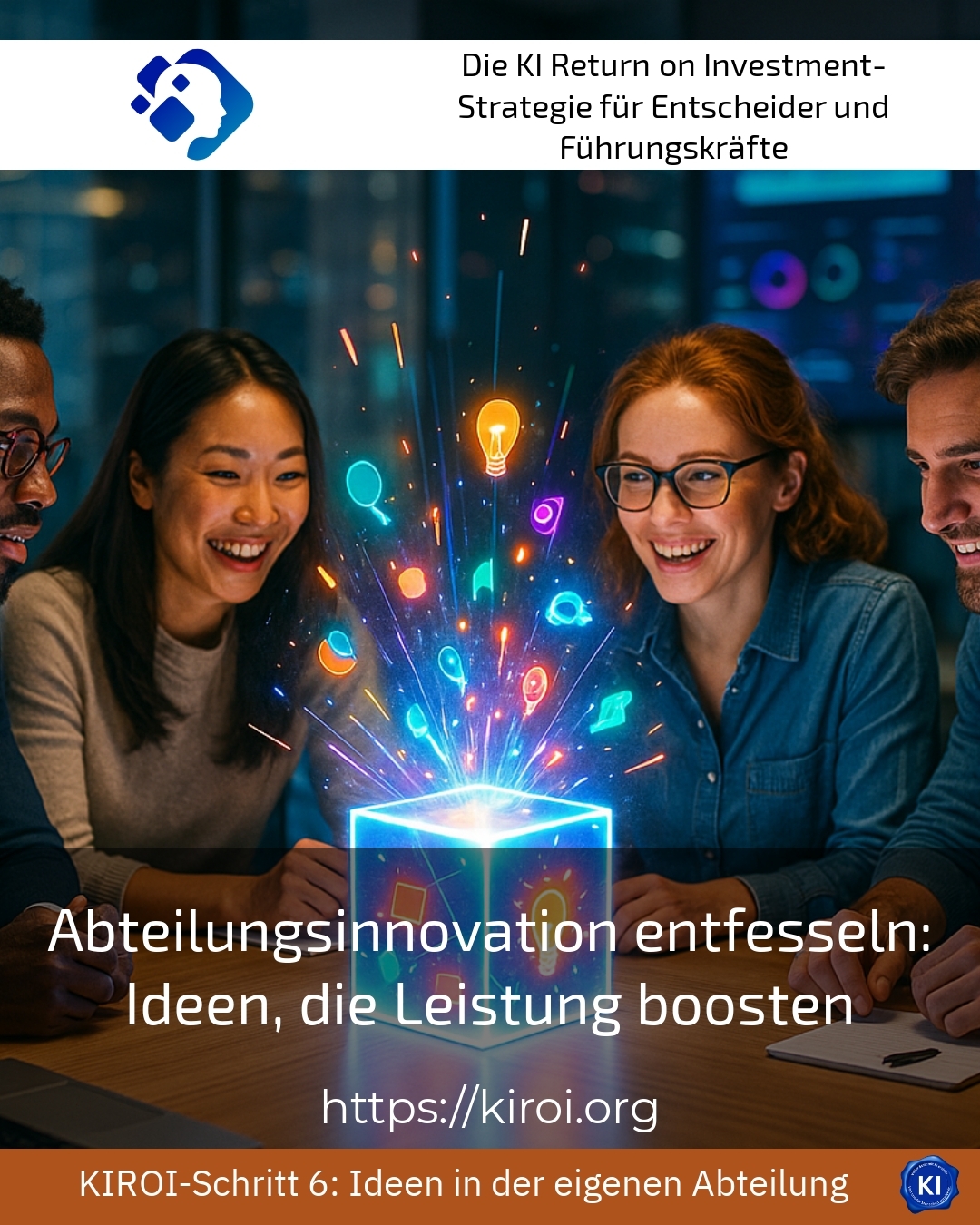
Have you ever wondered why some teams seem to effortlessly move from success to success while others, despite enormous efforts, stagnate and fail to realize their potential? The answer often lies in an area that many leaders underestimate, even though it is the cornerstone of sustainable competitiveness: the systematic promotion of creative processes within existing structures that we call Unleashing departmental innovation: ideas that boost performance In an economy that is changing at an astonishing pace, it is no longer enough to continue with established methods and rely on proven strategies; today’s stagnation is tomorrow’s regression, and that is precisely why more and more organizations are looking for ways to activate and sustainably strengthen their internal innovation capabilities.
Recognize the hidden potential in your teams
In almost every organizational unit, there lie untapped reserves of creativity and problem-solving skills that are only waiting to be awakened and channeled. The biggest challenge lies in creating the right framework conditions so that these potentials can actually be realized. Clients often report that their employees do indeed have innovative ideas, but for various reasons they do not bring them forward, whether it is because hierarchical structures make this difficult, because there is a lack of time in day-to-day operations, or simply because the appropriate communication channels do not exist. The art lies in creating spaces where new ideas are welcome and valued, without disrupting operational operations or endangering important processes.
For example, a medium-sized company in the manufacturing sector implemented regular brainstorming workshops where employees from all levels of the hierarchy come together to work on improvement proposals. This initially met with skepticism, but within a few months led to measurable efficiency increases. Another example is a service company that introduced digital platforms through which employees can submit suggestions at any time, with the best ideas being rewarded and implemented promptly, which significantly increased motivation. Furthermore, there are organizations that have appointed so-called innovation ambassadors whose task is to gather and evaluate creative ideas and to accompany their implementation so that good ideas do not get lost in the sand.
Best practice with a AIROI customer
An international manufacturing company approached us because the rate of innovation in several key departments had stagnated for years, and the management felt that valuable ideas remained untapped. As part of a transruptive coaching process, we analyzed the existing communication structures together and identified several bottlenecks that hindered the flow of ideas, including rigid hierarchies, a lack of time budgets for creative work, and a corporate culture that more often sanctioned mistakes than viewed them as learning opportunities. We supported the company over a period of six months and initially conducted moderated innovation circles in which employees from different departments came together to discuss cross-departmental challenges and jointly develop solutions. In parallel, we trained leadership in innovative communication and established a transparent system for evaluating ideas that ensured that every proposal received immediate feedback. The results significantly exceeded expectations, as more than thirty concrete improvement proposals were implemented within the first year, leading to measurable cost savings and quality improvements, and employee satisfaction in the affected departments increased significantly.
Unleashing departmental innovation through cultural change
Creating an innovation-friendly culture is a long-term process that requires patience, consistency, and a clear commitment from the leadership level, with many organizations underestimating how profound the necessary changes can be and how much resistance they may have to overcome. It is not about holding occasional brainstorming sessions or hanging up a corkboard; rather, it is about fundamentally rethinking and, if necessary, redesigning the way people collaborate, communicate, and make decisions. Often, clients report that they initially start with small pilot projects to gather experience and convince skeptics of the benefits before implementing more comprehensive measures.
For example, a business company introduced so-called Failure Fridays, where teams openly discuss failed projects and together analyze what lessons can be learned; this significantly reduced the fear of mistakes and increased risk-taking. Another example comes from the healthcare sector, where a clinic formed interdisciplinary innovation teams that meet regularly to develop and implement process improvements, with the results immediately improving patient service. Additionally, financial service providers have established innovation labs where new technologies and business models are tested before being rolled out to regular operations, significantly accelerating market maturity.
Ideas that boost performance: methods and tools
Choosing the right methods and tools plays a crucial role in whether innovative approaches actually lead to measurable improvements in performance or remain merely well-intentioned declarations of intent that do not bring anyone any further. Design Thinking, for example, offers a structured framework for developing user-centric solutions, while agile methods like Scrum or Kanban help quickly prototype ideas and iteratively improve them. Furthermore, digital collaboration tools can facilitate the exchange and ensure that valuable ideas are not lost, even when team members work in different locations or have different working hours.
For example, a logistics company used crowdsourcing platforms to collect and evaluate ideas from employees from all its branches; the best suggestions were rewarded with attractive incentives, which significantly increased participation [1]. A technology company, on the other hand, implemented regular hackathons where teams developed innovative prototypes within a few days, some of which were later developed into successful products [2]. Finally, there are consulting firms that pursue so-called open innovation approaches and involve external partners, customers, or even competitors in their development processes to benefit from different perspectives [3].
Unleashing the role of leadership in department innovation
Without the active support and role model function of leaders, most innovation initiatives remain ineffective because employees closely observe whether the management lives up to the proclaimed values or merely issues lip service. Leaders must be willing to relinquish control, allow for experimentation, and accept failures as part of the learning process, which presents a significant challenge for many. Clients often report that they had to work on their own attitude first before they could encourage their teams to be more creative and self-motivated, and that this personal development process was often more demanding than expected.
A family-run food company reports that the CEO initially participated in an innovation workshop himself to learn about the methods and appreciate their value before implementing them across the entire company. Another example is a software company whose leadership team regularly spends time with the development teams to understand their challenges and work together to find solutions, which significantly improved trust and collaboration. Additionally, there are organizations in the public sector that have developed specialized training programs for executives to prepare them for their new role as innovators.
Best practice with a AIROI customer
A medium-sized engineering company sought guidance because the management team, while calling for innovation, was unknowingly blocking it through their own behavior, leading to frustration and declining motivation in the specialist departments. As part of our transruptive coaching approach, we first conducted detailed discussions with management at various levels and identified several behaviors that hindered innovation, including excessive control, short-term focus on success, and a lack of tolerance for failure. Together, we developed a customized leadership development program that included both knowledge dissemination and practical exercises and regular reflection sessions, with particular emphasis on developing a coaching attitude. The leaders learned how to encourage their teams to take risks and try new approaches without losing the necessary guidance and security. After about nine months, initial significant changes were evident, as employees reported a more open atmosphere, and the number of submitted improvement proposals increased by more than three times, while at the same time the implementation rate increased significantly.
Measurable results through structured innovation processes
To be sustainably successful, innovation activities must be embedded in structured processes that enable systematic idea generation, evaluation, prioritization, and implementation; otherwise, there is a risk that good ideas will be lost in day-to-day operations or fail due to lack of resources. The implementation of an innovation management system can help create transparency and ensure that promising ideas receive the attention they deserve and that progress is continuously tracked and communicated. Clients often report that the introduction of clearer processes initially faced resistance because some employees feared that this would restrict creativity, but in the end it was shown that the opposite was true.
For example, an insurance company developed a multi-stage funnel process where ideas are first collected, then evaluated by an expert panel, and finally tested in pilot projects before being scaled up [4]. A media company, however, uses a decentralized approach where each department receives its own innovation budget and can decide for itself which projects it pursues, which strengthens self-responsibility. Additionally, there are manufacturing companies that have closely linked their innovation activities with the continuous improvement process, so that small and large improvements are equally systematically recorded and implemented.
My AIROI Analysis
The intensive engagement with the topic Unleashing departmental innovation: ideas that boost performance It clearly shows that successful organizations do not leave innovation to chance but promote it consciously and systematically, while maintaining the necessary flexibility to respond to unforeseen developments. The examples from various industries illustrate that there is no one-size-fits-all approach; each organization must find its own approach that suits the existing culture, available resources, and specific challenges. What all successful cases have in common is a clear commitment from leadership, a culture that understands experimentation and mistakes as learning opportunities, and structured processes that ensure that good ideas do not get lost.
From my perspective as a facilitator of transformation projects, I can confirm that the greatest success is achieved when organizations are willing to question fundamental assumptions and to address uncomfortable changes. It is important not to aim for too much at once but to start with manageable pilot projects, gather experience, and gradually expand the measures. Transruptive coaching can provide valuable insights and help identify and overcome obstacles that are often difficult to see from the inside. Ultimately, the goal is to become a learning organization that continuously develops and thus remains competitive in the long term, although the path to achieving this is challenging but also extraordinarily rewarding.
Further links from the text above:
[1] Harvard Business Review – Innovation Insights
[2] McKinsey – The Eight Essentials of Innovation
[3] Forbes – Innovation Coverage
[4] BCG – Innovation Strategy and Delivery
For more information and if you have any questions, please contact Contact us or read more blog posts on the topic Artificial intelligence here.









 Deutsch
 English (UK)