
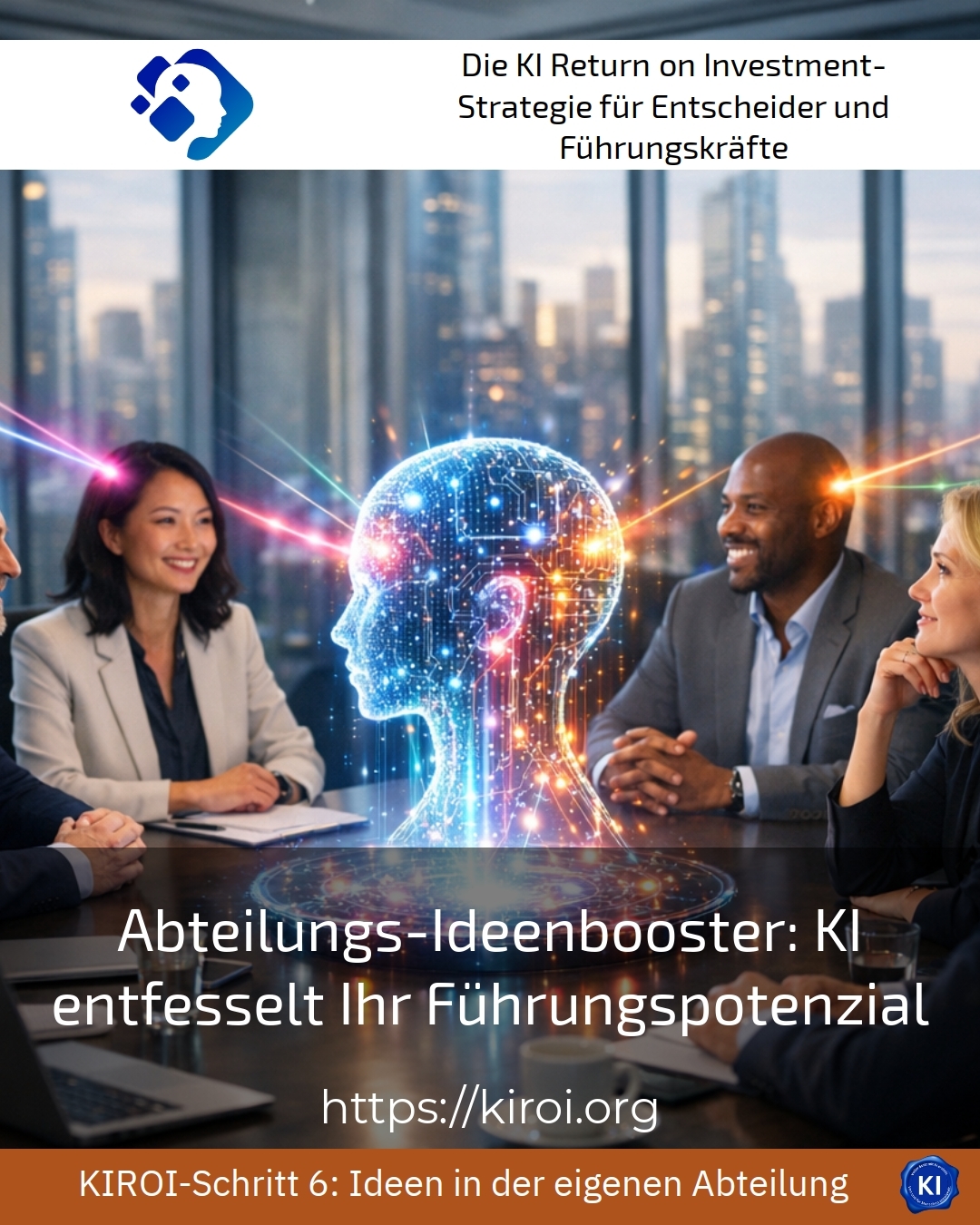
Do you sometimes wonder why some teams in companies are literally bursting with innovation potential, while others persist in routines and never reach their full potential? The answer often lies not in the lack of talent among employees, but in the way leadership stimulates, accompanies, and sustainably embeds creative processes. Departmental Idea Booster: AI unleashes your leadership potential describes a paradigm shift that is causing a stir in knowledge-intensive organizations. Modern technologies help activate latent resources. They help teams grow beyond conventional mindsets. In this article, you will learn what concrete impulses digital assistants can provide. You will also learn how transruptive coaching can support you as a guide in projects related to innovative leadership approaches.
Why traditional leadership models are reaching their limits
The working world has fundamentally changed in recent years. Classic hierarchies only work to a limited extent in dynamic environments. Employees today expect involvement, transparency, and meaningful tasks. Leaders face the challenge of simultaneously thinking strategically and being operational. This double burden often leads to creative impulses being sidelined. In many departments, daily business and routine tasks dominate the workday. There simply isn’t enough time for genuine innovation work. This is where intelligent systems come in, capable of taking on repetitive tasks.
A medium-sized manufacturing company in the mechanical engineering sector recently reported similar experiences. Department heads spent up to 60 percent of their working time on administrative tasks. There was little room for strategic considerations. After the introduction of automated reporting systems, this situation changed noticeably. The time gained flowed into team discussions and creative workshops. Another example comes from the financial sector, where compliance requirements impose enormous demands on capacity. There, progressive teams are now using intelligent analysis tools for document review. This frees up employees to focus more on customer relationships and innovative product ideas. Similar developments are also evident in the healthcare sector, where nurses are relieved of administrative tasks through digital documentation assistants.
The Department Ideas Booster: AI unleashes your leadership potential in everyday work
When we talk about intelligent assistance systems, many people immediately think of chatbots or automated email responses. However, this idea is far too limited. Modern systems analyze complex data streams, recognize patterns, and generate actionable recommendations. They can help executives make informed decisions faster. At the same time, they create spaces for interpersonal interactions. Because one thing remains indispensable: the human component in leadership.
In retail, innovative store managers are already relying on forecasting systems for personnel planning. These tools take into account weather data, local events, and historical sales figures alike. The resulting deployment plans save time and significantly improve employee satisfaction. In the field of software development, team leaders use algorithmic support for task distribution. The system recognizes the strengths of individual developers and suggests optimal team compositions. In the logistics industry, intelligent systems analyze supply chains and identify potential bottlenecks early on. This enables management to act proactively rather than merely responding to problems.
Best practice with a AIROI customer
An internationally operating automotive supplier approached us with a special challenge that many companies in this industry will be familiar with. The innovation cycles became increasingly shorter while at the same time the cost pressure continuously increased. The department heads in R&D felt completely torn between these opposing requirements. In joint workshops, we first analyzed the existing workflows and identified areas with optimization potential. It turned out that a significant portion of the working time was spent searching for existing solutions within the company. Knowledge management did not work across departments, which is why teams often reinvented the wheel. We supported the implementation of an intelligent knowledge management system that combined relevant information from various sources. The management team gained a completely new overview of existing competencies and completed projects. After six months, the department heads involved reported on a noticeable change in team dynamics. The employees brought more ideas to the table because they could access relevant knowledge more quickly. The role of the management team changed from an information disseminator to a true innovation coach.
Practical application areas for the Department Ideas Booster: AI unleashes your leadership potential
The applications of intelligent systems in leadership are diverse and relevant across industries. In human resources, algorithmic analyses support the identification of individual employees’ development potential. This provides leaders with valuable insights for individual development measures and career paths. In project management, predictive tools help realistically assess time schedules and resource requirements. Historical data from comparable projects is incorporated into the calculation.
A marketing agency recently implemented a system for automated mood analysis in team communication. Executives received anonymized feedback on potential conflicts or declining motivation. This allowed them to seek out conversations early on and address issues. In the field of technical maintenance, shift supervisors use predictive analysis systems for machine monitoring. Instead of responding to outages, they proactively plan maintenance work. This reduces stress and creates planning certainty for the entire team. In the insurance industry, intelligent systems analyze customer inquiries and prioritize complex cases automatically. Team leaders are thus able to allocate their capacities much more efficiently across the various task areas.
Human leadership and technological support in harmony
Despite all the enthusiasm for technological possibilities, one must not forget one thing: leadership remains at its core a human task. Algorithms can recognize patterns and make recommendations. However, the actual decision-making, the empathetic conversation, and the motivating presentation remain reserved for human leaders. It is this combination that makes the difference between successful and less successful teams.
Many clients report in our accompaniment processes about initial concerns about technological support. They feared a dehumanization of their leadership work or a loss of control over important decisions. However, this perspective fundamentally changed over the course of our joint work. Technology was increasingly perceived as a tool that creates more time for real leadership tasks. A production manager from the food industry put it aptly: The numbers now come from the machine, but the conversations are still led by me. In the education sector, school principals use intelligent systems for lesson planning. This saves time for pedagogical conversations with teachers. A chief physician reported on similar experiences in her clinic, where administrative relief led to more intensive team leadership.
Transruptions coaching as a support in the transformation process
The introduction of new technologies in leadership processes rarely happens overnight. Rather, it is a transformation process that deserves professional support. Transruptive coaching positions itself here as support for projects involving the redesign of leadership roles. We provide guidance, accompany critical phases, and help develop individual solutions.
An energy provider came to us with the challenge of transforming several departments simultaneously to new ways of working. The management needed not only technical knowledge but also emotional support in the change process. In the pharmaceutical industry, we supported a research team in integrating analytical systems into their innovation processes. The scientists had to learn to understand algorithmic suggestions as inspiration rather than as constraints. At a telecommunications company, we supported the introduction of intelligent customer service systems [1]. The team leaders developed completely new competencies in collaboration between humans and technology.
Best practice with a AIROI customer
A medium-sized retail company with multiple locations faced the challenge of fundamentally modernizing its leadership culture. The traditional structures no longer met the expectations of the younger generation of employees. At the same time, the experienced executives should not be overwhelmed. In the joint analysis, we first identified the biggest pain points in the leadership day-to-day. These included inefficient meetings, a lack of information flow, and unclear decision-making processes. We developed a phased introduction plan for various support tools that took into account the individual needs of the departments. The purchasing department began with automated market analyses, while the marketing team introduced intelligent campaign planning. Particularly important was the mentoring of the executives during the transition phase through regular reflection sessions. After a year, the managers involved reported a significantly increased level of job satisfaction in their teams. Turnover decreased measurably, while the number of improvement proposals submitted by the workforce increased significantly. The company transformed from a traditional employer into an attractive innovation partner for its employees.
Common topics in our support work
The target groups that come to us bring different challenges with them. Often, clients report feeling overwhelmed by the multitude of available technological options. They don’t know where to start or which tools truly suit their situation. Others come with specific implementation problems because established systems do not deliver the expected results. Some executives seek support in change management because their teams are skeptical about the change.
In the construction industry, we accompanied a project manager whose team boycotted the new planning tools [2]. The employees feared that the systems would monitor their performance. Together, we developed a communication strategy that created transparency and built trust. In the banking sector, we supported a department manager in restructuring her leadership role. The automated processing of standard requests fundamentally changed the entire scope of her team’s tasks. A hotel manager approached us because he wanted to adapt his leadership style to the changing expectations of guests. Intelligent analysis systems provided him with new insights into customer needs and employee performance.
Departmental Idea Booster: AI sustainably unleashes your leadership potential
The sustainable embedding of new working methods requires more than just the introduction of technical systems. It involves a cultural change that must be supported by the entire organization. Leaders play a key role as role models and multipliers. They must take advantage of the new opportunities themselves and be able to authentically communicate their benefits.
A media company established regular innovation rounds in which executives exchanged their experiences with new tools. These peer-learning formats proved extremely effective in spreading successful practices. In the chemical sector, a company introduced a mentoring program in which technically-oriented younger employees accompanied experienced executives. The cross-generational collaboration enriched both parties and promoted knowledge transfer. A municipality in southern Germany modernized its administration with intelligent citizen services [3]. The municipal managers had to learn to redefine their leadership role in an increasingly digitalized environment.
My AIROI Analysis
Integrating intelligent systems into leadership work represents one of the most significant development steps of recent years. This is not about replacing human leaders; rather, it is about empowering them to perform more strategically and creatively. Technology takes on repetitive and data-intensive tasks, while people can focus on relationship building and fostering innovation.
From my experience in guiding numerous transformation projects, several success factors emerge. First, a realistic assessment of the current situation is needed, without excessive expectations of quick results. Second, involving employees from the outset is crucial for accepting new work methods. Third, leaders need sufficient space to experiment and learn, without immediate pressure to achieve success.
The companies that invest in the further development of their leadership culture today will be the most attractive employers tomorrow. Talented professionals are looking for environments in which they can optimally apply their skills. Intelligent support systems contribute to creating such environments. They relieve them of tedious routine and open up spaces for meaningful work. At the same time, they allow leaders to fulfill their true mission: to inspire, develop, and together achieve the extraordinary.
Further links from the text above:
[1] Bitkom – Artificial Intelligence in Companies
[2] Haufe – Change management in practice
[3] BMWK – Digitization in Germany
For more information and if you have any questions, please contact Contact us or read more blog posts on the topic Artificial intelligence here.







 Deutsch
 English (UK)