
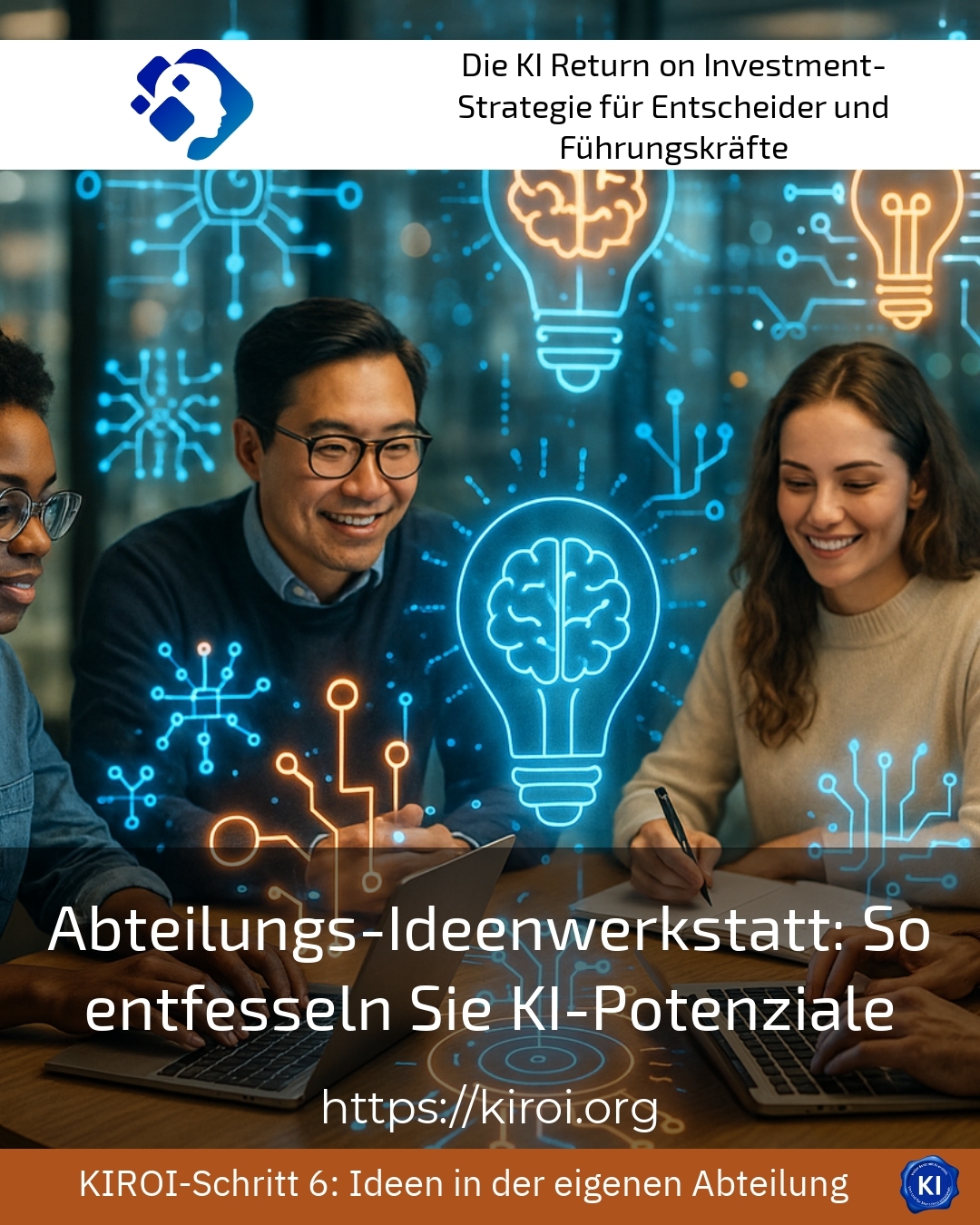
Imagine your employees suddenly develop ideas that could revolutionise your company. Departmental ideation workshop makes exactly that possible, transforming hidden creativity into measurable innovation. While many organisations still hesitate, forward-thinking leaders are already discovering the enormous potential that lies dormant within their teams. But how can this energy be channelled and systematically harnessed? This post shows you concrete ways, using structured approaches and intelligent technologies, to transform your departments into true centres of innovation.
Why traditional innovation processes often fail
Many companies invest considerable sums in innovation departments and external consultants. Nevertheless, managers frequently report disappointing results and a lack of implementation of their ideas [1]. The problem often lies not in a lack of will, but in unsuitable structures and processes. Traditional top-down approaches often ignore the valuable knowledge of employees at the grassroots level. These people know the daily challenges and have often already developed sound solution proposals. However, they frequently lack a suitable forum to systematically contribute these ideas.
Another obstacle is the lack of networking between different departments. Silo thinking prevents the valuable exchange of perspectives and experiences. This results in duplicated work and missed synergies, costing the company time and resources. The Departmental ideation workshop This is exactly where it starts, creating spaces for cross-departmental collaboration. Transruption coaching supports organisations in developing appropriate structures and processes.
The fundamental principles of a successful departmental idea workshop
An effective ideation workshop is based on several fundamental principles that must be consistently implemented. Firstly, it requires a culture of psychological safety, where employees can experiment without fear of negative consequences. This atmosphere does not arise spontaneously but requires conscious action from leadership. Additionally, participants need clear frameworks and sufficient time for creative work. Regular time slots in the daily work routine signal the company's appreciation for innovative ideas.
Another important element is the systematic documentation and further processing of the generated ideas [2]. Many workshops fail because brilliant ideas are forgotten after the event. Intelligent digital tools can provide valuable support here and help to categorise, prioritise and track the implementation of ideas. This technological support enables a sustainable innovation culture that extends beyond individual events.
Best practice with a AIROI customer
A medium-sized manufacturing company approached us with a clear challenge. Management reported stagnant innovation despite a highly qualified workforce and motivated teams. As part of the transruption coaching, we jointly developed a tailor-made concept for an interdepartmental ideas workshop. First, we analysed the existing communication structures and identified critical bottlenecks in the flow of information. We then established monthly innovation rounds with representatives from production, sales, quality assurance, and development. Participants received an introduction to creative methods and the use of digital tools for idea generation. After just three months, the company reported a significant increase in submitted suggestions for improvement. Particularly noteworthy was the high quality of the ideas, which often involved multiple departments and offered holistic solutions. Management also reported improved collaboration and a strengthened sense of community among employees.
Intelligent technologies as a catalyst for creative processes
Modern technologies are opening up entirely new possibilities for shaping innovation processes within companies. For example, machine learning can analyse large amounts of customer feedback and recognise patterns that would remain hidden to human observers. These insights provide valuable impetus for the work in the idea workshop and stimulate new approaches to solutions. Likewise, voice-based assistance systems can take over the documentation of brainstorming sessions and automatically create summaries.
Another exciting application area is the automated evaluation and categorisation of ideas [3]. Intelligent systems can sort submitted suggestions according to various criteria and merge similar concepts. This creates clusters of related ideas that can be developed further together. This saves time and prevents promising approaches from being overlooked. At the same time, the technology enables a fair and transparent evaluation that minimises personal biases.
Practical examples of technology deployment in the departmental idea workshop
In the field of product development, teams use intelligent analysis tools to identify market trends early and integrate them into their planning. A manufacturer of industrial components used such systems to anticipate customer needs and develop suitable solutions. The sales department of a service company used text-based analyses to identify common customer inquiries and derive new service offerings. In human resources, digital assistants support the development of innovative recruiting strategies and employee programmes.
Intelligent tools are increasingly being used in the financial sector to generate new business models. Controllers are using automated analyses to identify cost drivers and uncover savings potential. The IT department of a medium-sized company developed an innovative security concept with the help of technological support. In marketing, intelligent data analysis is leading to personalised campaigns that target customers more precisely.
The role of leaders in establishing innovation structures
Leaders bear a crucial responsibility for the success of an idea workshop within their area of responsibility. Firstly, they must act as role models themselves and demonstrate an open attitude towards new ideas. This also means viewing mistakes as learning opportunities and dealing constructively with failed experiments. Additionally, they should actively provide resources and integrate time for creative work into the daily routine.
A common theme that leaders come to us with is uncertainty in dealing with new technologies [4]. Many feel overwhelmed by the multitude of available tools and their constant evolution. Transruption coaching can provide valuable impetus here and support the selection of suitable solutions. Experience shows that a step-by-step introduction with a clear focus on specific use cases is most successful. This builds trust in the new possibilities without overwhelming the organisation.
Best practice with a AIROI customer
A senior executive from the banking sector sought our guidance in transforming their department into a more innovative working environment. The team comprised experienced professionals, some of whom were sceptical about technological innovations. Together, we developed a sensitive approach that took their concerns seriously and gradually built trust. Initially, we jointly identified specific pain points in the daily workflow with the employees that were suitable for improvement. Subsequently, we introduced easy-to-use digital tools that offered immediate work simplifications and enabled positive experiences. The regular innovation workshop sessions were facilitated by an experienced moderator who introduced creative methods and inclusively involved all voices. After six months, participants reported increased job satisfaction and improved team cohesion. The executive was able to implement several innovative process improvements that delivered measurable efficiency gains. Particularly valuable was the changed attitude of the employees towards change and new technologies.
Methods for activating all team members in the departmental ideation workshop
A successful ideation workshop thrives on the active participation of all attendees, regardless of their position or experience. Silent brainstorming also enables introverted personalities to contribute their thoughts without having to assert themselves against dominant voices. With this method, all participants first jot down their ideas silently before they are collected and discussed together. This leads to a greater diversity of perspectives and less group-conformist thinking.
Edward de Bono's Six Thinking Hats method has also proven to be an effective tool [5]. In this method, participants consider a topic one after another from different predefined perspectives. A logistics company successfully used this technique to develop new delivery concepts, taking all relevant aspects into account. A healthcare provider applied the method to analyse and improve patient processes from various perspectives. An educational provider used the thinking hats to design innovative learning formats for different target groups.
Overcoming obstacles and creating sustainable structures
On the path to an established innovation culture, organisations typically encounter various obstacles and resistance. Clients frequently report time pressure in day-to-day operations, which pushes creative work into the background. Others struggle with a lack of support from senior management or unclear responsibilities when implementing ideas. These challenges are normal and can be overcome with the right strategies.
A tried-and-tested approach is to make small successes visible and celebrate them. When employees experience that their ideas are taken seriously and implemented, their motivation for further involvement increases. A retail company introduced a monthly innovation award that recognised particularly creative suggestions. A technology company established an internal communication format that regularly reported on implemented employee ideas. A craft business incorporated the presentation of new ideas into weekly team meetings as a fixed agenda item.
Digital tools for continuous idea generation
Modern platforms enable the continuous collection and further development of ideas between the in-person sessions of the idea workshop. Digital idea boards allow employees to submit suggestions at any time and comment on others' contributions. Gamification elements such as point systems and leaderboards can further increase participation and encourage playful competition. Automated notifications keep all participants informed about progress and ensure transparency.
An insurance company implemented such a system and saw a significant increase in idea submissions within a few months. An energy provider used the platform to collect and further develop sustainability suggestions. A media company linked the digital idea management with its existing project management system for seamless implementation. This technological integration significantly speeds up the path from idea to realisation.
My AIROI Analysis
The systematic establishment of a departmental idea workshop represents a promising approach to unlocking an organisation's full innovation potential. My analysis shows that success is significantly dependent on the combination of several factors that need to be carefully coordinated. Firstly, authentic support from management is required, which must manifest in concrete resources and time. Without this clear commitment, even the best methods and tools will remain ineffective.
Furthermore, the intelligent integration of modern technologies proves to be a significant success factor for sustainable innovation structures. However, these tools should never be an end in themselves, but should be used specifically to support human creativity and collaboration. Experience from numerous support projects shows that a step-by-step approach with a clear focus on specific use cases achieves the best results. Organisations that actively involve their employees and take their concerns seriously develop a viable innovation culture.
The combination of structured innovation processes with professional support through transruption coaching is particularly valuable. This combination allows for individual challenges to be addressed and tailor-made solutions to be developed. The future belongs to those organisations that manage to systematically utilise and continuously develop the collective knowledge of their employees. The departmental idea workshop offers a proven framework for this, which can produce extraordinary results with the right impulses and tools.
Further links from the text above:
[1] Harvard Business Review – Innovation Management
[2] McKinsey – The Eight Essentials of Innovation
[3] Gartner – Artificial Intelligence Insights
[4] Forbes – Leadership and Innovation
[5] De Bono Group – Six Thinking Hats Method
For more information and if you have any questions, please contact Contact us or read more blog posts on the topic Artificial intelligence here.







 Deutsch
  English (UK)