
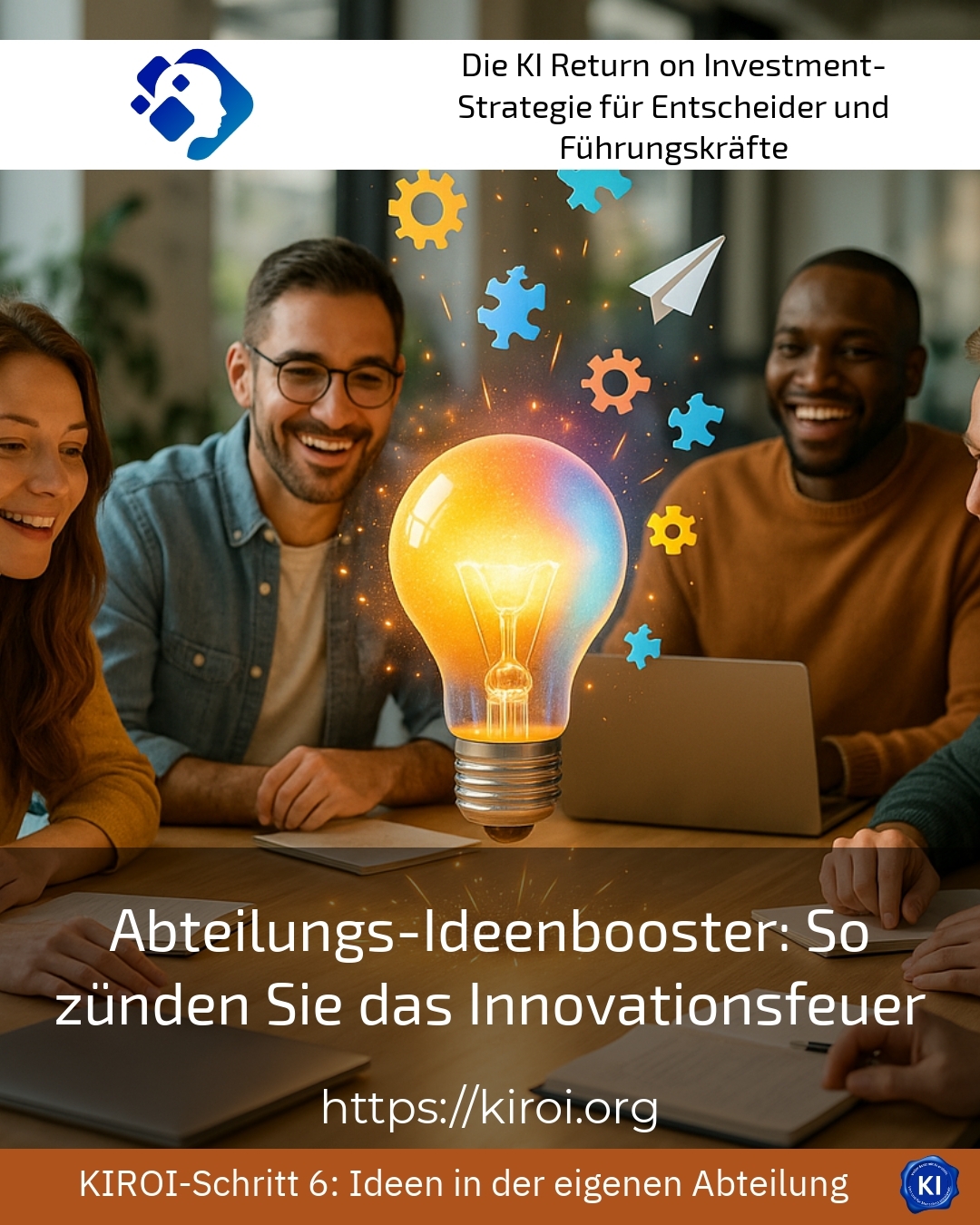
Imagine your department turning into a seething idea factory where creative sparks fly and groundbreaking concepts emerge. The Departmental Idea Booster is not abstract wishful thinking, but a tangible methodology that can inspire teams at all levels. Many managers and team members come to me with the same concern: they want more momentum in their processes and are looking for ways to break through entrenched thought patterns. The good news is that every department has the potential to become a source of innovation if the right stimuli are provided.
Why the Departmental Idea Booster Has Become Indispensable
The working world is in a state of permanent change, requiring ever faster adaptations and challenging traditional structures. Companies that fail to activate their internal creative reserves run the risk of being overtaken by more agile competitors. This is long since no longer just about large research departments or specialised development teams, but about every single area of an organisation. Accounting can contribute valuable suggestions for improvement just as well as marketing or logistics. Clients frequently report that it is precisely the unexpected impulses from supposedly non-creative peripheral areas that trigger the most sustainable changes.
For example, a medium-sized manufacturing company in southern Germany was faced with the challenge of optimising its production processes [1]. The solution did not come from external consultants, but from the quality assurance employees themselves. Over a period of months, they had gathered observations and independently developed a proposal for the redesign of the inspection processes. Another example can be found in a large insurance group that completely restructured its claims management. The decisive ideas came from case handlers who were confronted with the challenges on a daily basis. A traditional family-run business in mechanical engineering was also able to expand its product range through internal idea competitions. These examples impressively demonstrate that innovation does not have to be the privilege of certain departments.
Best practice with a AIROI customer
An internationally operating logistics service provider approached us because internal communication between the various locations was increasingly faltering and creative suggestions were getting lost within the hierarchical levels. Employees felt unheard and increasingly retreated into their routine tasks. As part of a transruption coaching programme, we supported the company in implementing a digital ideas platform while simultaneously raising managers' awareness of appreciative feedback cultures. Within six months, over three hundred suggestions for improvement were received, more than forty of which were implemented directly. The savings resulting from optimised routes and more efficient warehouse processes significantly exceeded the investment costs in the very first quarter following implementation. However, what was particularly remarkable was the increased employee satisfaction, which was clearly reflected in the regular surveys. This project impressively illustrates how structured guidance can support transformative processes.
The psychological foundations of creative team dynamics
Creativity rarely occurs in a vacuum, but rather requires specific framework conditions that must be actively shaped by corporate management [2]. Psychological safety plays a central role here, because employees will only express unconventional thoughts if they do not fear negative consequences. An open error culture fosters a willingness to experiment and enables teams to test even daring hypotheses. Studies show that diverse groups tend to develop more innovative solutions than homogeneous teams. These insights can be applied directly to the design of workshops and brainstorming sessions.
For example, a well-known technology company in Silicon Valley has introduced so-called failure parties, where failed projects are celebrated instead of being hidden. This practice sends a strong signal to all employees and encourages bolder pushes for innovation. A Scandinavian furniture retailer also relies on similar principles and regularly hosts cross-departmental creative days. At a German automotive supplier, on the other hand, so-called reverse mentoring programmes have been established, in which younger employees pass on their expertise to experienced managers. Such measures break down ingrained hierarchies and open up new perspectives for everyone involved.
The department idea booster as a structured methodology
Successful idea development requires more than good intentions and demands a well-thought-out structure that channels creativity rather than restricting it. The process ideally begins with a thorough analysis of existing workflows and an honest stocktake of current challenges. Targeted impulses are then introduced that open up new directions of thinking and question entrenched patterns. Facilitating such processes requires tact and experience, which is why many companies rely on external support. Transruption coaching can provide valuable assistance in this regard, as it brings both methodological competence and an impartial external perspective.
For example, a medium-sized pharmaceutical supplier used design thinking workshops to fundamentally rethink its packaging solutions. The results exceeded all expectations and led to several patentable new developments. At a large energy provider, on the other hand, hackathons were introduced where mixed teams had to develop prototypes within 48 hours. A long-established publishing house also relied on innovative formats, organising regular futures workshops for its editorial teams. These different approaches show that there is no single correct method, but rather various paths that can lead to the goal.
Digital tools as amplifiers of creativity
Digital transformation opens up entirely new possibilities for collaborative idea development and enables spatially distributed teams to work creatively together [3]. Virtual whiteboards, brainstorming apps and AI-supported idea generators can significantly enrich the creative process. In doing so, these tools by no means replace human interaction, but rather complement it with additional dimensions. The choice of the right tools depends heavily on the corporate culture and specific requirements. Above all, it is important that the technology supports the process rather than dominating it.
For example, an international consultancy firm uses a special platform where employees worldwide can submit and evaluate ideas. The best proposals are automatically forwarded to the relevant decision-makers and are guaranteed to receive feedback. In the case of a large retail group, on the other hand, an AI-powered system was implemented that analyses customer feedback and generates innovation impulses from it. An up-and-coming start-up in the fintech sector also uses advanced analysis tools to identify market trends at an early stage and align internal development projects accordingly. These examples illustrate the enormous potential of digital support for innovative processes.
Best practice with a AIROI customer
A long-established trading company with several thousand employees was going through a difficult transitional phase and was looking for ways to get the entire organisation enthusiastic about digital transformation. The management recognised that change can only succeed if all departments are actively involved and allowed to make their own contributions. As part of our support, we jointly developed a multi-stage programme that linked the departmental idea booster with digital collaboration tools. First, so-called innovation ambassadors were appointed in each department to act as multipliers and raise awareness among their colleagues regarding the new possibilities. Subsequently, cross-departmental workshops were held to address specific challenges and develop initial solution approaches. The results were documented on a central platform and could be commented on and further developed by all employees. After one year, the company not only recorded measurable efficiency gains, but also a significantly improved corporate culture. Employees felt more involved and identified more strongly with the company's goals.
Sustainable anchoring of the departmental idea booster
One-off bursts of creativity often fizzle out without effect if they are not translated into lasting structures. The sustainable embedding of innovative practices requires continuous attention and regular nurturing. Leaders play a crucial role in this, as their behaviour significantly shapes the corporate culture. The connection between idea generation and concrete implementation is also important so that employees experience that their suggestions actually make an impact. Regular feedback loops and transparent communication regarding the status of ideas strengthen trust in the entire process.
For example, a large telecommunications company has firmly anchored quarterly innovation days in its calendar and set aside dedicated budgets for this purpose. This continuity signals to all involved that creative thinking is not a flash in the pan, but has a permanent place in the company. At a medium-sized software firm, on the other hand, so-called innovation time slots have been introduced during which employees are allowed to work on their own projects. A renowned financial services provider also relies on structured idea management processes that are firmly integrated into annual target agreements. These examples show that sustainable change is possible when appropriate framework conditions are created.
My AIROI Analysis
The intensive examination of the various facets of promoting organisational creativity impressively demonstrates the potential that lies dormant in most companies, waiting to be awakened. The systematic approach that I pursue in my consulting practice combines proven methods with innovative digital tools, while always taking into account the individual circumstances of each organisation. It has repeatedly been confirmed that sustainable change only succeeds when all levels of hierarchy are involved and authentically support the change. The examples from various industries illustrate that there are no ready-made solutions, but rather that every company must find its own way.
I find the insight particularly important that creativity is not a luxury good for good times, but can become the decisive competitive advantage precisely in challenging phases. The combination of psychological safety, well-thought-out structures and technological support creates optimal conditions for innovative breakthroughs. Transruption coaching can provide valuable impetus and accompany organisations on their transformation journey without delivering ready-made recipes. Instead, it is about activating existing resources and unlocking dormant potential. Anyone who is willing to question ingrained thinking patterns and venture down new paths will very likely be positively surprised by the creative power that lies within their own teams.
Further links from the text above:
[1] Harvard Business Review – Innovation Topics
[2] Psychology Today – The Basics of Creativity
[3] McKinsey – The Eight Essentials of Innovation
For more information and if you have any questions, please contact Contact us or read more blog posts on the topic Artificial intelligence here.






 Deutsch
 English (UK)