
Have you ever wondered why some teams seem to effortlessly develop ground-breaking ideas, while others tread water despite enormous efforts and the creative potential of their employees remains completely untapped?
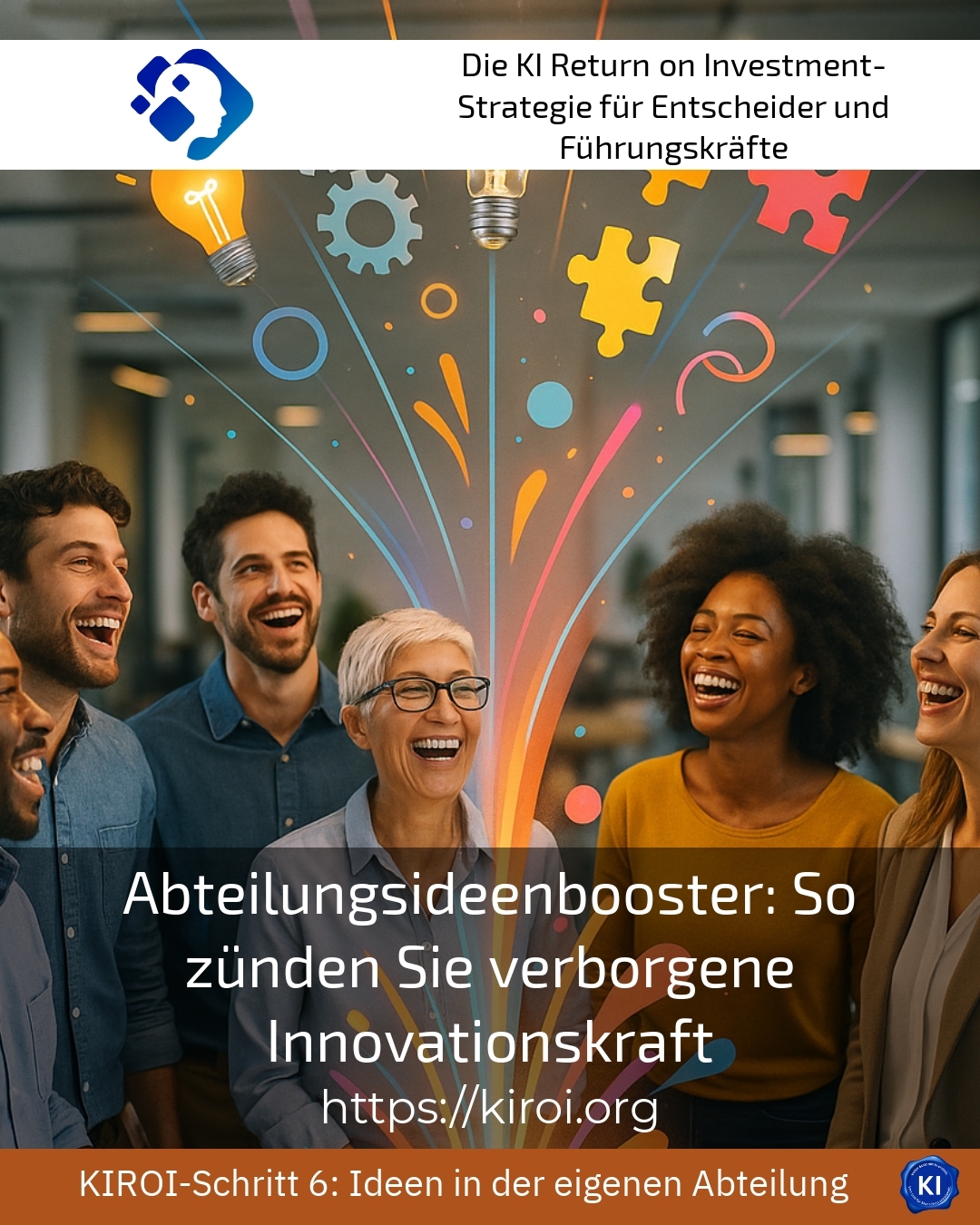
This question occupies leaders and organisational developers worldwide, because the answer to it often decides the long-term success of a company. The Departmental idea booster represents an effective approach that systematically activates hidden innovative power and empowers teams to unlock their full creative potential. In my many years of supporting transformation processes, I repeatedly experience how departments transition from a passive stance to active drivers of innovation through targeted impulses. It consistently becomes apparent that the best ideas are often already slumbering in the minds of the employees – they merely require the right framework to come to light.
Why traditional methods frequently fail
Many organisations still rely on traditional approaches when it comes to fostering innovation. They organise isolated brainstorming sessions, set up suggestion boxes or run sporadic workshops. However, these measures rarely generate sustainable change because they do not address the deeper structural barriers. In the automotive industry, for example, clients frequently report rigid hierarchies that block the free flow of ideas. In healthcare, on the other hand, we often observe that immense time pressure stifles creative thinking in the bud. And in the financial sector, many employees experience how risk aversion prevents any unconventional idea from even emerging.
Another common problem is that while leaders demand innovation, they simultaneously penalise mistakes. This contradiction creates uncertainty and reluctance among employees. The consequence is a climate of caution in which nobody wants to take the risk of standing out with an unusual idea. In the logistics sector, for example, teams repeatedly describe how innovative proposals for route optimisation or warehousing go unheard. In retail, on the other hand, creative concepts for customer experiences often fail due to bureaucratic decision-making processes. These patterns repeat themselves across industries and highlight the need for systematic change.
The department idea booster as a structured approach
The Departmental idea booster differs fundamentally from one-off creativity measures because it creates a holistic framework. This framework encompasses cultural as well as procedural and technological elements. First of all, it is about establishing psychological safety within the team. Employees must feel that their ideas are welcome and taken seriously. In the telecommunications industry, for example, a client has created an atmosphere through regular open dialogue sessions in which even critical suggestions are heard. In mechanical engineering, on the other hand, we have seen how the introduction of cross-departmental creativity circles has led to a significant increase in usable ideas. Similar effects can be seen in the pharmaceutical industry when teams are systematically given the freedom to think experimentally.
Furthermore, networking within the organisation plays a crucial role. Isolated departments often develop solutions that already exist elsewhere or fail at interfaces. An effective idea booster therefore promotes continuous exchange between different areas. In the energy sector, clients report remarkable synergy effects when technicians and sales staff work together on innovation projects. In the insurance industry, on the other hand, the best product ideas often emerge when claims handlers and marketing experts bring their different perspectives together.
Best practice with a AIROI customer
A medium-sized manufacturing company approached us with the challenge that, despite highly qualified employees, hardly any innovative process improvements were emerging. The management team had the impression that the teams were stuck in routines and the potential for further development remained untapped. As part of our support, we first analysed the existing communication structures and identified several bottlenecks that were hindering the flow of ideas. We introduced a format where employees from different production areas came together once a month to discuss current challenges. In doing so, we provided impulses for creative problem-solving techniques and moderated the exchange. Within a few months, a vibrant innovation culture emerged in which employees proactively contributed suggestions for improvement. It was particularly noteworthy that experienced specialists and younger colleagues learned from one another and jointly developed solutions that neither would have found alone. The management team reported a noticeably increased level of motivation and personal responsibility within the teams, which was also reflected in measurable increases in productivity.
Psychological Safety as a Foundation
Without a foundation of psychological safety, all further measures remain ineffective. Employees must be able to trust that their contributions are valued. They need to know that mistakes are viewed as opportunities for learning rather than as failures. In the media sector, for example, it repeatedly becomes apparent that creative teams become conservative under pressure. They resort to tried-and-tested formats instead of venturing into new territory. In the construction industry, on the other hand, we experience that innovative approaches for sustainable building often fail due to internal resistance. And in the hospitality industry, head chefs report that strict hierarchies make creative experiments difficult.
Leaders bear a special responsibility for creating this safe framework. They should actively ask for dissenting opinions and value them. They should openly address their own mistakes and thus model vulnerability. And they should ensure that critical voices are not silenced. In the education sector, for example, we observe that schools with an open error culture are significantly more innovative in developing new teaching formats. In the social economy, on the other hand, participatory concepts succeed best when employees can freely express their concerns.
Practical tools for the department idea booster
The implementation of an effective Departmental idea boosterconcept requires concrete tools and methods that prove effective in daily work. A particularly effective technique is the so-called perspective reversal, where teams consciously adopt the viewpoint of customers, competitors, or critics. In the hotel industry, we use this approach, for example, to identify service improvements. In the transport sector, on the other hand, the method helps to uncover weak points in the customer experience. In the IT industry too, teams report valuable insights through systematic changes of perspective [1].
Another proven tool is the time-limited innovation unit, in which teams are completely freed from operational tasks for a defined period. In the chemical industry, such formats have led to remarkable breakthroughs in the development of eco-friendly products. In retail, on the other hand, the most successful new business concepts often emerge during protected creative phases. And in the aviation sector, safety innovations are frequently developed during such focused phases [2].
The role of transruption coaching in innovation projects
As part of transruption coaching, we accompany teams in breaking through entrenched thought patterns and treading new paths. This guidance differs from traditional management consultancy because it focuses on sustainable empowerment rather than one-off solutions. We provide stimuli, ask the right questions, and create spaces for reflection. In the utility sector, for example, we experience how teams become pioneers in digitalisation through targeted process guidance. In the cultural sector, on the other hand, we support institutions in developing new communication formats. And in agriculture, we accompany businesses in integrating innovative technologies.
Best practice with a AIROI customer
A facility management service provider approached us with the request to strengthen the innovative capacity of its regional teams. Head office had noticed that local branches hardly developed any ideas of their own and instead passively waited for instructions. Together with the management level, we developed a multi-stage programme tailored to the specific needs of the organisation. We began with workshops to raise awareness of innovation topics and then introduced regular virtual exchange formats between the locations. The teams learned from each other and inspired one another to adopt new approaches. A special focus was placed on recognising and showcasing successful initiatives, which created a positive competition for the best ideas. After several months of support, the regional managers reported a significantly increased level of personal initiative among their staff. Suggestions for improving efficiency and increasing customer satisfaction were regularly submitted and implemented. The company eventually established its own internal innovation format, which continues to be successfully run to this day and continuously generates valuable ideas.
Sustainable embedding of an innovation culture
The biggest challenge with Departmental idea booster is to anchor the achieved changes permanently. After initial enthusiasm, many organisations experience a relapse into old patterns. To counteract this, we recommend integrating innovation rituals into the daily routine. In the textile industry, for example, we have observed how short weekly brainstorming meetings remain effective in the long term. In the healthcare sector, on the other hand, monthly innovation rounds in which new treatment approaches are discussed have proven successful. And in the events industry, creative morning meetings are establishing themselves as an integral part of the work culture [3].
Furthermore, it is important to make successes visible and to celebrate them. When employees experience that their ideas are actually implemented and have an impact, motivation for further participation increases significantly. In the gaming industry, for example, successful innovations are communicated internally and those who submitted the ideas are recognised. In the trades, on the other hand, master craftsmen create incentives for creative suggestions for improvement. And in the advertising industry, groundbreaking concepts are taken as an opportunity for team-wide recognition.
My AIROI Analysis
Following my intensive examination of the subject and my diverse experience in supporting transformation processes, I have arrived at a differentiated assessment. The systematic approach to activating innovation potential within departments represents an important lever for organisational development. However, many managers underestimate the effort required for sustainable embedding. It is not enough to run occasional workshops or introduce tools. Rather, it requires persistence and the willingness to question fundamental structures. Psychological safety as a foundation deserves special attention here, as it is frequently neglected. Organisations that take this aspect seriously usually achieve significantly better results. My observations also show that sector-specific adjustments are crucial for success. What works in the creative industries cannot be transferred one-to-one to the manufacturing sector. Therefore, I always recommend a careful analysis of the specific framework conditions before implementing concrete measures. Ultimately, it is about empowering people and creating spaces where creative thinking can flourish. The technical and procedural aspects are important, but they remain secondary to the cultural dimension.
Further links from the text above:
[1] Harvard Business Review – Innovation Insights
[2] McKinsey – The Eight Essentials of Innovation
[3] Forbes – Innovation Section
For more information and if you have any questions, please contact Contact us or read more blog posts on the topic Artificial intelligence here.







 Deutsch
 English (UK)