
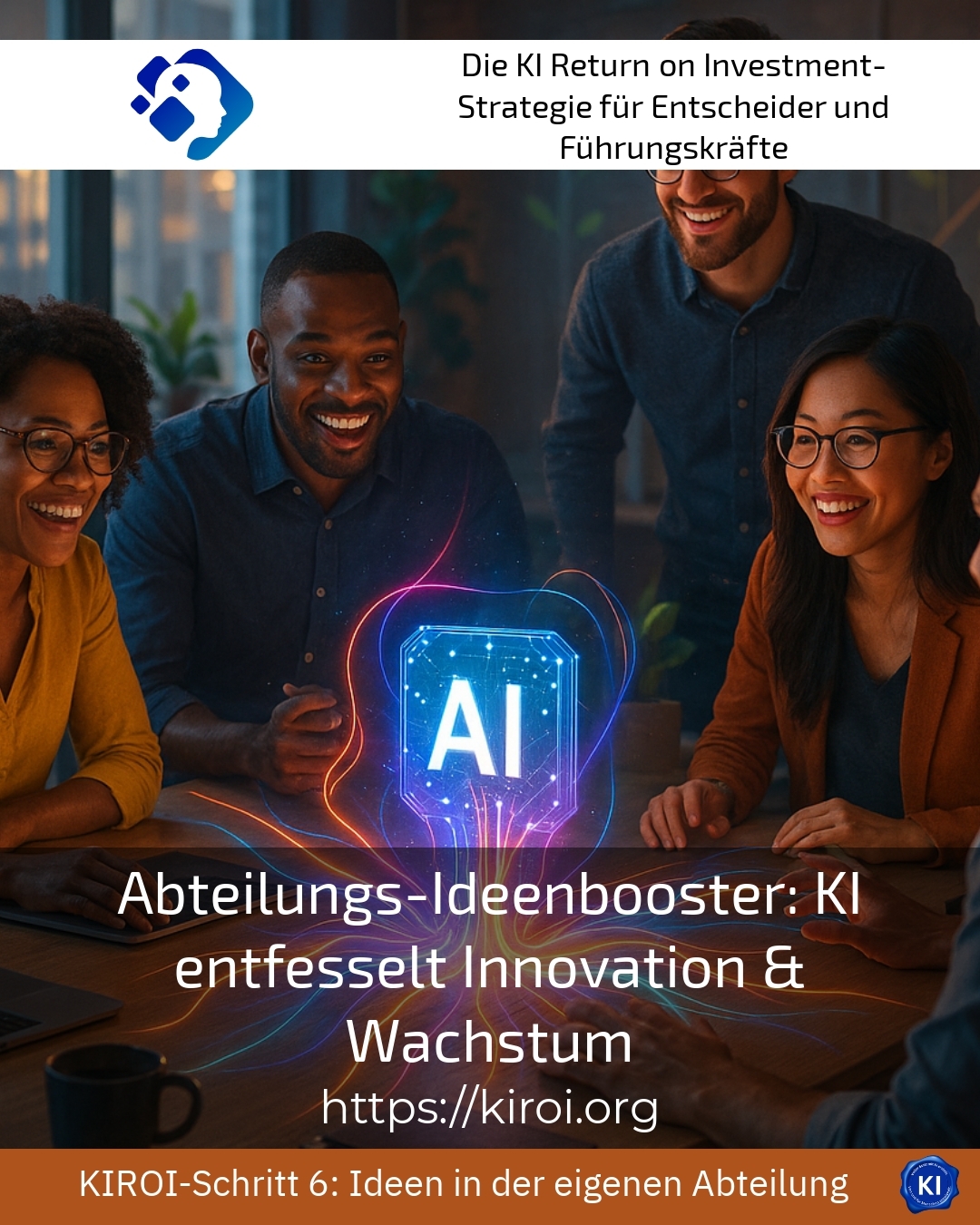
Imagine your department transforms into an innovation hub, continuously producing fresh ideas whilst intelligently utilising resources. The Departmental Idea Booster: AI Unleashes Innovation & Growth precisely describes this transformation process that sustainably changes companies. Many executives report stagnating processes and exhausted teams that, despite enormous efforts, no longer develop groundbreaking concepts. We know this challenge very well from numerous consulting discussions. However, the good news is that intelligent technologies can serve as a catalyst for creative thinking today. They support teams in unleashing hidden potentials and breaking new ground.
Why traditional brainstorming often reaches its limits
In many companies, brainstorming sessions repeat themselves following the same patterns, with the same voices dominating and similar suggestions emerging. The classic Post-it wall certainly has its merits, but it rarely captures the full spectrum of possible solutions. Teams often unconsciously develop mental blocks because past experiences limit their perspective. Furthermore, time pressure in modern work environments leaves little room for in-depth reflection.
For example, a medium-sized logistics company had been struggling with inefficient warehouse processes for years without achieving sustainable improvements. The employees were well aware of the problems but could find no innovative ways out of the entrenched structures. A retail group experienced something similar when developing new customer service concepts, as all suggestions followed known patterns. A financial service provider also told us about recurring innovation workshops that ultimately only produced marginal adjustments.
These examples clearly show that the problem isn't a lack of motivation, but rather a lack of external stimuli. The Departmental Idea Booster: AI Unleashes Innovation & Growth sets in precisely at this point. It provides the fresh perspectives that inspire human creativity and open up new ways of thinking.
Intelligent systems as sparring partners for creative processes
Modern algorithms analyse datasets that would simply be unmanageable for humans, recognising patterns and correlations in the process. These insights can be used by teams as a starting point for innovation processes, with the machine never replacing the human. Rather, it functions as a sparring partner that asks unusual questions and highlights blind spots.
An insurance company successfully used this approach to identify entirely new product categories that no one had previously considered. The technology analysed customer requests, uncovering unmet needs that served as a basis for innovation. A mechanical engineering company, in turn, used intelligent systems to fundamentally rethink maintenance concepts and develop proactive service models. A healthcare provider also benefited significantly when the analysis of patient feedback revealed innovative care approaches.
Best practice with a AIROI customer
A long-established family business in the manufacturing sector approached us with a specific request. The innovation department had not developed any marketable new products for several years, even though the team was working with high motivation. As part of our Transruptions Coaching, we supported the management team in integrating intelligent analysis tools into their idea-generation processes. The technology systematically scanned market data, patent databases, and customer feedback. In doing so, it identified several niche markets that the company had previously completely overlooked. Employees received these findings as a basis for discussion and, within a few weeks, developed three promising product concepts from them. Particularly noteworthy was the changed dynamic in meetings, as suddenly all participants were arguing on the same knowledge base. The Transruptions Coaching helped to integrate the new tools meaningfully into existing workflows without generating resistance. Today, the company reports a noticeably increased enthusiasm for innovation throughout the entire workforce.
The Departmental Idea Booster: AI Unleashes Innovation & Growth in Practice
The practical implementation requires more than just purchasing appropriate software, because technical solutions alone do not bring about cultural change. Teams must learn to critically question the generated impulses and link them to their own experiences. This process is particularly successful when managers act as role models and demonstrate openness to new approaches.
A telecommunications provider extensively trained its project managers in the use of data-driven innovation methods, which significantly improved the quality of the results [1]. An automotive supplier, in turn, set up special innovation labs where teams could experiment without fear of failure. An energy provider also reported positive experiences after assembling mixed teams of experienced employees and digitally affine junior staff.
Overcoming resistance and creating acceptance
We frequently encounter concerns in consultation meetings regarding the role of humans in the creative process. Employees fear that intelligent systems could devalue their expertise or even make them redundant. We take these worries very seriously because they can significantly influence the success of any transformation.
However, experience shows that well-supported change processes can resolve these fears. A pharmaceutical company invested considerable resources in training and workshops to bring all stakeholders on board. A media group focused on voluntary pilot groups that acted as internal ambassadors for new ways of working. A retail company, in turn, communicated transparently about the goals and limits of technological support.
In all these cases, the support of transruption coaching proved to be a crucial success factor. The external perspective helped to resolve entrenched discussions and initiate constructive dialogues [2].
Concrete impetus for different departments
Different business areas benefit in various ways from intelligent innovation tools. For example, marketing departments use them to develop surprising campaign concepts that stand out from the crowd. Product development teams receive insights into features that customers want but haven't yet articulated. HR departments, in turn, discover innovative approaches to employee retention and talent development.
A consumer goods manufacturer completely revolutionised its product launch strategy after the analysis of consumer data revealed surprising preference patterns. An IT service provider developed novel service models because technology identified gaps in the existing offering. A construction company significantly optimised its project planning through predictive analyses of potential risk factors.
Best practice with a AIROI customer
A sales department within an international industrial company was struggling with stagnant sales figures in several core markets. The decision-makers were looking for fresh approaches to tap into new customer groups and deepen existing relationships. As part of our support, we integrated intelligent analytical tools into the department's strategic planning. The systems systematically examined market movements, competitor activities, and customer behaviour. This process revealed several previously overlooked market segments that showed considerable potential. Based on this, the sales team developed innovative engagement strategies that significantly deviated from previous patterns. The transruptions coaching continuously supported this process and helped overcome initial scepticism from individual team members. The technology's ability to assess the probability of success for different strategies proved particularly valuable. After six months, the department recorded significant growth in all markets served for the first time in years.
Sustainable integration into existing structures
Long-term success depends crucially on how well new methods are integrated into everyday work. Isolated pilot projects rarely bring about sustainable change because they are often perceived as special initiatives. Instead, gradual integration is recommended, which carefully expands and improves existing processes.
A technology group established weekly innovation rounds in which data-driven insights were systematically discussed [3]. A service company linked its quality management processes with intelligent suggestions for improvement. A food manufacturer integrated the new way of working directly into its product development cycles.
The Departmental Idea Booster: AI Unleashes Innovation & Growth unfolds its full potential only when it has become an integral part of the company culture. This transformation process requires patience, perseverance, and professional support from experienced partners.
My AIROI Analysis
Observations from numerous projects clearly show that intelligent systems can meaningfully complement, rather than replace, human creativity. Companies adopting this approach often report a noticeably increased dynamic of innovation within their teams. Technical aspects play an important, but by no means the sole, role in the overall process.
More crucial for success, however, is the cultural readiness to accept new impulses and develop them constructively. Leaders bear a special responsibility here, as they must act as role models and enablers. The integration of transruption coaching has proven to be valuable support in many cases.
The analysis also shows that gradual approaches often have a more sustainable effect than radical upheaval. Teams need time to build trust in new tools and to fully unlock their potential. Patience and consistent support pay off in the long term.
In conclusion, it can be stated that the Departmental Idea Booster: AI Unleashes Innovation & Growth significant opportunities for businesses across all sectors. The technology provides valuable impetus, but people always remain at the centre of all creative processes. Finding and maintaining this balance represents the real challenge.
Further links from the text above:
[1] McKinsey Digital – The Economic Potential of Generative AI
[2] Harvard Business Review – Management of Innovation
[3] Gartner – Artificial Intelligence Research and Insights
For more information and if you have any questions, please contact Contact us or read more blog posts on the topic Artificial intelligence here.











 Deutsch
  English (UK)