
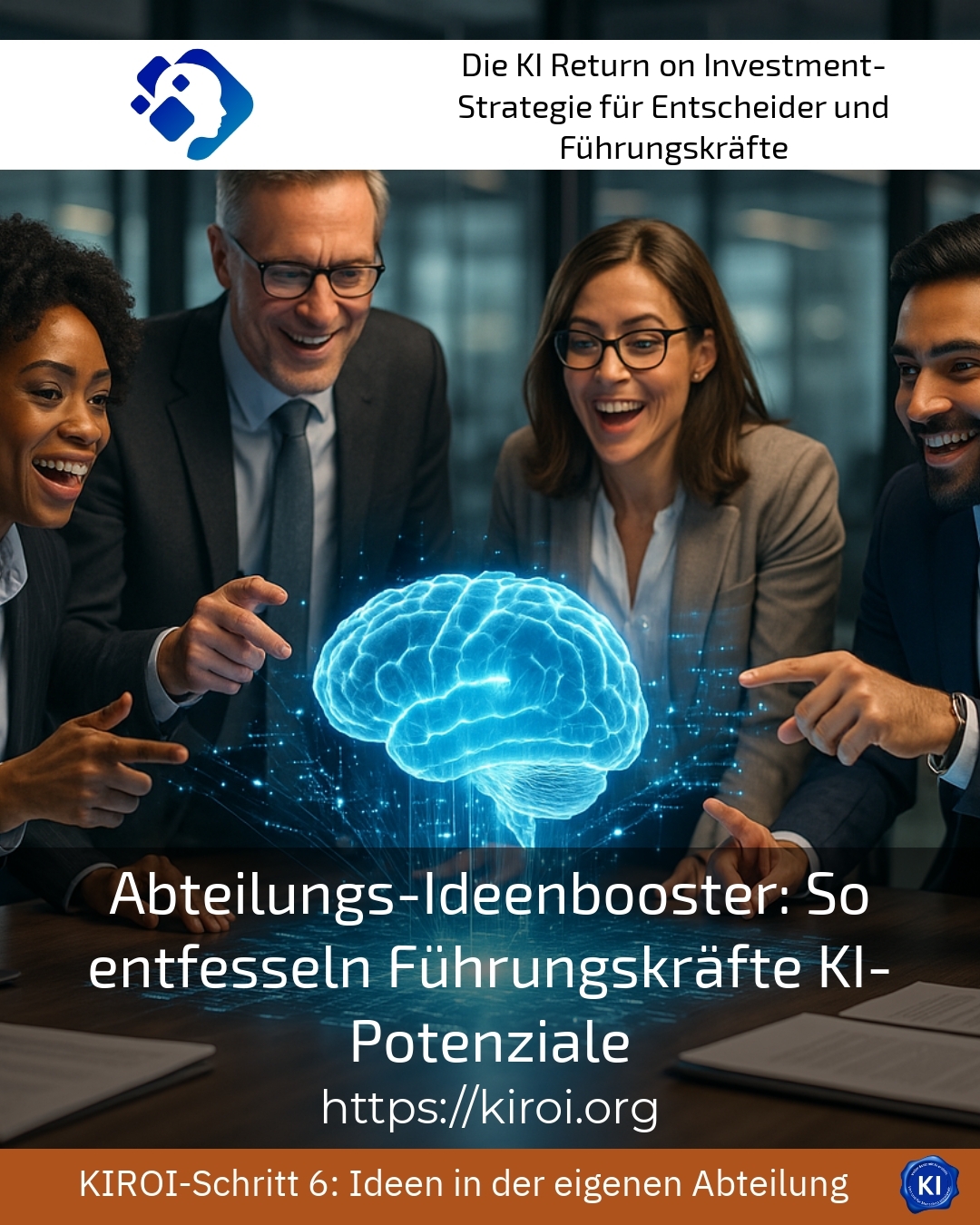
Imagine your department developing more innovative concepts in a few weeks than in the entire past year combined. The Departmental Idea Booster makes exactly that possible by giving managers the tools to systematically unlock the latent potential of artificial intelligence and make it usable for their own area of responsibility. Many decision-makers report feeling overwhelmed by the rapid pace of technological development and not knowing where to start. But herein lies the great opportunity, because those who set the right course now will reap the rewards of a well-thought-out strategy tomorrow. In this article, you will learn how, as a leader, you can unleash the creative forces of your team and which concrete steps will support you in doing so.
Why the department's idea booster is becoming indispensable right now
The world of work is undergoing a fundamental transformation, affecting all industries and departments. Leaders face the challenge of navigating their teams through this transformation while ensuring operational excellence. It is becoming increasingly clear that traditional management methods alone are no longer sufficient to remain competitive. The integration of intelligent systems into daily work opens up entirely new possibilities that go far beyond simple automation. Leaders often report that they desire more guidance and practical insights. A structured approach that combines creativity and technology offers precisely this support [1].
In the manufacturing industry, production managers are already experimenting with intelligent assistance systems that can predictively plan maintenance intervals. Retailers are using data-driven recommendation systems to create personalised shopping experiences. In healthcare, algorithm-based analysis tools are impressively supporting medical diagnostics. These examples show that the application possibilities are virtually limitless and every industry can benefit.
The Departmental Idea Booster as a Catalyst for Innovation
A systematic approach to idea generation fundamentally differentiates successful transformation projects from failed initiatives. The key lies in actively involving employees in the process and linking their specialist expertise with technological possibilities. This creates a powerful synergy that promotes innovation at all levels. A particularly effective method is the combination of structured workshops and continuous support from experienced experts. Transruptions-Coaching supports managers with precisely these projects and provides valuable impulses for implementation [2].
Logistics companies optimise their route planning using self-learning algorithms and save significant resources. Financial service providers rely on automated risk analyses that support and secure human decisions. Insurance companies accelerate their claims processing through intelligent document capture. Each of these examples shows how concrete the advantages can be felt in everyday life.
Best practice with a AIROI customer
A medium-sized manufacturing company approached the transruptions coaching team with a clear challenge. Department heads from various areas were working in silos and were barely utilising the potential of modern technologies for their daily tasks. As part of a three-month support programme, the management team jointly developed a concept that fundamentally changed cross-departmental collaboration. The teams first identified their biggest pain points and time sinks in operational business. Subsequently, in moderated idea workshops, they developed concrete solution approaches based on intelligent systems. The purchasing department implemented an automated supplier evaluation system that analysed historical data and made recommendations. Quality assurance introduced an image-based inspection system that detected errors early on. Sales now used a forecasting tool that predicted customer needs and improved consulting. After six months, the management team reported noticeably higher employee satisfaction and increased productivity. The investment fully paid for itself through efficiency gains within the first year.
Practical steps to unleash the departmental idea booster
The first step is to establish an open innovation culture within your department. Leaders should signal that new ideas are welcome and that experimentation is part of learning. This creates psychological safety and encourages employees to contribute creative suggestions. At the same time, it is important to create a structured framework for idea generation and evaluation. Regular innovation meetings can help to focus attention on forward-looking topics [3].
In customer service, companies rely on intelligent chatbots that handle simple queries autonomously. HR departments use automated systems to pre-filter applications and identify suitable candidates. Marketing teams analyse campaign data in real-time and dynamically adapt their strategies. These examples show that every department can benefit from technological support.
Taking employees along and overcoming resistance
Change naturally encounters scepticism and sometimes active resistance from the workforce. Leaders should take these concerns seriously and address them openly rather than ignore them. Transparent communication about goals, methods, and expected changes builds trust and promotes acceptance. It is particularly helpful to identify quick wins and celebrate early, visible successes. This way, even sceptical team members recognise the concrete benefits of the new approaches [4].
Banks are training their advisors in the use of AI-powered analytics tools and experiencing positive feedback. Craft businesses are digitalising their order processing and significantly reducing administrative effort. Educational institutions are integrating adaptive learning systems that adapt to individual student needs. In all these cases, the involvement of employees from the outset was crucial.
Transruption coaching helps leaders professionally guide these change processes. Clients frequently ask how to engage their teams with new technologies. Others seek ways to make their own processes more efficient without overwhelming employees. These concerns are addressed individually within the coaching process with tailored solutions.
Best practice with a AIROI customer
A leader from the service industry approached the coaching team with a specific concern. The order processing department was struggling with long lead times and frequent queries. In a collaborative process, the current workflow was first analysed in detail and bottlenecks were identified. The employees were involved from the outset and were able to contribute their experience. Together, the team developed a prototype for an intelligent assignment system that automatically categorised and prioritised incoming orders. The leader learned how to initiate and manage such projects independently in the future. Particularly valuable was the realisation that technical solutions are only successful if they are supported by people. After implementation, processing time decreased by thirty percent and customer satisfaction increased noticeably. Employees reported less stress and more enjoyment in their work. The project became a role model for other departments in the company and inspired further initiatives.
Strategic Positioning through the Departmental Idea Booster
Leaders who position their department as a driver of innovation not only strengthen their own standing within the company. They also create attractive working environments that attract and retain talented employees. The systematic use of intelligent technologies is increasingly becoming a differentiating factor in the competition for skilled workers. The aim is not to use technology for its own sake, but to create real added value. The Departmental Idea Booster helps to make precisely this connection [5].
Pharmaceutical companies significantly accelerate their research processes through intelligent literature analyses. Energy suppliers optimise their grid utilisation with predictive models and save costs. Media houses personalise their content based on user preferences and increase their reach. Each of these applications began with an idea that was systematically developed and implemented.
Sustainable embedding of innovation in everyday work
One-off initiatives often fizzle out without lasting impact, leaving teams frustrated. The key to success lies in the continuous integration of innovation processes into everyday work. Leaders should incorporate regular reflection loops and systematically document learnings. This creates a learning organisation that continuously develops and improves. Transruptions coaching provides impetus on how this embedding can be achieved.
Automotive suppliers are establishing weekly innovation rounds to discuss new technologies. Hotel chains are testing smart room controls and systematically collecting guest feedback for improvement. E-commerce companies are conducting continuous A/B tests and optimising their processes based on data. All these examples show that innovation is not a one-off project, but a permanent attitude.
My AIROI Analysis
Following intensive engagement with the topic, it becomes clear that the success of transformation projects is significantly dependent on the leadership culture. Technology alone changes nothing if people are not willing to break new ground and question old habits. The Departmental Idea Booster it only unfolds its full effect when leaders actively take on their role model function and demonstrate a willingness to learn. The realisation that even small pilot projects can trigger major changes is particularly impressive. Companies that experiment bravely and learn from mistakes develop more quickly and sustainably.
The AIROI methodology offers a structured framework to systematically guide and support this development. Viable solutions emerge from the combination of strategic analysis, practical implementation support, and continuous reflection. It is important that each organisation must find its own path, as there are no one-size-fits-all remedies. Individual circumstances, corporate cultures, and industry-specific factors demand tailored approaches. transruptions-Coaching supports leaders precisely with this demanding task, providing orientation in a complex world. The future belongs to those who have the courage today to dare something new and to take their teams along on this journey. With the right mindset and professional support, departments can become genuine innovation hubs that drive the entire company forward.
Further links from the text above:
[1] McKinsey Digital Insights – The Economic Potential of Generative AI
[2] transruptions-Coaching – Support for transformation projects
[3] Harvard Business Review – Innovation Topics
[4] Gartner AI Insights
[5] BCG – Artificial Intelligence Capabilities
For more information and if you have any questions, please contact Contact us or read more blog posts on the topic Artificial intelligence here.







 Deutsch
  English (UK)