
Why do so many companies drown in their own data volumes, when they are supposed to possess the most valuable asset of the digital age?
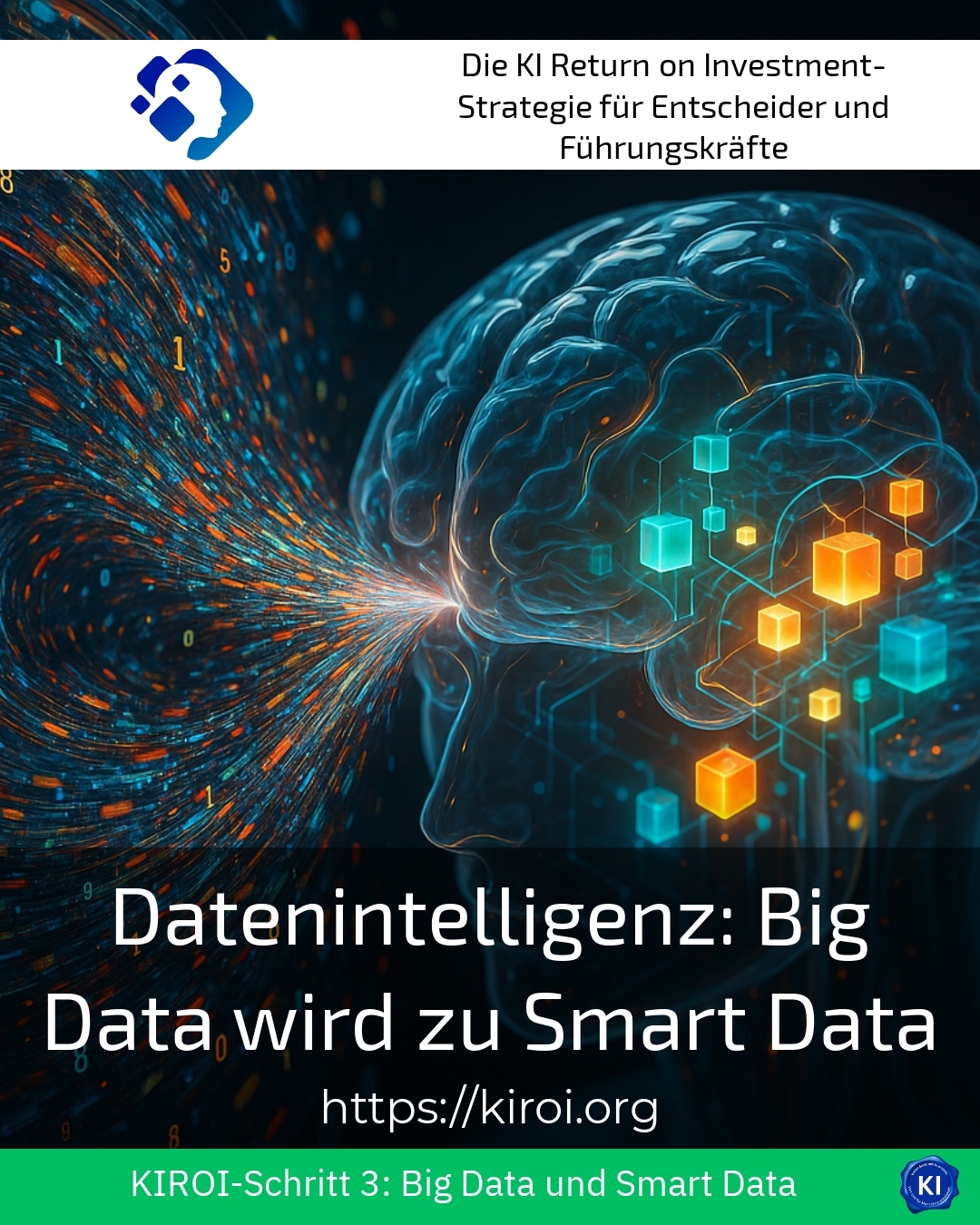
The transformation of Data intelligence: Big Data becomes smart data It employs executives and decision-makers worldwide. Countless organizations collect terabytes of information every day. Yet, only a few manage to generate real value from it. The mere accumulation of data is like raw diamond, which only becomes truly brilliant through masterful processing. In this article, you will learn how intelligent data processing revolutionizes business processes. Additionally, we highlight the challenges that await you in this process.
The evolution of data processing: From the mass to the class
The history of digital data processing began with the simple desire to store information. Early systems collected data without a major strategy. The only thing that mattered was the quantity. Today we know that this approach is not effective. Because the sheer volume of data overwhelms systems and people alike. Only intelligent filtering and linking create actionable insights.
Modern algorithms scan gigantic data sets in fractions of a second. They recognize patterns that remain hidden from the human eye. At the same time, they evaluate the relevance of individual information for specific questions. This transforms the data set into a structured knowledge landscape. This transformation fundamentally changes how companies make decisions.
Clients often report an initial level of overwhelm. The sheer volume of data available overwhelms many teams. Therefore, it is crucial to first define clear objectives. What questions should be answered? What processes can be optimized? This strategic groundwork determines the success of every data project.
Data intelligence: Big Data becomes Smart Data in practice
The practical implementation of intelligent data strategies requires more than just technical expertise. It requires a deep understanding of business processes and customer relationships. Successful projects combine technological capabilities with human expertise. In doing so, solutions are created that actually work in everyday life. The following examples illustrate the enormous potential.
Manufacturing companies use sensor data to proactively maintain their machines. Instead of performing maintenance at fixed intervals, service is provided based on actual needs. Predictive Maintenance significantly reduces downtime. At the same time, the costs of unnecessary maintenance are reduced. An intelligent system detects critical conditions before they lead to breakdowns.
Retail companies analyze purchasing behavior in real time. They detect trends before they reach the mass market. Personalized recommendations increase sales and customer satisfaction. Warehousing adapts dynamically to the forecasted demand. This way, retailers avoid both overstocking and shortages.
Service companies optimize their resource planning based on data. They detect peak workloads and capacity bottlenecks early. Employees are used more efficiently. Customers benefit from shorter waiting times. The quality of service improves measurably.
Best practice with a AIROI customer
A medium-sized manufacturing company with multiple production sites faced a formidable challenge, as the various plants operated with different data sources and systems, making a holistic analysis of the production processes practically impossible [1]. As part of a comprehensive transruptive coaching project, we supported the project team over several months in developing an integrated data strategy that connected all locations together and established a unified analysis platform. The biggest hurdle was not in the technical implementation but in convincing the various site managers, who initially feared their autonomy and expressed concerns regarding transparency. Through intensive workshops and clear communication of the benefits, it was possible to win over all stakeholders for the project and establish a culture of data-based collaboration, with the results proving to be impressive. Production efficiency was demonstrably increased by over fifteen percent, while the rejection rate significantly decreased and delivery reliability was raised to a new level. Today, the company also uses the insights gained for strategic decisions and views its data competence as a significant competitive advantage.
The technological foundation for intelligent data utilization
Without the right technical infrastructure, any data strategy remains theoretical. Modern cloud solutions offer flexible storage and computing capabilities [2]. They scale with the company’s requirements. At the same time, they enable access from different locations. The decentralization of IT resources creates new opportunities.
Machine learning forms the core of many data-driven applications. Algorithms train themselves based on historical data. They continuously improve their predictions. The more data available, the more precise the results become. This self-reinforcing effect makes AI systems particularly valuable.
Data visualization translates complex relationships into understandable graphics. Dashboards display relevant metrics at a glance. Decision-makers receive exactly the information they need. The processing is automated and in real time. This ensures that executives remain operationally capable at all times.
Challenges on the path to a data-driven organisation
The path to intelligent data utilization is rarely linear. Many organizations underestimate the cultural change that accompanies it. Data-based decisions require a change of mindset at all levels. Intuition and experience remain important, but are complemented by facts. Finding this balance is a leadership task.
Data quality often represents the biggest obstacle. Inaccurate, outdated, or incomplete data lead to false conclusions. Maintaining and cleaning up data sets consumes significant resources. Nevertheless, it is indispensable for reliable analyses. Automated validation processes can support this.
Data protection and compliance set clear limits. The processing of personal data is subject to strict regulations. Companies must communicate transparently about the data they collect and for what purposes [3]. Violations can lead to severe penalties. A well-thought-out data protection concept is therefore indispensable.
The shortage of skilled workers makes it difficult to implement ambitious data projects. Qualified data scientists are in high demand and therefore expensive. Therefore, many companies invest in the further training of their employees. External consulting can also bridge skills gaps. The right mix of internal and external expertise is crucial.
Data intelligence: Big Data becomes Smart Data as a competitive advantage
Companies that use their data intelligently gain significant advantages. They react faster to market changes. They recognize customer needs earlier. They continuously optimize their processes. This agility becomes the decisive success factor in volatile markets.
The personalization of products and services reaches a new level. Customers expect individual attention and tailored offers. Data-driven companies meet these expectations. They create unique customer experiences. Their customers’ loyalty increases accordingly.
Innovation processes also benefit from intelligent data analysis. Market research provides more precise insights. Product development takes place closer to the customer. Misjudgments are less likely to occur. The time-to-market is noticeably shortened.
Best practice with a AIROI customer
A logistics company with a European network struggled with inefficient routes and high empty run rates, which affected both profitability and the environmental footprint. There was an urgent need for action. The transruptions coaching accompanied the company in implementing an intelligent route planning that linked historical order data, current traffic information, and weather forecasts to calculate optimal routes and better utilize capacities. The challenge lay in integrating various data sources, as vehicle telematics, customer orders, and external information service providers used completely different formats and interfaces. Through a step-by-step approach and continuous feedback loops with the dispatchers, it was possible to develop a system that is both technically mature and practical and accepted by the employees. The results exceeded the original expectations significantly, as fuel consumption decreased by more than twenty percent, while at the same time more orders could be processed in shorter time and customer satisfaction increased due to improved delivery punctuality.
The human component: Why technology alone is not enough
Even the most advanced technology remains ineffective without competent people. Data analysts interpret results and provide recommendations for action. Leaders must understand and implement these findings. The entire workforce must recognize the value of data-based decisions. Only then can a true data culture be created.
Change management plays a central role in data projects. Resistance to change is natural and predictable. Transparent communication helps reduce fears. Successes should be made visible and celebrated. In this way, acceptance grows organically.
Training and further education enable employees to master new tools. Not everyone needs to become a data expert. But a basic understanding of data-based work is helpful. It enables constructive collaboration with specialists. This creates interdisciplinary teams that create real added value.
Strategic decisions for sustainable success
A well-thought-out data strategy begins with the business strategy. What are the company’s goals? What data is relevant for these goals? How can these be collected and analyzed? These questions must be answered before any technical decision is made.
Prioritizing application cases prevents overwork. Not all ideas can be implemented simultaneously. Pilot projects with manageable risk provide valuable experience. They lay the foundation for more ambitious endeavors. An iterative approach has proven effective.
Partnerships and ecosystems expand one’s own capabilities. Hardly any company possesses all the necessary competencies. Specialized service providers complement the internal team. Platforms enable the exchange of data and insights [4]. Cooperation often overcomes isolation.
My AIROI Analysis
Transforming raw data into usable intelligence is one of the most significant challenges of our time, and it affects companies of all industries and sizes alike. In my long-standing consulting practice, I have observed that technological hurdles are rarely the real problem, because modern tools are powerful and increasingly user-friendly. The real stumbling blocks lie in organization, culture, and leadership, because working with data requires a fundamental rethinking. Many companies start with great ambitions, but lose focus when rapid successes fail to materialize or resistance arises. Therefore, I always recommend a pragmatic approach that begins with clearly defined, manageable projects and gradually expands them. Close involvement of all stakeholders from the very beginning is essential, because only those who understand the benefits will bear the burden of change and actively shape it. The role of external support is not to provide ready-made solutions, but to provide inspiration, uncover blind spots, and constructively manage the process. Clients often report that it is this external perspective that has enabled crucial turning points, because internal dynamics and established mindsets have been broken down. The future belongs to organizations that not only collect data but also understand and utilize it. The path to achieving this is challenging, but with the right support it is certainly possible.
Further links from the text above:
[1] Bitkom: Data and analysis in the economy
[2] Gartner: Cloud Computing Insights
[3] Datenschutz.org: Information about the GDPR
[4] Accenture: Artificial Intelligence and Data Analysis
For more information and if you have any questions, please contact Contact us or read more blog posts on the topic Artificial intelligence here.









 Deutsch
 English (UK)