
Why do so many executives drown in data floods, even though they are actually looking for guidance?
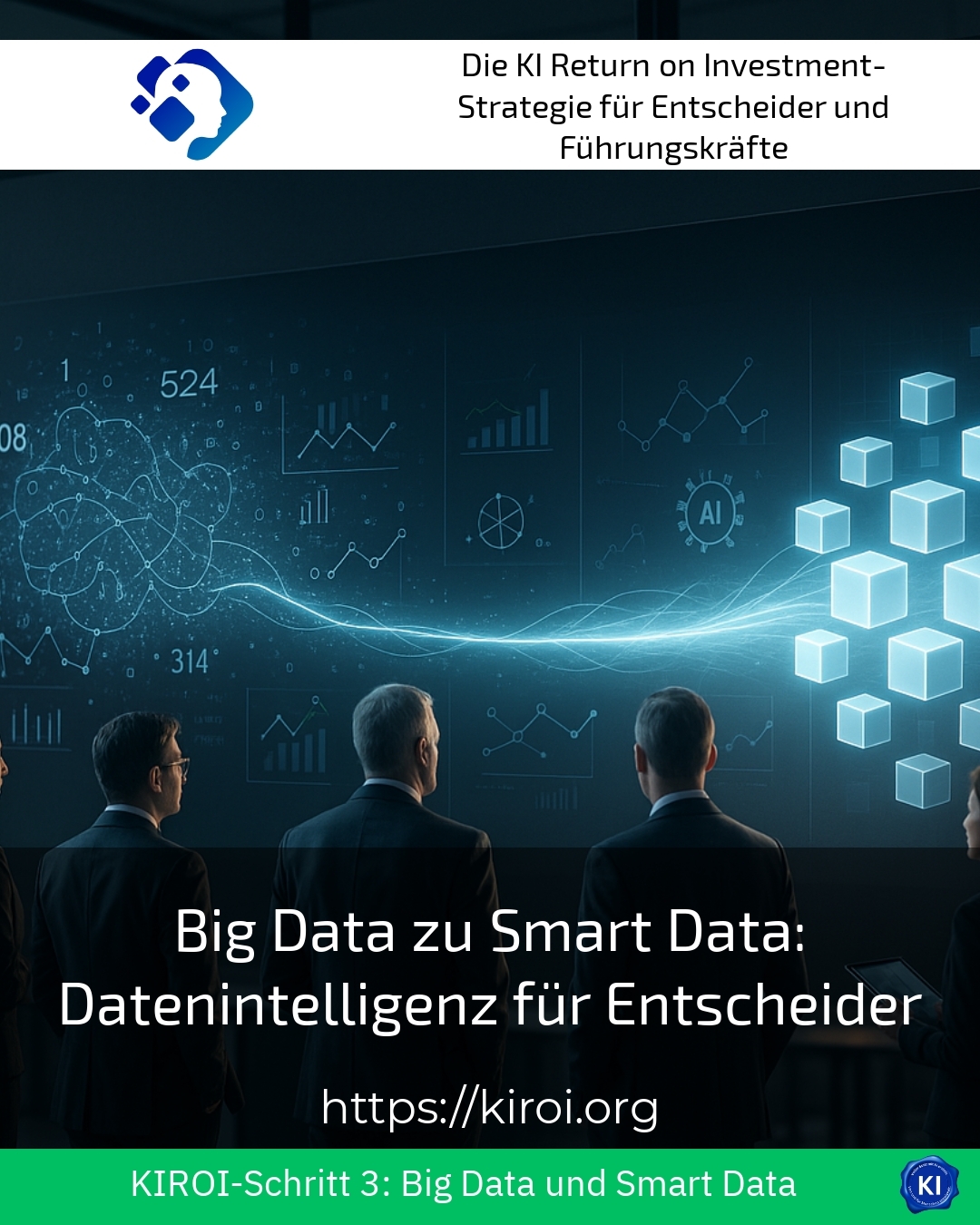
This question concerns decision-makers in almost all economic sectors, because the mere availability of enormous amounts of information still does not guarantee better decisions. The change from Big Data to Smart Data This marks a fundamental paradigm shift that goes far beyond technical aspects. While companies for years have been preoccupied with collecting and storing as much information as possible, today a sobering realization emerges: quantity alone does not create added value; rather, it often creates additional complexity. Data intelligence for decision-makers therefore primarily means filtering out the essentials from the sheer mass and transforming it into actionable knowledge. This article explores how this transformation process is achieved and what concrete impulses it can provide for strategic decisions.
Understanding the evolution of data processing
The history of business information processing can be described as a continuous evolution from mere collection to intelligent interpretation. In the early days of digitalization, the primary focus was on documenting business processes and preserving historical records. For example, banks stored transaction data to meet regulatory requirements and were able to track customer histories. Insurance companies archived damage reports and contract information in growing databases. Retail corporations recorded sales figures and inventory levels, without systematically using this information for strategic decisions.
With the exponential increase in digital touchpoints, this situation changed fundamentally. Suddenly, customer interactions through websites, mobile applications, and social networks generated information flows on a scale never before seen. A medium-sized retail company now produces more data points in a single day than in all of the 1990s combined. This development presented management with a paradoxical dilemma: the more information became available, the more difficult it became to meaningfully analyze it. The transformation from Big Data to Smart Data It thus became an entrepreneurial necessity [1].
From the data mountain to the basis for decision-making
The crucial difference between raw information assets and intelligent data intelligence lies in the contextualization and processing. Raw information is like a disorganized puzzle with millions of parts, where neither the overall picture nor the coherence of the elements is discernible. Intelligent systems, on the other hand, sort, categorize, and link these fragments into meaningful patterns. For example, a logistics company can correlate delivery time data with weather conditions, traffic volumes, and customer behavior to create more precise forecasts. Pharmaceutical companies link clinical trial results with epidemiological information and genetic profiles to identify promising drug candidates.
However, this transformation requires more than just powerful technology. It requires a fundamental change in corporate culture and decision-making processes. Leaders must learn to work with probabilistic statements instead of waiting for absolute certainties. They must accept that even the best analysis cannot provide one hundred percent certainty, but nevertheless provides valuable guidance. This change of mindset represents a greater challenge for many organizations than the technical implementation of corresponding systems.
Best practice with a AIROI customer
A medium-sized company in the industrial manufacturing sector faced the challenge of generating reliable decision-making bases from heterogeneous information sources. The various production sites provided machine data in different formats and quality levels, while the sales team maintained customer information in separate systems. Through systematic guidance within the framework of the transruptions coaching, the management team developed a deeper understanding of the relationships between operational metrics and strategic objectives. Together, we developed a step-by-step approach that initially identified and prioritized the most important information sources. Instead of integrating all available data simultaneously, the project team focused on those areas with the highest potential for insight. Within eight months, the company managed to significantly improve production planning and reduce downtime. Particularly noteworthy was the change in communication between departments, which was now based on shared information. The executives reported a noticeably higher level of decision-making certainty, because for the first time they were able to identify reliable connections between different business areas.
Big Data to Smart Data: Technological Foundations and Human Factors
Technological infrastructure forms the foundation of any successful transformation towards intelligent information utilization. Modern analytics platforms combine machine learning with traditional statistical methods to identify patterns in complex information repositories. Cloud-based architectures enable the scalable processing of even very large amounts of data without requiring companies to operate their own data centers. Automotive manufacturers use such systems to analyze sensor data from connected vehicles and to detect maintenance needs early on. Energy providers analyze consumption patterns in real time to predict peak loads and ensure grid stability [2].
Despite all technological advancements, the human factor remains crucial for the success of such initiatives. Algorithms can detect patterns and reveal correlations, but they cannot translate these insights into strategic actions. This task continues to fall to the leadership, who must interpret technical analysis results in their business context. A retail company may find that certain product combinations are frequently purchased together, but the decision on appropriate placement strategies requires entrepreneurial judgment. Media companies can precisely analyze usage patterns of their content, but the editorial direction remains a creative and strategic decision.
Data intelligence as a strategic competitive advantage
Companies that use information intelligently gain sustainable competitive advantages over competitors that continue to rely on intuition and experience. These advantages manifest themselves in various dimensions of entrepreneurial action. Telecommunications providers can detect customer churn early and initiate targeted engagement measures before the customer becomes active. Mechanical engineering companies optimize their supply chains based on demand forecasts that take into account market trends and customer behavior. Financial service providers develop personalized product offerings based on individual risk profiles and lifestyles [3].
The strategic importance of data intelligence is particularly evident in times of crisis and when disruptive market changes occur. Companies with advanced analytical capabilities can react more quickly to changing circumstances because they can detect changes earlier and better assess their impact. A food manufacturer can identify demand shifts almost in real time and adjust its production planning accordingly. A tourism company can analyze booking trends and flexibly adapt its offerings to changing travel preferences.
Best practice with a AIROI customer
A service company in the field of professional consulting was looking for ways to optimize its project acquisition and resource planning. The previous approach was heavily based on the partners’ subjective assessments and historical experience, which led to significant fluctuations in utilization. As part of the coaching process, we developed a structured approach together to analyze project data and market indicators. The company learned to systematically link various sources of information and derive forecasts from them. The integration of external economic indicators with internal project information was particularly valuable, as it significantly improved the predictability of order intake. The partners reported a noticeable relief because they were no longer solely reliant on their intuition. At the same time, employee satisfaction improved as projects could be distributed more evenly and overload situations occurred less frequently. The company was able to increase its profitability without having to build additional capacity, which impressively underscores the strategic importance of intelligent information utilization.
Mastering implementation challenges
The path to intelligent information utilization is rarely linear and often fraught with obstacles that are often underestimated. The greatest challenge often lies not in the technology but in overcoming organizational resistance and established mindsets. Executives who have made decisions based on experience and intuition for decades sometimes perceive data-based approaches as a challenge to their expertise. Employees fear being replaced by algorithms, although intelligent systems rather support their work than replace it. These cultural barriers require sensitive change management and transparent communication about goals and impacts [4].
Technical challenges often manifest themselves in the form of data silos and quality issues. Many companies possess valuable information repositories that are however isolated in different systems and have different formats. A insurance company may have detailed information about claims, contract data, and customer interactions, but they store it in separate systems that do not communicate with each other. Integrating such information islands requires significant investments and careful planning. At the same time, questions of data quality arise, as even the most sophisticated analysis methods provide no usable results if the underlying information is flawed or incomplete.
Consolidate smart data strategies in a sustainable way
Sustainable success in intelligent information utilization requires the embedding of corresponding competencies and processes throughout the entire organization. Point-specific projects and isolated initiatives may generate short-term success, but they do not create lasting competitive advantages. Companies must develop data intelligence as a strategic core competency and integrate it into their governance structures. This means that analytical capabilities must be built not only in specialized departments but throughout all business areas. For example, a chemical company establishes analytical competencies not only in research and production, but also in sales, distribution, and finance.
The continuous development of analytical skills also requires investments in the qualification of executives and employees. Many decision-makers feel uncertain when dealing with complex analysis results and tend to resort to familiar decision-making patterns. Training programs can help reduce this uncertainty and provide a fundamental understanding of statistical concepts and their limitations. The goal is not to turn executives into data analysts, but to empower them to critically question analytical results and meaningfully integrate them into their decision-making processes.
My AIROI Analysis
The transformation of Big Data to Smart Data It represents far more than a technological trend; it marks a fundamental change in the way companies generate knowledge and make decisions. In my opinion, the ability to intelligently utilize information will become the decisive differentiating characteristic of successful organizations in the coming years. Experience from numerous support projects shows that the technological aspect is often overestimated and the human factor underestimated.
I observe the greatest success in companies that do not view data intelligence as an isolated IT project but as a strategic transformation task that affects all areas of the organization. These companies simultaneously invest in technology, processes, and people, rather than focusing solely on one of these elements. They understand that intelligent systems can enhance human decision-making ability but cannot replace it, and accordingly design their processes.
Coaching through transruptional coaching can help organizations structure this transformation and avoid common pitfalls. The external perspective, which can uncover blind spots and provide new impulses, is particularly valuable. Executives who open themselves to this development often report a noticeable improvement in their decision-making quality and a greater confidence in handling complex challenges. The journey from information overload to data intelligence is challenging, but it is worth it for any organization that wants to succeed in an increasingly data-driven economy.
Further links from the text above:
[1] Bitkom – Big Data and Analytics in Business Applications
[2] Gartner – Definition and classification of Smart Data
[3] McKinsey – The data-driven company of the future
[4] Fraunhofer – Smart Data Research and Applications
For more information and if you have any questions, please contact Contact us or read more blog posts on the topic Artificial intelligence here.










 Deutsch
 English (UK)