
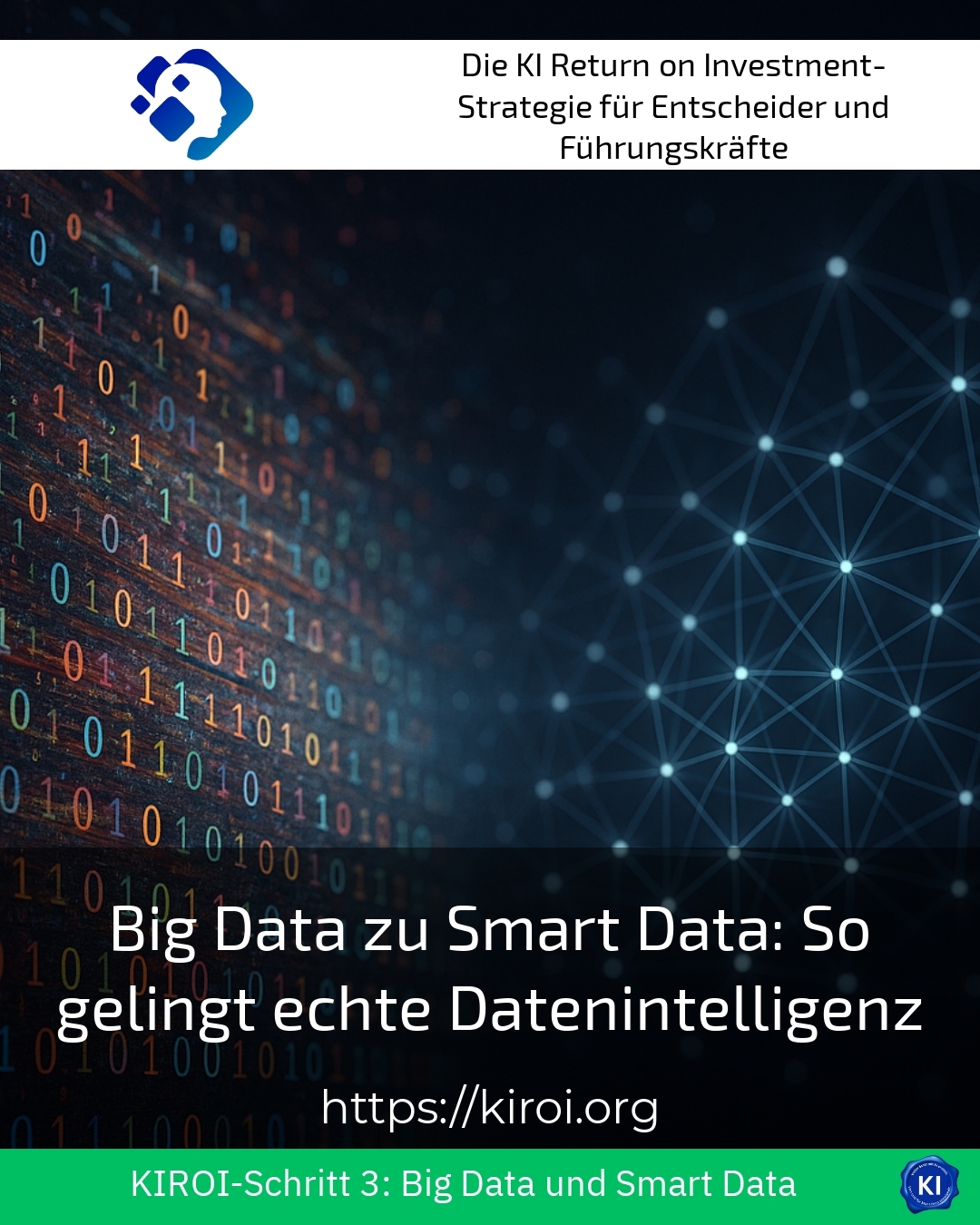
The flood of information hitting businesses every day is increasingly overwhelming many decision-makers and leaving behind a sense of helplessness. Yet, herein lies a huge hidden opportunity, as the shift from big data to smart data makes it possible to gain real insights from chaotic data volumes. Imagine being able to filter out precisely those data points from millions that will drive your business forward. However, this transformation requires more than just technical solutions. It demands a fundamental rethink in the way organisations handle information and the importance they attach to the intelligent use of data. In the following sections, you will learn how to make this transition a success and which concrete steps are necessary.
Understanding the data deluge
Companies are collecting more information today than ever before in the history of business. Sensors in production facilities deliver measurement values every second. Customer interactions on digital platforms continuously generate behavioural patterns. Financial transactions leave digital traces on a massive scale. However, this mass of raw data alone creates no added value for the business. Clients frequently report the feeling of drowning in data without being able to derive smart decisions from it. The actual challenge consists in separating relevant information from irrelevant information [1].
A medium-sized manufacturer of precision components faced precisely this problem. Quality control recorded thousands of parameters per workpiece, but nobody knew which of them were truly meaningful. A logistics company collected GPS data from hundreds of vehicles without using it for route optimisation. An industrial machinery supplier stored maintenance logs for years, but was unable to derive predictive maintenance measures from them. These examples show that the mere existence of data is by no means equivalent to data intelligence.
Big Data to Smart Data: The transformation process in detail
The path from raw data volumes to actionable insights requires a structured approach. First of all, companies need to understand which questions they actually want to answer. Only then is it possible to determine which data are relevant for this and how they should be prepared. This process begins with an honest inventory of the existing data sources and their quality. Many organisations significantly underestimate the effort required for data cleaning. Inaccurate entries, duplicate records and outdated information distort even the most sophisticated analysis.
Transruptions-Coaching helps companies to clarify these fundamental questions and develop individual strategies. Experience shows that technical solutions alone rarely lead to success. Rather, what is needed is a combination of methodical procedure, cultural change and technological support. An automotive supplier used this approach to structure its production data meaningfully. A mechanical engineering company was able to plan service calls better and reduce downtime as a result. An electric motor manufacturer identified critical quality parameters and significantly improved its scrap rate.
Best practice with a AIROI customer
A traditional manufacturing company approached us with a complex problem because, despite significant investments in sensor technology and data acquisition, they had failed to gain meaningful insights for production control. The existing infrastructure was collecting several gigabytes of machine data daily, which, however, lay unstructured in various systems and were not linked together. As part of our support, we jointly developed a data strategy that first defined the relevant key performance indicators for quality and efficiency and then enabled the technical integration of the various data sources. The involvement of the employees was particularly important here, as their experiential knowledge was crucial in helping to interpret the analysis results. After six months, the company was able for the first time to practice predictive maintenance based on real-time data and significantly reduce unscheduled downtime. The transformation from mere data collection to genuine data intelligence required patience and continuous adaptation, but resulted in measurable economic benefits and a new culture of innovation throughout the operation.
Technological foundations for real data intelligence
The technical infrastructure forms the foundation for every data-driven approach in modern organisations. Cloud-based platforms now enable scalable storage and computing capacities at manageable costs [2]. Machine learning and artificial intelligence recognise patterns in data sets that would remain hidden to the human eye. These technologies support decision-making processes at various levels. However, they do not replace the critical thinking and experience of the people within the company.
An industrial pump manufacturer used machine learning to predict wear patterns. The algorithms analysed vibration data, temperatures and operating hours combined with historical failure logs. A manufacturer of plastic parts used image recognition systems for automated quality control, thereby significantly reducing error rates. An automation solutions provider linked data from different parts of the plant, creating the basis for holistic process optimisation. These examples illustrate that technology can provide impetus when deployed purposefully and with clear objectives.
Cultural change as a prerequisite for big data to smart data
Technology alone does not bring about transformation if the people in the company are not brought along. Data-driven decision-making requires a rethink at all hierarchical levels of the organisation. Managers must learn to supplement or question gut feeling with sound analyses. Employees need training and time to use new tools safely and interpret their results. This cultural dimension is frequently underestimated in digitalisation projects, which then leads to frustration and resistance.
Transruption coaching supports precisely this aspect of change and guides teams in developing new ways of working. A medium-sized toolmaking company introduced weekly data reviews where production managers and quality officers discussed key figures together. A system supplier for the automotive industry established cross-functional analysis teams made up of engineers, controllers, and IT specialists. A drive technology specialist created the new role of data steward, who acts as a mediator between specialist departments and data experts. Such organisational measures create the necessary foundation for sustainable change.
Concrete application areas and their potentials
The intelligent use of data opens up new possibilities in various areas of business [3]. In production, real-time analysis of machine data enables predictive maintenance and minimises unplanned downtime. In sales, customer analytics help to identify needs early on and make suitable offers. In logistics, algorithms optimise routes and inventory levels based on historical consumption patterns and current demand signals. Research and development benefits from the systematic evaluation of test data and simulation results.
A precision tool manufacturer used data analytics to compare the service lives of its products across various applications. These insights fed directly into product development and enabled targeted improvements. A hydraulic component supplier systematically analysed complaint data and identified recurring root causes of failure in specific operating environments. A measurement technology specialist linked calibration data with environmental conditions, enabling more precise recommendations for maintenance intervals. These applications demonstrate the range of possibilities arising from the intelligent use of data.
Best practice with a AIROI customer
An internationally active engineering supplier approached us with the request to fundamentally improve its service processes by utilising the existing operational data from its installed machinery. The initial situation was characterised by reactive behavior, as service only became active once a machine failed at the customer's site, at which point it would try to find a solution under time pressure. Together, we developed an approach that first identified the relevant early indicators of impending failures and integrated them into a monitoring system that automatically alerts service technicians to critical changes. The biggest challenge was winning customers' trust regarding data transmission, which is why we devised a transparent communication concept that clearly demonstrated the added value for both sides. Following the pilot phase with selected reference customers, the company was able to gradually expand its offering and established a new business division for predictive maintenance services. The financial results exceeded initial expectations, and customer satisfaction rose measurably because unplanned production downtime occurred much less frequently than before.
Challenges and typical pitfalls
The path to data intelligence is rarely straightforward and entails various risks that need to be considered. Data protection and data security require careful planning and continuous attention. The quality of the source data significantly determines the quality of all analyses and decisions based upon it. Departmental silos often prevent the necessary integration of information from various sources. Missing or unclear responsibilities for data management lead to inconsistencies and quality issues over time.
A packaging machinery manufacturer underestimated the effort required to harmonise historically grown data formats from different plants. A provider of robotics solutions had to adapt its analysis projects several times because the original questions turned out to be imprecise. A manufacturer of fasteners initially invested in expensive software solutions before the fundamental processes for data collection were established. These experiences illustrate that a step-by-step approach with clear priorities is often more promising than attempting a comprehensive transformation in a single attempt.
Success factors for sustainable data intelligence
Certain patterns that promote or make success more likely can be derived from numerous projects. Clear support from the executive board signals the strategic importance of the topic within the company. The formulation of concrete use cases with measurable benefit creates motivation and enables the evaluation of progress. An iterative approach with rapid learning cycles reduces risks and allows course corrections when necessary [4]. The involvement of domain experts from operational areas ensures that analyses are relevant to practice.
An injection moulding machine manufacturer started with a manageable pilot project and only scaled to further applications after proven success. A linear technology provider formed an interdisciplinary team of design engineers, data analysts and sales staff for its analytics project. A surface technology specialist defined clear metrics for project success and reviewed them regularly in steering meetings. These practices support realistic expectations and foster the continuous improvement of data skills throughout the company.
My AIROI Analysis
For many companies, the transformation from big data to smart data represents one of the key challenges of the coming years. In my view, success in this regard will depend less on the technology used and more on the ability to create the necessary organisational and cultural conditions. Experience gained from supporting numerous organisations shows that a pragmatic approach with clear priorities often yields better results than ambitious large-scale projects with an unclear focus. Companies should first identify their most pressing issues and, building on that, establish the necessary data infrastructure. The AIROI methodology provides a structured framework for this, taking technical, organisational and human factors into account in equal measure.
Of particular importance to me is the realisation that data intelligence is not a state that is achieved once and then maintained. Rather, it is a continuous process of further development and adaptation to changing framework conditions. Technological possibilities are evolving rapidly, constantly opening up new analytical potential. At the market level, customer requirements and competitive situations are changing at an accelerating pace. Companies that view data intelligence as a core strategic competency and build it up systematically will be able to use this dynamic as an opportunity. The transruptions coaching accompanies precisely this development process and helps to generate genuine business value from the flood of data.
Further links from the text above:
[1] Bitkom – Guide to Corporate Data Management
[2] Fraunhofer – Artificial Intelligence and Data Analysis
[3] Platform Industry 4.0 – application examples for data-driven production
[4] VDI – Digitalisation in Mechanical Engineering
For more information and if you have any questions, please contact Contact us or read more blog posts on the topic Artificial intelligence here.









 Deutsch
  English (UK)