
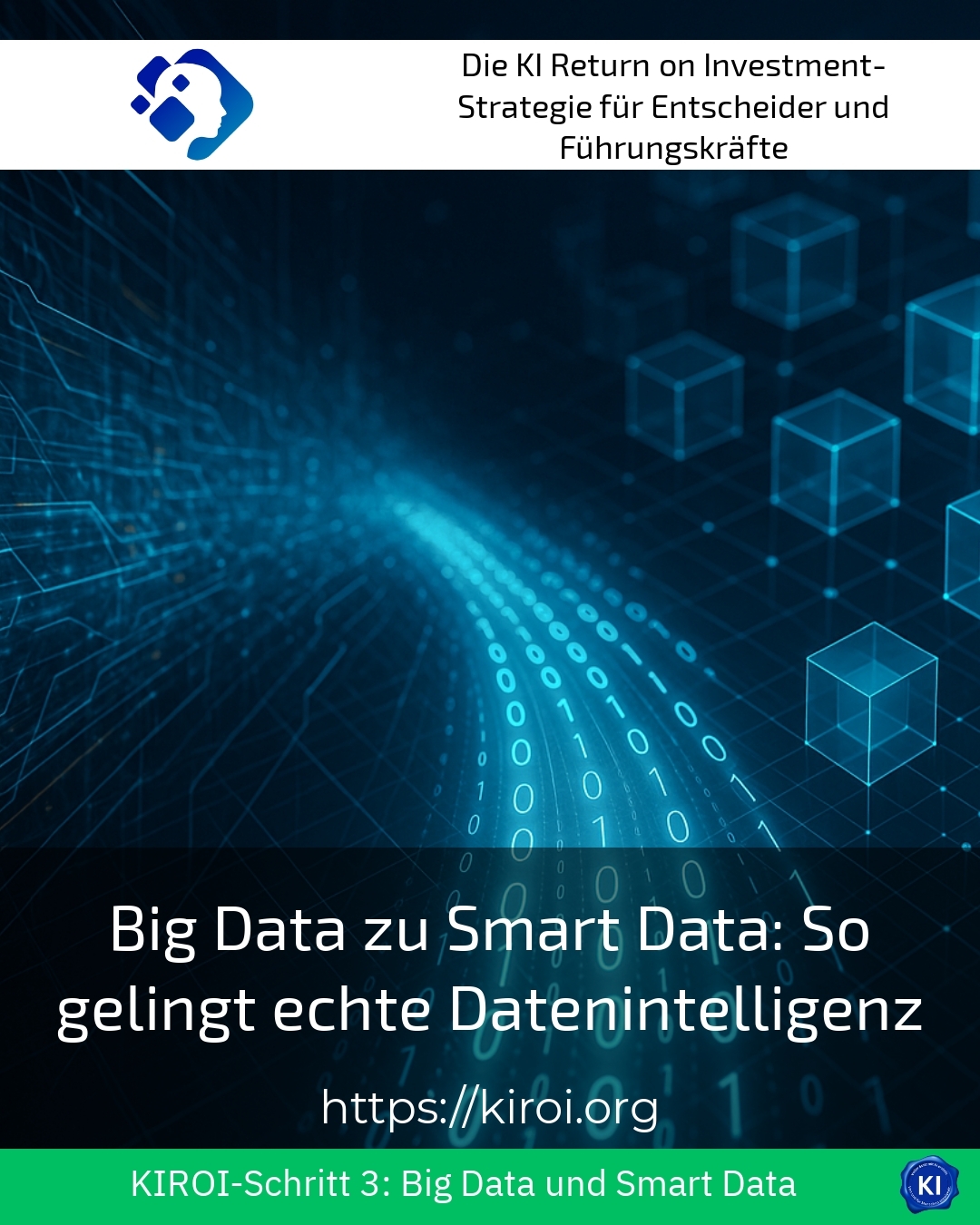
Have you ever wondered why some companies generate genuine competitive advantages from their data volumes, while others literally drown in a sea of information? The transformation from big data to smart data represents one of the most critical turning points that organisations have to deal with today. At a time when unimaginable amounts of information are generated daily, mere collection is long no longer enough. Rather, it is about distilling actionable insights from raw columns of figures that can actually support strategic decisions. This article accompanies you on the path to genuine data intelligence and demonstrates practical approaches that frequently lead to remarkable results for clients.
Why the sheer volume of data is not the solution
Many organisations find themselves in a paradoxical situation today. They have more information at their disposal than ever before. At the same time, they are finding it harder to draw wise conclusions from it. This discrepancy does not arise by chance; rather, it results from a fundamental misunderstanding. For quantity and quality are by no means the same thing. If logistics companies record millions of shipment data points, for example, optimised routes do not automatically result from this. Only the intelligent linking of various parameters enables genuine efficiency gains. The situation is similar for financial service providers that want to analyse transaction data in real time. The sheer speed of data collection is of little use. What is crucial is the ability to recognise relevant patterns and interpret them correctly.
The challenge lies in distinguishing between noise and signal. Retail companies experience this daily when evaluating customer behaviour. Not every click actually reveals anything about purchase intentions. And not every duration of stay on a page signals interest. The art is to identify those data points that truly possess predictive value. Transruption coaching can provide valuable impulses here. It accompanies teams in developing new thinking patterns and critically questioning traditional analysis methods. Step by step, this creates a culture that not only collects data, but understands and permeates it.
The journey from big data to smart data begins with clear questions
Before algorithms are deployed, the right questions must first be formulated. This seemingly banal insight is overlooked surprisingly often. Manufacturing plants install sensors at every conceivable point along their production lines. Yet what exactly do they want to find out with them? Is it about predicting machine failures? Or about optimising throughput times? Both objectives require completely different data strategies. Energy suppliers face similar decisions when they want to manage their grids intelligently. The transformation from big data to smart data only succeeds if the objective has been precisely defined.
Clients frequently report on projects that initially started with a lot of promise. Over time, however, it turned out that the initial research question was formulated too vaguely. For example, a telecommunications provider wanted to improve customer satisfaction. But what does satisfaction actually mean in concrete terms? Shorter waiting times for enquiries? Fewer technical faults? Or cheaper tariffs? Each of these interpretations leads to different data sources and analytical methods. Clarity at the beginning saves enormous resources further down the line.
Best practice with a AIROI customer
A medium-sized manufacturing company faced the task of fundamentally modernising its quality assurance. Although the existing systems recorded numerous measured values during the production process, this data largely remained unused in various silos. As part of a structured support process, it was first determined which quality parameters were actually critical for end customers. This revealed that many of the values collected had little relevance for practical quality assessment. Instead, information on certain material properties was missing, even though these had a major influence on the durability of the products. By realigning data collection and introducing intelligent linking algorithms, the complaint rate was significantly reduced within twelve months. Employees also reported a noticeably higher level of job satisfaction. They now had a better understanding of why certain measurements were carried out and what contribution they made to overall quality. This case vividly illustrates the importance of strategic preparatory work in data intelligence initiatives.
Technological foundations for real data intelligence
The technical infrastructure forms the foundation of every successful data strategy. Without appropriate tools, even the best concepts remain theoretical constructs. Modern platforms make it possible to bring together heterogeneous data sources and analyse them in real time [1]. Cloud-based solutions offer scalability and flexibility that local systems can often not achieve. Insurance companies are increasingly using these capabilities for risk assessment. They combine internal contract data with external information on weather events or demographic developments. The resulting transparency supports more informed decisions in tariff design.
Machine learning plays a central role in transforming raw data into actionable insights. Algorithms can identify patterns that would remain hidden from human analysts. Pharmaceutical companies use such methods to filter out relevant correlations from clinical trials. The process from big data to smart data benefits enormously from these technological advances. Nevertheless, one should realistically assess the limitations. Algorithms do not make moral decisions. They can also reinforce systematic biases if the training data exhibit corresponding tendencies.
Data quality as a critical success factor
Even the most sophisticated analysis methods yield unsatisfactory results if the underlying data is flawed. This principle is often underestimated. Real estate companies, for example, frequently work with property data that has been maintained by different people over the years. Inconsistent spellings of street names or incorrect area figures can significantly distort analyses. Similar problems occur with healthcare providers when patient data from different source systems needs to be merged. Investing in data quality management pays off manifold in the long run.
Transport companies have realised that clean real-time data can make the difference between a functioning and a chaotic operation. Delay information must be precise so that connections can be coordinated. Media companies, in turn, need reliable usage statistics to tailor their content to their target audience. The continuous maintenance and cleansing of datasets requires organisational discipline. However, it is essential for every step towards true data intelligence.
Organisational changes on the path to smart data
Technology alone is not enough. Transformation also requires profound cultural adjustments within organisations. Departmental boundaries that have grown historically often hinder the free flow of information. Automotive suppliers experience this regularly when development and production data cannot be linked optimally. The introduction of overarching data strategies not infrequently meets with resistance. Established ways of working must be questioned. A possessive attitude towards „one's own“ data must be dismantled.
Transruptions-Coaching guides companies through precisely these change processes. It supports leaders in getting their teams on board with new ways of working. Banks have had positive experiences with establishing cross-functional data teams. These bring together IT expertise with operational business knowledge. Retailers benefit when marketing and logistics departments systematically share their insights. The transition from big data to smart data does not happen overnight. It is an evolutionary process that requires patience and continuous commitment.
Best practice with a AIROI customer
A multi-site service company struggled with fragmented customer information. Each branch maintained its own systems and used different categorisations. A unified view of customer relationships practically did not exist. As part of an accompanied transformation project, a shared data strategy was initially developed. All relevant stakeholders were involved early on to understand their specific requirements. This was followed by the gradual migration to a central platform. Training employees was particularly important in this process so that they recognised the added value of the new way of working. Upon completion of the first phase, the company was able to carry out cross-location analyses for the first time. Customer clusters were identified that had previously remained invisible. The marketing measures derived from this showed significantly higher response rates than previous campaigns. Furthermore, cooperation between the branches improved noticeably because a common information base now existed. This example shows how organisational and technical changes must go hand in hand.
Skills development for data-driven decisions
The ability to handle data is increasingly becoming a core competence in all areas. Not only specialists, but also business users require a basic understanding of analytical methods. Catering businesses can benefit from staff who can independently interpret reservation patterns. Construction companies work more efficiently when project managers can evaluate cost data autonomously. The democratisation of data skills creates more agile organisations.
At the same time, ethical aspects must be taken into account [2]. Personal data requires special care. Educational institutions that evaluate their students' learning data are operating in sensitive areas. Employers that analyse their employees' performance data must establish transparent rules. The teaching of data literacy should therefore always include questions of responsibility.
Practical steps for implementation
Getting started with systematic data management does not have to begin with a major project. It is often advisable to start with manageable pilot projects. Event organisers can, for example, first analyse the ticket sales data of a single event series. The insights gained can then be successively applied to other areas. Travel companies have had good experiences with specifically examining certain customer segments before initiating nationwide measures.
The iterative approach reduces risks and enables continuous learning. Sports organisations use this approach to analyse performance data of their athletes. They begin with individual metrics and gradually expand the spectrum. Cultural institutions such as museums or theatres can proceed similarly if they want to use visitor data intelligently. Every small success builds acceptance for further measures.
My AIROI Analysis
An examination of numerous projects reveals clear patterns for success and failure. Organisations that treat data intelligence as a purely technical issue regularly run up against limits. The transformation from big data to smart data requires a holistic perspective. Technology, processes and people must be involved in equal measure. Particularly successful are those initiatives that pursue concrete business goals right from the start. Abstract data collections without clear intended uses peter out sooner or later.
Experience across various industries also teaches that patience is indispensable. Quick successes are possible, but sustainable data intelligence is built over longer periods. Organisations should formulate realistic expectations and factor in setbacks. Guidance from experienced partners can offer valuable support in this process. Transruption coaching positions itself as a companion for projects involving these complex transformations. It provides impetus, encourages reflection and helps to avoid typical stumbling blocks. The future belongs to those organisations that not only possess their data, but truly understand and responsibly use it. The path there is demanding, but rewarding.
Further links from the text above:
[1] Gartner Glossary: Smart Data Definition
[2] Federal Ministry for Economic Affairs: Digitalisation and Data Ethics
For more information and if you have any questions, please contact Contact us or read more blog posts on the topic Artificial intelligence here.









 Deutsch
 English (UK)