
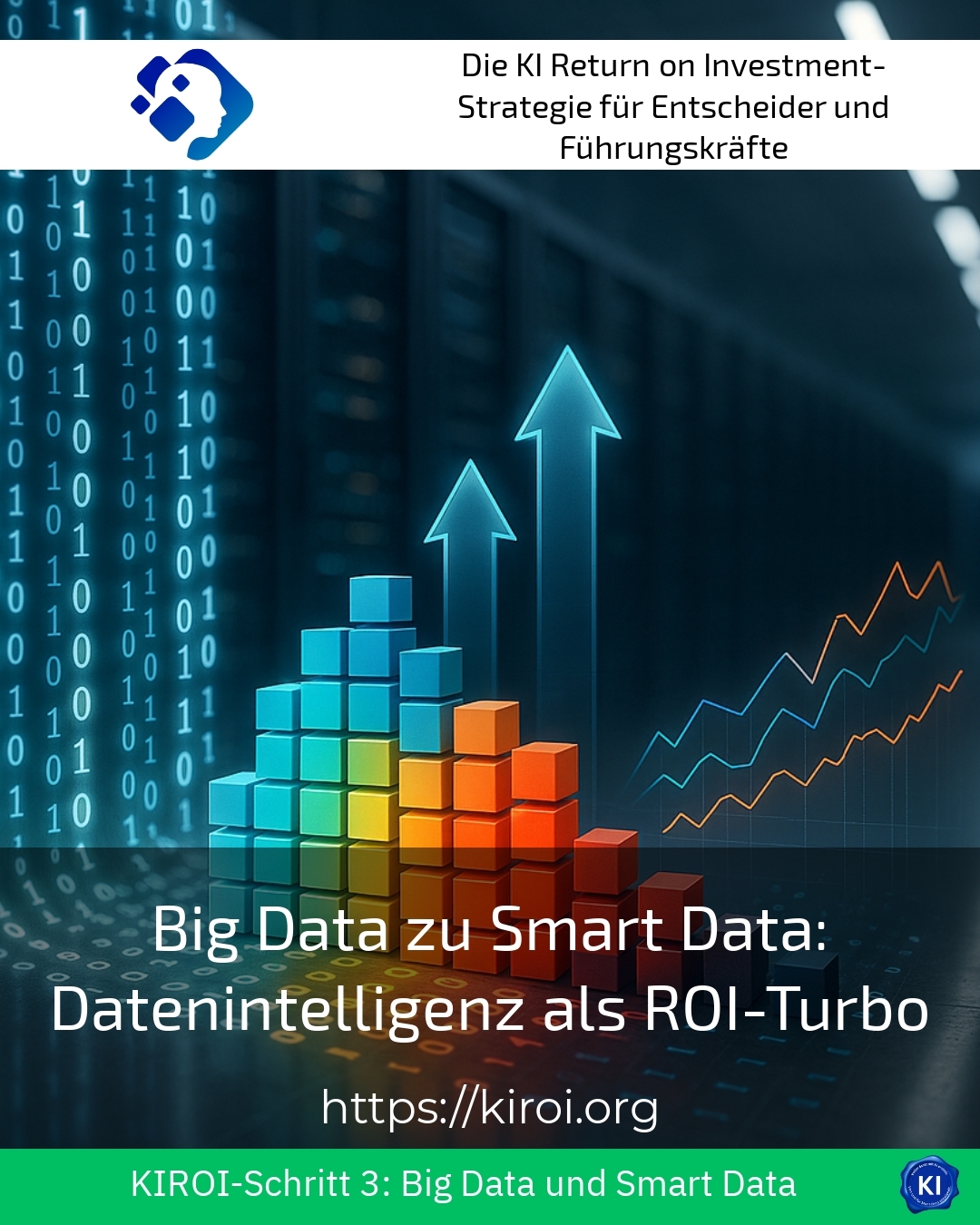
Imagine your company is sitting on a gigantic treasure trove of data that grows exponentially every day and yet yields hardly any usable insights. This is precisely where the transformation process of Big Data to Smart Data: Data Intelligence as an ROI Turbo , who transforms raw information volumes into strategic competitive advantages. While many organisations are still struggling simply to store their data floods, innovative pioneers have long since recognised that true value creation only arises through intelligent refinement. In this article, you will learn how this transformation succeeds and which concrete levers massively increase the return on investment.
Understanding the evolution of data usage
The mere accumulation of information has never yet brought a business sustainable advantages. Only systematic preparation and context-driven analysis create real added value. Many organisations already collect millions of data points from a wide variety of sources today. Yet this raw data is like an uncut diamond whose true value is only revealed through refinement. The decisive difference lies in the ability to recognise relevant patterns and draw actionable conclusions from them.
For example, a logistics company records hundreds of thousands of delivery data points, route information and customer interactions every day. Without intelligent analysis methods, this information remains useless storage hogs. It is only through algorithmic evaluation that optimisation potentials for supply chains and route planning emerge. Another example can be seen in retail, where point-of-sale systems continuously generate transaction data. The intelligent linking of this data with weather data, public holidays and local events enables precise demand forecasts. Financial service providers also benefit considerably because they can identify attempted fraud at an early stage through pattern recognition.
Why big data to smart data is the key to value creation
The transition from mere data storage to intelligent data usage marks a fundamental paradigm shift. Companies that successfully take this step frequently report significant increases in efficiency. However, the transformation requires more than just technological investments in analysis tools; it demands a fundamental rethinking across the entire organisational culture. Employees must be empowered to make and question data-driven decisions.
In the manufacturing sector, intelligent sensor evaluation enables predictive maintenance concepts that minimise unplanned downtime. Energy suppliers use smart meter data to optimise their grid utilisation and load distribution. Hospitals improve their treatment pathways and noticeably reduce waiting times through patient data analysis. These examples illustrate the broad range of applications for intelligent data refinement across industry boundaries. The common denominator is always the transformation from quantity to quality.
Best practice with a AIROI customer
A medium-sized engineering company came to us at transruptions coaching with a classic challenge. The organisation had extensive machine data from production, but was unable to use it effectively. Together, we developed a strategy for the step-by-step refinement of data and the implementation of analysis processes. First, we identified the most relevant data points for quality assurance and process optimisation in the manufacturing area. We then supported the team in introducing a dashboard system for the real-time monitoring of critical parameters. The employees received intensive training on how to interpret the visualised metrics and relationships. After six months, the company was able to reduce its scrap rate by twenty percent and significantly improve machine utilisation. The investment in intelligent data usage paid for itself in full within the very first year. Supporting the cultural shift towards evidence-based decision-making proved to be particularly valuable.
Data intelligence as an ROI turbo in practice
The return on data-driven investments depends significantly on the quality of implementation. Many projects fail not due to a lack of technology, but to a lack of strategic alignment. Defining clear success metrics before the project begins is therefore essential for measurable results. Organisations that closely link their data initiatives with business objectives demonstrably achieve better outcomes. The ROI manifests itself in various dimensions, ranging from cost savings to increased revenue.
Insurance companies use claim data analysis to optimise their tariff models and risk assessments. Telecommunications providers use customer behaviour patterns to identify churn risks early and take targeted countermeasures. Automobile manufacturers continuously improve their product development and service quality through vehicle data evaluation. In the hotel industry, booking and review data enable personalised guest experiences with higher customer satisfaction. Pharmaceutical companies significantly accelerate their research processes through intelligent evaluation of clinical trial data.
Establishing technological foundations for smart data
The technical infrastructure forms the foundation of every successful data strategy and analytical capability. Cloud-based solutions today offer flexible scaling options without massive upfront investments in hardware. Modern analytics platforms integrate machine learning and enable business users to perform complex evaluations as well. The democratization of analysis tools accelerates the spread of data-driven decisions within organizations. At the same time, data protection and data security are increasingly gaining strategic importance for companies.
Banks are implementing real-time analytics solutions for the immediate assessment of credit applications and transactions. Retailers rely on in-memory databases for lightning-fast inventory queries and price adjustments. Manufacturing companies are combining edge computing with centralised analytics platforms for hybrid architectures. These technological advances are continually lowering the barriers to entry for data-driven business models. Nevertheless, human expertise remains indispensable for the interpretation and implementation of analytics results.
Organisational prerequisites for success
Technology alone does not guarantee success in the transformation towards intelligent data utilisation. The organisational anchoring of data literacy requires continuous investment in employee development [1]. Leaders must act as role models by actively demonstrating and demanding data-driven decision-making processes. Establishing clear responsibilities for data quality and analysis standards is equally crucial. Cross-functional roles such as data stewards or analytics teams significantly promote company-wide collaboration.
Media companies are building cross-editorial data teams that systematically analyse and optimise content performance. Retail companies are creating category management roles that make and take responsibility for range decisions based on data. Industrial companies are establishing centres of excellence that develop best practices and roll them out across the company. In healthcare, new job profiles are emerging at the intersection of medicine and data analysis. We provide intensive, practical support for these organisational adaptations through transruptions coaching.
Best practice with a AIROI customer
A retail company with multiple branches sought support in realigning its data strategy. Although the existing systems generated extensive sales data, there was a lack of central analytical capability. As part of our coaching, we initially accompanied a comprehensive inventory of all available data sources. In doing so, we identified significant potential by linking point-of-sale data with customer footfall measurements and weather data. We supported the company in selecting a suitable analytics platform and defining relevant key performance indicators. The involvement of branch managers as future users of the new analysis tools was particularly important. Through regular workshops, we fostered an understanding of data-driven range optimisation and staff scheduling. Today, the company reports noticeably improved margins and more efficient resource utilisation across all branches. The acceptance of the new working methods was a decisive factor in the success of the transformation.
From Big Data to Smart Data: Implementing Data Intelligence as an ROI Turbo
The practical implementation of intelligent data strategies ideally follows an iterative approach with quick wins. Pilot projects in defined areas enable valuable learning experiences with manageable risk. The insights gained can subsequently be scaled and transferred to other business areas [2]. Continuous measurement of success against predefined metrics and milestones is important here. Regular retrospectives help to identify obstacles at an early stage and initiate countermeasures.
Logistics companies frequently start with the optimisation of individual delivery routes before implementing network-wide analyses. Banks test new scoring models initially in pilot regions before nationwide rollouts take place. Manufacturing companies often begin by monitoring critical machines before complete production lines are integrated. In retail, pilot stores prove effective as a test environment for new analytics applications and processes. This step-by-step approach reduces implementation risks and sustainably promotes organisational learning.
My AIROI Analysis
The transformation of raw data volumes into intelligent decision-making bases presents companies with complex challenges. Technological investments alone rarely lead to the desired success without accompanying organisational measures. Experience shows that the biggest hurdles lie in establishing a data-driven culture at all hierarchical levels. Employees need not only tools, but also skills and encouragement to use new opportunities.
The ROI of intelligent data utilisation often only becomes apparent in the medium term and requires patience when making investment decisions. Nevertheless, numerous practical examples demonstrate the enormous value-creation potential of successful transformation projects across various industries. The decisive factor is the consistent alignment of all measures with concrete business goals and measurable success criteria. In transruptions coaching, we support organisations in identifying their individual potentials and realising them step by step.
The coming years will bring a further acceleration of development and open up new application fields. Companies that invest in their data capabilities today are creating sustainable competitive advantages for the future. The integration of artificial intelligence will open up additional automation opportunities and analytical potentials in the process. At the same time, the requirements for responsible data use and transparent algorithms are continuously increasing. Actively shaping this balance between innovation and responsibility remains a central leadership task of our time.
Further links from the text above:
[1] McKinsey: The Data-Driven Enterprise
[2] Harvard Business Review: Data Strategy Insights
For more information and if you have any questions, please contact Contact us or read more blog posts on the topic Artificial intelligence here.









 Deutsch
 English (UK)