
In today's economic landscape, Data intelligence essential for sustainable success. Companies receive huge amounts of data daily – so-called big data – which on their own have little significance. The ability to refine this data and turn it into Smart Data to transform. Only through the targeted application of data intelligence can valuable insights be generated that help decision-makers act strategically and agilely.
Data Intelligence – Understanding More Than Just Data Volumes
Big Data stands for the enormous amount of varied data – from customer data to machine sensors to transactions. Their sheer volume makes them unmanageable for manual analysis. This is where data intelligence comes in, to filter out the truly relevant information from this raw sea of data.
One example from the manufacturing industry shows how data intelligence is used: Machines generate permanent sensor data. An intelligent system continuously evaluates this data, detects deviations at an early stage, and prevents costly failures through predictive maintenance. Similarly, an e-commerce company benefits from using data intelligence to analyse purchasing behaviour, in order to precisely adapt its product range and marketing campaigns to the needs of individual customer segments.
In the financial sector, portfolio managers are increasingly basing their decisions on smartly analysed data, rather than unstructured, confusing floods of information. This increases the reliability and efficiency of their strategies.
From Big Data to Smart Data: The quality of information matters
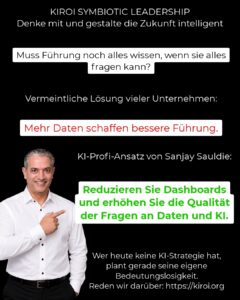
Big Data emphasises quantity, whereas Data Intelligence focuses on quality. Smart Data refers to specifically selected, cleaned, and interpretable datasets that serve a concrete business objective. By employing artificial intelligence and machine learning algorithms, irrelevant data is excluded, and only valuable insights are highlighted.
An example from marketing illustrates this impressively: Instead of broad wastage, a company uses data-intelligent systems that provide real-time target group analyses. This allows advertising campaigns to be flexibly adapted to customer preferences and increases sales.
The combination of Big Data and Smart Data also plays a significant role in logistics: by intelligently processing large amounts of data, bottlenecks can be identified early and supply chains managed more efficiently. This saves costs and improves customer satisfaction.
This shift from sheer volume of data to smart, targeted information not only facilitates the work of specialist departments but also provides management with the necessary impetus for better and faster decisions.
Fields of application for data intelligence in various industries
Data intelligence unfolds its potential across all industries and adapts flexibly to specific requirements:
- In healthcare, patient data from various sources – such as electronic health records, diagnostic devices, and wearables – are linked and analysed. This leads to personalised therapy approaches and better treatment outcomes.
- In the manufacturing sector, companies analyse production key figures using data intelligence, optimising processes and minimising waste. Unplanned downtimes are also avoided through intelligent data processing.
- In retail, precise customer analysis enables targeted promotions and personalisation across the entire customer journey. Customer loyalty and revenue profit from this sustainably.
BEST PRACTICE at the customer (name hidden due to NDA contract) A logistics company applied data-intelligent methods to extract precise KPIs from extensive sensor and transport data. This enabled reliable prediction of delivery times and efficient management of warehouse stocks. This resulted in significant cost savings and improved customer satisfaction.
BEST PRACTICE at the customer (name hidden due to NDA contract) A marketing agency employed data-intelligent systems to adapt campaigns in real-time to the behaviour of user groups. The resulting flexibility measurably reduced wastage and increased advertising effectiveness, which was reflected in a higher conversion rate.
These examples illustrate how diverse and effective data-intelligent approaches can be – regardless of the industry.
Data intelligence as the key to well-founded decisions
Data intelligence supports decision-makers on complex projects by identifying risks early and highlighting opportunities. The combination of Big Data and Smart Data thus creates a solid basis for decisions leading to action-oriented results.
For example, in manufacturing, a data-intelligent solution can continuously monitor the production status and report anomalies. In marketing, Smart Data can be used to address target groups more precisely and control campaigns more accurately. In the healthcare sector, intelligent data analyses enable the preparation of personalised therapies, which is often welcomed by doctors and patients alike.
My analysis
The meaning of Data intelligence In modern businesses, this is constantly growing. Only those who succeed in generating relevant smart data from the wide variety of big data can make well-founded and future-proof decisions. The intelligent use of data acts as an important lever for optimising processes, increasing efficiency and unlocking new business opportunities.
Those responsible who rely on data-intelligent strategies benefit from measurable advantages, for example, through improved forecasts, more individual customer approaches, and more efficient resource utilisation. This isn't about having as much data as possible, but about the quality and context of the information.
Companies should therefore consider data intelligence as an accompanying process that supports them in transforming their data worlds and provides valuable impetus for growth and innovation.
Further links from the text above:
With data intelligence from big data to smart data
Big Data vs. Smart Data – Quality over Quantity
Smart Data: Definition, Application and Benefits
Big and smart data - from statistics to data analysis
For more information and if you have any questions, please contact Contact us or read more blog posts on the topic TRANSRUPTION here.









 Deutsch
  English (UK)