
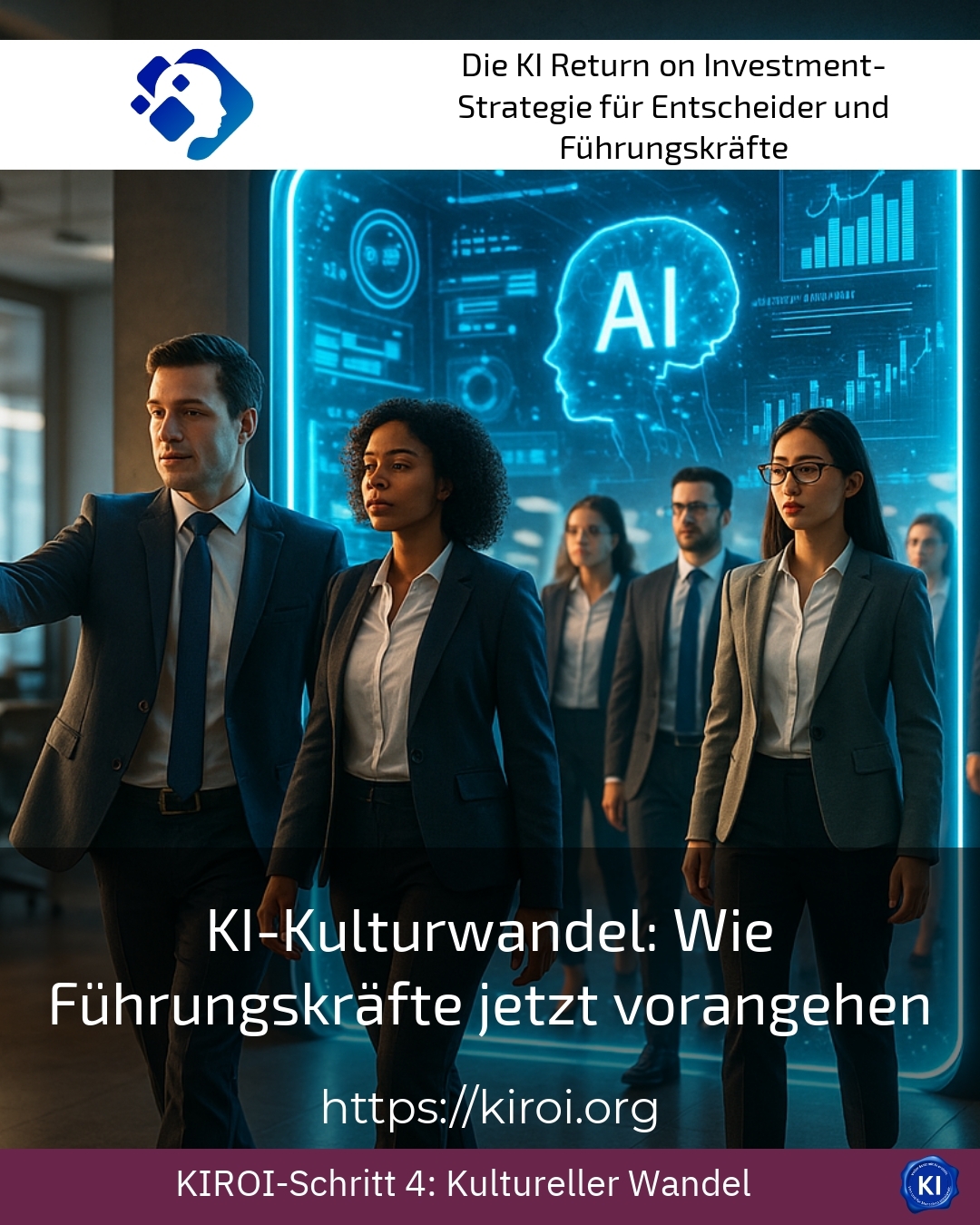
Imagine your entire company could develop a completely new way of working within months. The AI Culture Change: How Leaders Should Proceed Now describes precisely this transformation, which no longer affects only technological systems, but shakes the very foundations of entrepreneurial thinking. Many decision-makers are currently faced with the question of how to take their teams along on this journey. The answer lies not in the technology itself, but in the way people are led.
Why the change in corporate culture is crucial
In numerous discussions with decision-makers, a recurring pattern becomes very clear. The introduction of new technologies rarely fails due to technical hurdles or a lack of budget. Rather, it is human factors that determine the difference between success and failure. Employees fear for their jobs and react to changes with resistance. Leaders often underestimate how profoundly they need to rethink their own attitudes. The corporate culture, in this context, is like an invisible network that permeates all processes [1].
A medium-sized mechanical engineering firm from the Rhine-Main region experienced this dynamic firsthand. The management had invested considerable sums in automated quality control. After six months, the utilisation rate was below thirty percent. The cause was not the technology. Instead, there was a lack of trust between the departments. Furthermore, there was no clear communication about the objectives of the implementation. A logistics company from Hamburg reports similar experiences. Only when the management themselves actively used the new systems did the teams follow. An automotive supplier from Bavaria, in turn, initially only intensely trained managers. These then structuredly passed on their knowledge to their employees.
Best practice with a AIROI customer A family-run business with a long tradition in the manufacturing industry approached us with a clear challenge: despite state-of-the-art facilities, productivity and employee satisfaction had stagnated. Management had already launched several digitalisation projects, but none had achieved the desired results. As part of the transruption coaching, we first conducted a very in-depth analysis of the existing corporate culture. We found that middle management felt bypassed and were obstructing progress. Together, we developed a programme that turned these managers into active drivers of change. Within eight months, the acceptance of new systems rose from twenty-five to over eighty percent. Employees frequently reported a new sense of appreciation and inclusion. The decisive factor was the visible support from top management. They participated in training themselves and openly communicated their own learning processes. As a result, the company was able to significantly strengthen its market position.
AI Culture Change: How Leaders Can Move Forward Now
The role of decision-makers has fundamentally changed in recent years. Previously, it was enough to make strategic decisions and delegate their implementation. Today, leaders must become learners themselves and authentically embody this attitude. This means, in concrete terms, that they must familiarise themselves with new tools. They should be able to talk openly about their own uncertainties. And they must create spaces where experimentation and failure are permitted [2].
A particularly clear example from the chemical industry illustrates this approach. The technical managing director of a medium-sized company began holding weekly learning sessions with his team. Here, new applications were explored together, without any pressure to perform or evaluation. This simple measure positively transformed the entire atmosphere in the department. A pharmaceutical company from the Cologne region went a step further. There, reverse mentoring programmes were introduced, in which younger employees trained executives. An energy supplier from northern Germany established monthly innovation days for all hierarchical levels. These examples show that cultural change must start from the top, but should involve everyone.
The importance of psychological safety in the transformation process
Psychological safety refers to the feeling of being able to take risks without fear of negative consequences. This factor is absolutely central to successful transformations and should not be underestimated [3]. If employees are afraid to admit mistakes or ask questions, any change stagnates. Leaders can actively promote psychological safety through their own behaviour and communication.
In the financial sector, we are currently observing interesting developments in this regard. A regional bank from southern Germany introduced so-called "failure conferences" to learn from setbacks. Here, failures are analysed without individual people being exposed or blame being assigned. A Frankfurt-based insurance company established anonymous feedback channels for suggestions for improvement of all kinds. A Munich investment company created explicit experimentation budgets for teams without the need for justification. These measures signal to employees that innovation is desired and that failure is part of the process.
Communication as the Key to AI Cultural Change: How Leaders Can Move Forward Now
Many transformation projects fail due to poor or misleading communication from leadership. Employees often receive conflicting messages about goals and timelines, or they are bombarded with information without understanding its relevance to their work. Successful leaders therefore develop a clear communication strategy from the outset. They use various channels and tailor their messages to different target groups [4].
A retail group from Düsseldorf developed an internal communication format that addresses this challenge. Weekly video updates from management explained progress and next steps clearly. A telecommunications company from Berlin opted for town hall meetings with Q&A sessions for all employees. A media company from Hamburg used interactive dashboards to transparently present transformation progress. All approaches have in common the combination of regularity, transparency, and the management's willingness to engage in dialogue.
Best practice with a AIROI customer An internationally operating trading company approached us because two previous transformation attempts had failed. Employee surveys revealed massive distrust of management and their intentions. As part of our support through trans-ruptions coaching, we first analysed the previous communication in detail. We identified several critical weaknesses in the way information was communicated. Firstly, successes were communicated too early and too optimistically, which later caused disappointment. Secondly, there was a lack of a forum for honest concerns and critical questions from the workforce. Thirdly, messages were inconsistent between different leadership levels and sometimes contradictory. Together, we developed a new communication concept with clear responsibilities for all involved. Central to this was the introduction of monthly dialogue formats at all levels of the company. Managers were trained to speak authentically about uncertainties without stirring up fears. After one year, a new survey showed an increase in trust of over forty percentage points.
Understanding and constructively using resistance for change
Resistance to change is often seen as a problem that needs to be overcome. However, this view is far too simplistic and hinders genuine progress. Resistance is, first and foremost, a signal that people are thinking and are engaged. Savvy leaders use this resistance as a source of information and a driver for improvement. They ask about the causes and take concerns seriously, rather than ignoring them [5].
This dynamic is particularly pronounced and complex in the healthcare industry. A hospital group in North Rhine-Westphalia experienced massive resistance when introducing new documentation systems. Instead of ignoring this, the management entered into detailed discussions with the critics. It became apparent that there were legitimate concerns around patient safety behind the resistance and that these needed to be taken seriously. These findings led to adjustments that significantly improved the system. A nursing home operator from Bavaria used a similar approach when digitalising resident care. A pharmaceutical manufacturer from Baden-Württemberg established resistance groups as official advisory bodies for projects.
The role of further education and continuous learning
Transformation requires new competencies at all levels of the company and among all stakeholders. This not only concerns technical skills but also social competencies. Leaders must learn to navigate uncertain environments and bring others along. Employees need support to further develop their skills and remain relevant. Successful companies therefore establish a culture of continuous learning as a firm component [6].
A technology company from the Rhineland is investing considerable resources in learning time for all employees. Each employee receives several hours per week for self-directed further training without pressure to justify it. A mechanical engineering firm from Saxony is collaborating with universities on bespoke further training programmes for its workforce. A food manufacturer from Lower Saxony has established internal learning platforms with user-generated content. These approaches demonstrate that learning should be understood not as a cost factor, but as a strategic investment.
My AIROI Analysis
The transformation of businesses through new technologies is, ultimately, a deeply human matter. Technical systems can optimise processes and create new opportunities, but they cannot change a culture. This task falls to people, especially those in leadership positions with the power to shape things. The AI Culture Change: How Leaders Should Proceed Now, proves to be a multifaceted process in practice.
From my consulting experience, I can say that successful transformations always combine several elements. Firstly, a clear vision is needed, authentically communicated and embodied by leadership. Secondly, structures are required that enable and promote psychological safety and a willingness to experiment. Thirdly, continuous learning must be established as an integral part of the company culture. Fourthly, resistance should be used as a valuable source of information rather than being fought against.
Companies that embrace these principles will emerge stronger from the current transformation phase. They will not only be more competitive but also more attractive to talented employees. This is because people want to work for organisations that value and develop them. The role of leaders in this process cannot be overstated and is crucial. They are the architects of a new corporate culture that fears change not, but welcomes it. Transruption coaching supports companies with precisely these challenges, offering impetus and structure.
Further links from the text above:
[1] Harvard Business Review: Organisational Culture
[2] McKinsey: Culture – 4 Keys to Why It Matters
[3] Forbes: Psychological Safety at Work
[4] MIT Sloan: The Hard Side of Change Management
[5] Gallup: Resistance to Change
[6] World Economic Forum: Future of Work and Skills
For more information and if you have any questions, please contact Contact us or read more blog posts on the topic Artificial intelligence here.







 Deutsch
  English (UK)