
Automation solutions play a central role in keeping companies competitive. They support making processes more efficient and responding flexibly to changing market requirements. Especially in times of increasing digitalisation, automation solutions provide impetus for optimising workflows and sustainably increasing product quality.
Automation solutions as the cornerstone of modern business processes
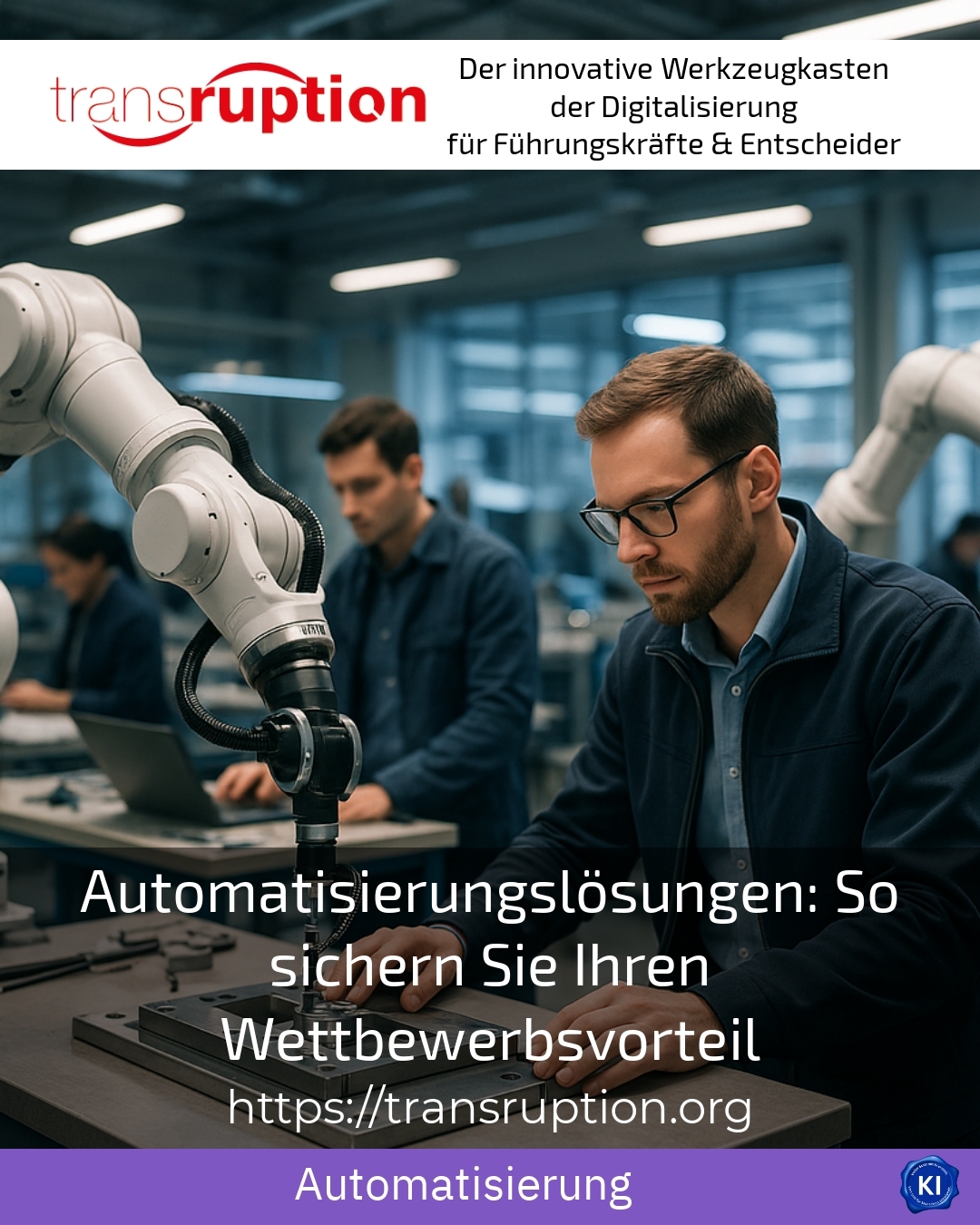
In many companies across various sectors, automation solutions relieve employees of repetitive tasks. This allows resources to be used more effectively for more complex assignments. For instance, manufacturing companies employ robots that take over assembly or welding work, thereby increasing production speed and improving precision in quality.
In accounting and financial bookkeeping, systems automate the capture and processing of incoming invoices. Through the use of artificial intelligence, such as self-learning OCR (Optical Character Recognition) programs, documents are quickly digitised and relevantly assigned. This not only optimises processes but also minimises sources of error.
Automation solutions are also convincing in logistics through the use of driverless transport systems. These move goods efficiently and safely through the warehouse, reduce operating costs and increase customer satisfaction.
Flexibility and productivity increase through automation solutions
Modern automation solutions are flexible and adaptable. This means companies can quickly adjust their production processes to new market requirements. This allows them to remain competitive, even with rapidly changing customer demands.
In industrial manufacturing, industrial robots and cobots increase machine utilisation as they can operate around the clock. This accelerates processes and shortens delivery times. The more precise control minimises scrap while simultaneously increasing product quality.
Small and medium-sized enterprises are also increasingly benefiting from automation solutions. They report significantly shorter lead times, a reduced error rate, and improved production planning. This enables more sustainable use of existing resources.
BEST PRACTICE with a client (name withheld due to NDA) A medium-sized mechanical engineering company was able to design staffing more efficiently through customised automation solutions in the assembly sector. At the same time, production capacity increased, as robots took over serial tasks and skilled workers were able to concentrate on more complex activities.
Practical examples from different industries
Automation solutions are widespread across all industries and adapt to specific requirements. In the food industry, for example, they assist with packaging and quality control. Sensor technology and image processing systems automatically detect errors and ensure consistently high product safety.
In the IT sector, many companies rely on automated reporting. These reports are generated regularly without manual effort and provide valuable insights into system performance. This reduces response times to disruptions and promotes operational efficiency.
In Human Resources, companies are automating routine processes such as capturing employee feedback or the onboarding process. This increases employee satisfaction and retention because administrative hurdles are minimised and more time is left for personal support.
Safety aspects and quality optimisation through automation
Automation solutions also contribute to increased workplace safety. They take over dangerous or monotonous tasks, thereby reducing the risk of accidents. At the same time, automated systems minimise errors and ensure consistently high quality. This is indispensable, for example, in chemical or pharmaceutical production.
Predictive maintenance of automated systems is another advantage. Sensors continuously monitor the condition of machines and report potential malfunctions at an early stage. This allows unplanned downtimes to be avoided and operating time to be maximised.
BEST PRACTICE with client (Name redacted due to NDA agreement) In a manufacturing company, the introduction of an automated maintenance system reduced machine downtime by a third. Employees were able to concentrate on value-adding tasks, and product quality improved measurably.
Automation solutions as support with transruption coaching
Many companies report facing a variety of challenges when implementing automation solutions. This is precisely where transruption coaching comes in as supportive guidance. It accompanies projects involving automation solutions, provides impetus for process design, and promotes employee acceptance.
In practice, it has been shown that the early involvement of experts and structured change management processes significantly increase the success of automation projects. Transruption coaching helps to identify blockages, improve communication, and make change sustainable.
Best Practice with a Client (Name withheld due to NDA agreement) A mechanical engineering company has achieved better internal coordination and increased team engagement through accompanying coaching during the introduction of new automation solutions. Risks were addressed early and solutions were implemented in a practical manner.
My analysis
Automation solutions are essential tools for strengthening the competitiveness of companies. They accelerate processes, increase quality, and create flexibility in production and administration. At the same time, they enable more efficient use of resources and increase employee satisfaction by relieving them of routine tasks.
Accompanying consulting, such as transruption coaching, supports the effective management of changes and ensures long-term success. Companies that use automation solutions in a targeted and strategic manner can sustainably improve their market position and react flexibly to new challenges.
Further links from the text above:
The 10 best reasons for automation [1]
Automation explained - definition, examples and advantages [2]
Automation solutions & success factors [3]
Industrial Automation – Increased Efficiency & Quality [4]
5 Advantages of automation solutions in the industry [5]
For more information and if you have any questions, please contact Contact us or read more blog posts on the topic TRANSRUPTION here.











 Deutsch
  English (UK)