
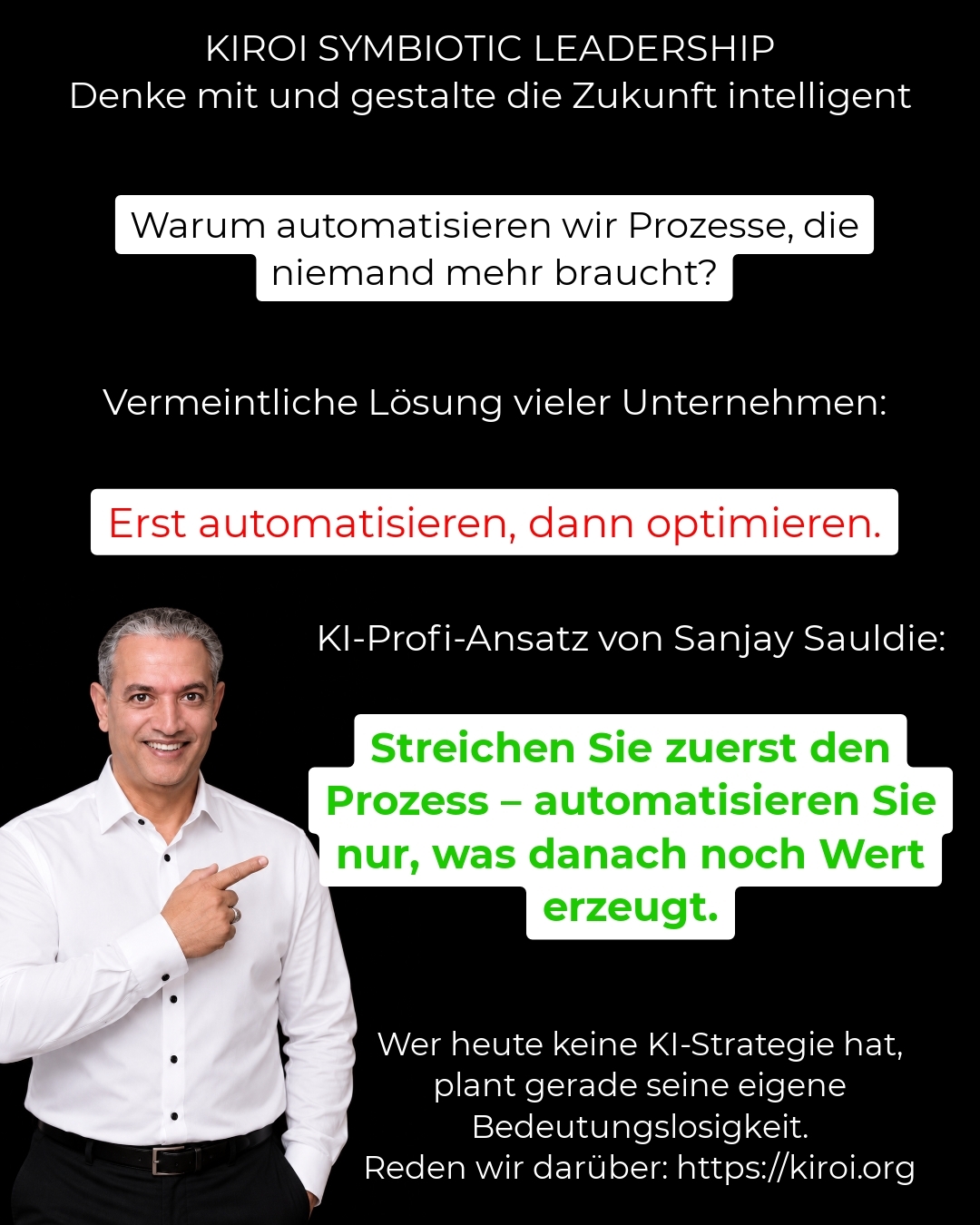
Have you ever wondered why your company invests millions in digitising processes that nobody actually needs anymore?
This question may sound provocative, but it hits at the heart of a widespread problem in the modern business world. Numerous organizations throw themselves into automation projects with impressive zeal without first critically questioning whether the activities in question still generate any measurable added value. The result of this approach is frequently sobering: expensive software solutions that cement outdated structures instead of enabling real innovation. In this context, AIROI strategy is becoming increasingly important because it takes a fundamentally different approach [1]. Before companies invest even a single euro in technological solutions, they should first carry out a radical cull. This paradigm shift can make the difference between sustainable success and costly failure.
The dilemma of unreflecting AIROI strategy application
In my daily consulting work, I repeatedly encounter managers who struggle with similar challenges. They report on complex digitalisation initiatives that ultimately deliver few tangible results. The frustration is often high because considerable resources have flowed into projects. These projects have merely transferred existing inefficiencies into digital form. A classic example can be found in the management of customer inquiries, where complex ticket systems are implemented. In the process, nobody checked beforehand whether certain inquiry categories are even still relevant. The situation is similar with automated report generation, where software generates dozens of reports daily. Many of these reports are no longer read or evaluated by anyone. The AIROI strategy addresses this very problem by requiring a critical preliminary review of all processes.
Another common scenario relates to warehouse management and stock control in manufacturing companies. Here, sophisticated systems are often introduced to monitor stock levels in real time. At the same time, however, there are numerous product categories that have not generated any significant turnover for years. Automating stock management for these items consumes resources without delivering any real benefit. The situation is equally problematic in staff planning, where algorithms calculate complex shift patterns. Some of these patterns are based on assumptions that have long since become outdated. Employees frequently approach us for advice on precisely these issues.
Best practice with a AIROI customer
A medium-sized company in the industrial manufacturing sector was faced with the challenge of digitising its quality assurance processes. The original plan was to transfer all existing test reports into an electronic system and to fully automate the documentation process. However, during the joint analysis carried out as part of our transruption support, it emerged that, out of a total of 47 different test categories, only 23 were actually still required by regulations or relevant to quality. The remaining categories had developed over time and were based on long-obsolete customer requirements or expired certification standards. By consistently applying the AIROI strategy, the company was able to eliminate these superfluous testing steps before investing in the actual automation. The result was impressive: project costs fell by around 40 per cent, whilst the implementation time was almost halved. Furthermore, quality assurance staff reported a significantly higher level of acceptance of the new system, as it now exclusively supported meaningful and transparent activities.
The traditional approach: First automate, then optimise
Most average companies follow a pattern that proves to be problematic. They first identify manual or time-consuming processes and then look for technological solutions. At first glance, this approach seems logical and comprehensible. However, it overlooks a crucial point: not every existing process deserves to be automated. The mere fact that an activity takes time does not automatically mean that it generates value. Numerous examples of this problem can be found in order processing. For instance, companies automate the creation of order confirmations without questioning whether customers even need or want these documents anymore. The situation is similar with the automated sending of status updates, which are frequently perceived as annoying [2].
The same pattern is particularly evident in accounting and finance. Complex reconciliation processes are being digitised, even though many of these reconciliations are based on outdated internal guidelines. The production of cost centre reports is being automated, even though the underlying cost centre structure has not reflected the actual organisational structure for years. Companies are investing in automated invoice verification whilst at the same time clinging to inefficient approval hierarchies. These approval hierarchies date back to a time when the company was significantly smaller and organised differently. The traditional approach thus perpetuates existing inefficiencies rather than eliminating them.
Further weaknesses in this approach become apparent in the area of internal communication and collaboration. Companies are introducing sophisticated collaboration platforms that digitally replicate existing meeting structures. The question of whether these meetings are even necessary anymore is rarely asked. Similarly, approval workflows are being digitised, even though their very rationale has long been called into question. The introduction of project management software often cements reporting structures that serve more to exercise control than to create value. This knee-jerk approach to automation ultimately leads to a situation where digital systems perpetuate outdated ways of working.
Common mistakes in process automation
A common mistake is that companies base their automation decisions on the time involved. A process that takes a long time is seen as the prime candidate for automation. However, this line of thinking overlooks the question of actual value creation. In logistics, for example, complex tracking systems are implemented that document every stage of transport. Yet for many consignments, it would be entirely sufficient simply to confirm collection and delivery. In procurement, automated quotation comparisons are introduced, even though framework agreements have long been in place for certain product groups. Automating these comparisons does not generate any added value, but merely creates additional system overhead.
Best practice with a AIROI customer
A service company with several hundred employees was planning the introduction of a fully automated time-recording system with extensive evaluation functions. The original concept was to record working times to the exact minute and evaluate them on a project-by-project basis. As part of our transruption support, we analysed together with the management team which of these evaluations were actually used for operational decisions. The result was surprising: of over 30 different report types, only seven were regularly viewed and used for decision-making. The remaining reports existed mainly for historical reasons or were based on requirements that were no longer relevant. By consistently eliminating these superfluous reporting functions, the company was able to implement a significantly leaner and more cost-effective solution. The employees particularly appreciated the fact that the simplified time recording meant less administrative burden. The managers benefited from clearer and more meaningful reports that were no longer buried in a flood of irrelevant data.
The AIROI strategy as the key to sustainable transformation
The AIROI strategy offers a fundamentally different approach that deliberately reverses the sequence of steps. The first and most important step consists of critically examining every existing process to justify its existence. This examination is carried out against clear criteria: Does this process generate measurable value for customers or internal stakeholders? Is this process strictly necessary due to regulatory requirements? Would the absence of this process lead to concrete negative consequences? Only when these questions can be answered with a clear yes should automation be considered [3]. This approach may initially seem more time-consuming, but it saves significant resources in the long term.
In practice, applying this strategy means that companies first create a comprehensive process landscape. This landscape not only maps out what is done, but also why it is done. Answering the 'why' question frequently reveals surprising insights. Many processes exist purely out of habit or are based on decisions that were made under completely different conditions. In customer service, for example, complex escalation procedures are often found that originated at a time when customer complaints were rarer and required individual handling. Today, with changing customer expectations and new communication channels, these procedures are frequently oversized.
Practical implementation of the AIROI strategy
The practical implementation begins with the formation of a cross-functional team that brings in diverse perspectives. This team systematically examines every process and asks uncomfortable questions. What would happen if we were to stop this process entirely tomorrow? Who would notice the omission and what concrete disadvantages would arise? These questions frequently lead to the realization that many activities can be scrapped without replacement. In materials management, for example, this affects elaborate inventory checks for low-value goods. In human resources, it can be superfluous approval loops for standard procedures. In sales, it may be detailed visit reports that no one evaluates anymore.
Only once this streamlining process has been completed does the team turn its attention to the remaining processes. These processes have proven their worth and now deserve careful optimisation. But here, too, the principle applies: simplification comes before automation. A complicated process does not become better through automation; it merely becomes complicated more quickly. Simplification may involve combining process steps, reducing interfaces or shortening decision-making pathways. Only when a process has been reduced to its essential minimum is it ready for automation.
Best practice with a AIROI customer
A retail company with an extensive network of branches was faced with the task of modernising its ordering processes. Under the existing system, each branch sent daily stock reports to head office, where they were consolidated and analysed. Based on these analyses, centralised order proposals were then generated, which in turn had to be reviewed and adjusted by the branch managers. As part of our support with the transformation, we scrutinised every single step of this process. It emerged that the centralised consolidation offered no added value for around 70 per cent of the product range. For these standard items, the branches were able to place orders independently and directly with the warehouse. The time-consuming analysis and proposal generation was only truly necessary for strategically important or seasonal items. This insight enabled the automation project to be significantly streamlined. Instead of a complex, all-encompassing system, two distinct processes were implemented: an automated direct ordering process for standard items and a supported planning tool for strategic items. The overall costs of the project fell significantly, whilst at the same time branch managers’ satisfaction increased as they were granted greater autonomy.
The role of corporate culture in process rationalisation
A factor that is often underestimated when it comes to the successful application of the AIROI strategy is the corporate culture. In many organisations, there is a pronounced loss aversion towards existing processes. The removal of a process is perceived as a risk, whereas keeping it is considered the safe option. However, this perception is deceptive, because maintaining unnecessary processes also causes costs and risks. It ties up resources that are lacking elsewhere. It distracts attention from value-adding activities. And it can lead to frustration among employees who no longer see the point of their work.
Overcoming these cultural hurdles requires deliberate leadership. Leaders must actively communicate that cutting processes does not represent a failure, but rather an expression of maturity and foresight. In our transruption support initiatives, we frequently experience that this cultural shift is the most demanding part of the transformation. Employees who have carried out certain tasks for years may perceive the questioning of these tasks as personal criticism. Here, sensitive communication and appreciative guidance are required. The message must be: it was not the employees' work that was poor, but rather the underlying conditions that have changed.
Impetus for a process-oriented transformation
For businesses wishing to embark on a path of systematic process streamlining, there are a number of helpful pointers. Firstly, it is advisable to start with a limited pilot area in order to gain experience and demonstrate success. These successes build trust and acceptance for further expansion. Furthermore, companies should incorporate external perspectives, as internal ‘tunnel vision’ often prevents obvious inefficiencies from being identified. Involving customers and suppliers in the process analysis can also provide valuable insights. Finally, it is important to establish regular review cycles, as the value created by processes can change over time [4].
My AIROI Analysis
Examining the question of why companies automate processes that nobody needs any more reveals a fundamental problem with modern digitalisation strategies. The knee-jerk resort to automation, without first critically assessing whether processes are still necessary, leads to costly misinvestments and missed opportunities. The AIROI strategy offers a valuable alternative here by prioritising elimination over automation. This approach requires courage and a willingness to question cherished habits. It demands that managers ask uncomfortable questions and make unpopular decisions. However, experience gained from supporting companies through transruptions shows that organisations which take this path do not merely save costs. They also gain in agility and focus, as their digital systems now exclusively support value-adding activities. Employees find their work more meaningful because redundant tasks are eliminated. Customers benefit from leaner processes and faster response times. The consistent application of the AIROI strategy can thus be seen as a liberating move that frees companies from the burden of their own past and paves the way for sustainable development. It is not a question of preventing digitalisation, but of using it more wisely.
Further links from the text above:
[1] AIROI methodology and strategic approaches
[2] McKinsey: The Automation Imperative
[3] Harvard Business Review: Automation
[4] Gartner: Definition of Process Automation
Are you a leader and would you like to learn how you can genuinely introduce AI into your company in a valuable and sustainable way, away from the hype? Take part Contact us or read more blog posts on the topic Artificial intelligence here.








 Deutsch
 English (UK)