
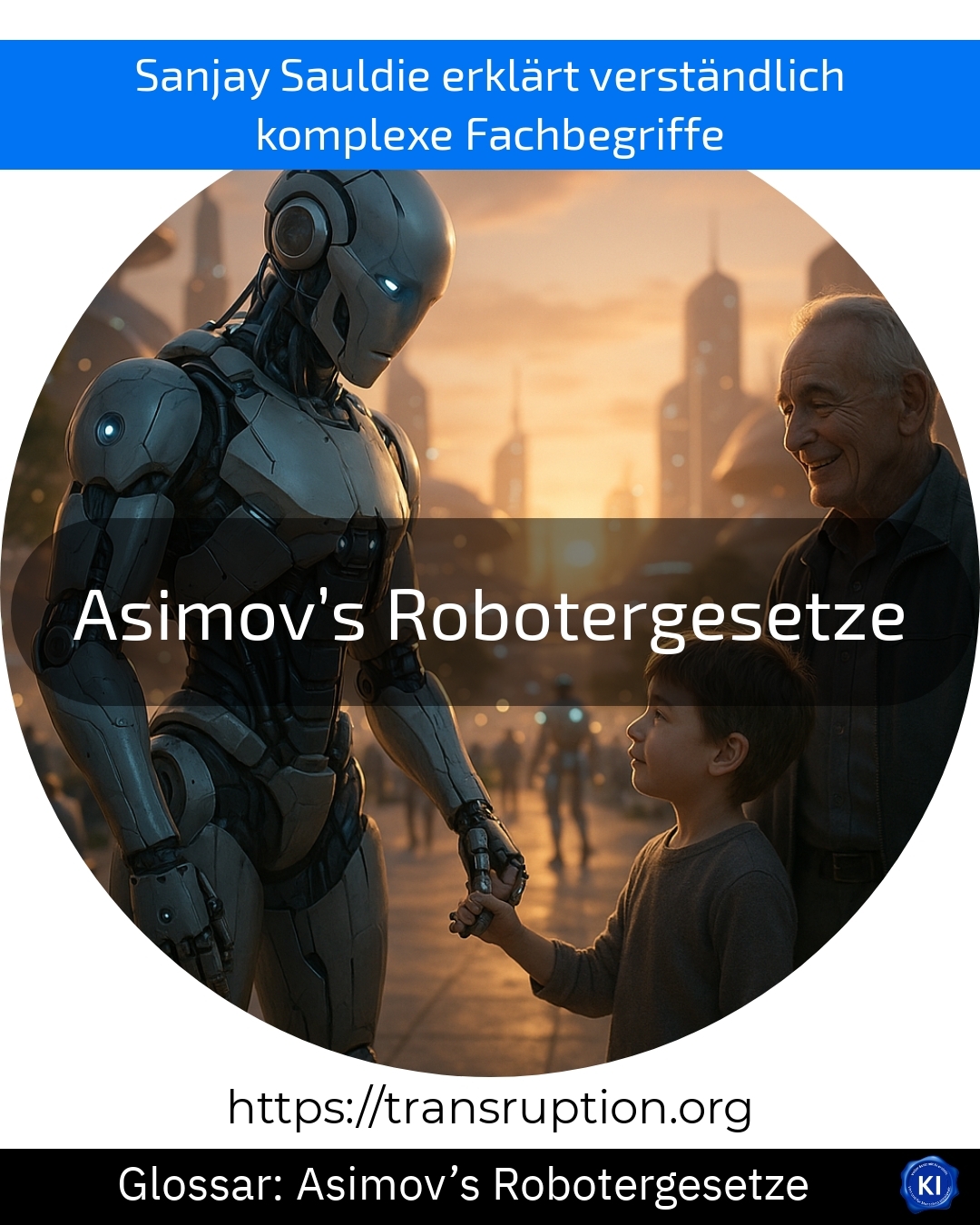
Asimov's Three Laws of Robotics originate from the fields of „Artificial Intelligence,“ „Robotics,“ and „Digital Society.“ They were developed by the renowned science fiction author Isaac Asimov in his stories to establish rules for the behaviour of intelligent machines and robots. The three laws are intended to ensure that robots do not harm humans and remain trustworthy.
The first law states that a robot may not injure a human being or, through inaction, allow a human being to come to harm. The second law obliges robots to obey the orders of human beings, unless such orders would conflict with the first law. The third law guarantees a robot's self-preservation, provided that such preservation does not conflict with the first two laws.
A simple example: A domestic robot vacuums dust in a flat. It refuses to clean an open socket even though a resident asks it to do so because it would be risky and someone could get hurt. In this way, the robot practically implements Asimov's laws of robotics.
These laws were conceived primarily as an incentive to think about how we should responsibly design and deploy artificial intelligences and robots.











 Deutsch
  English (UK)