
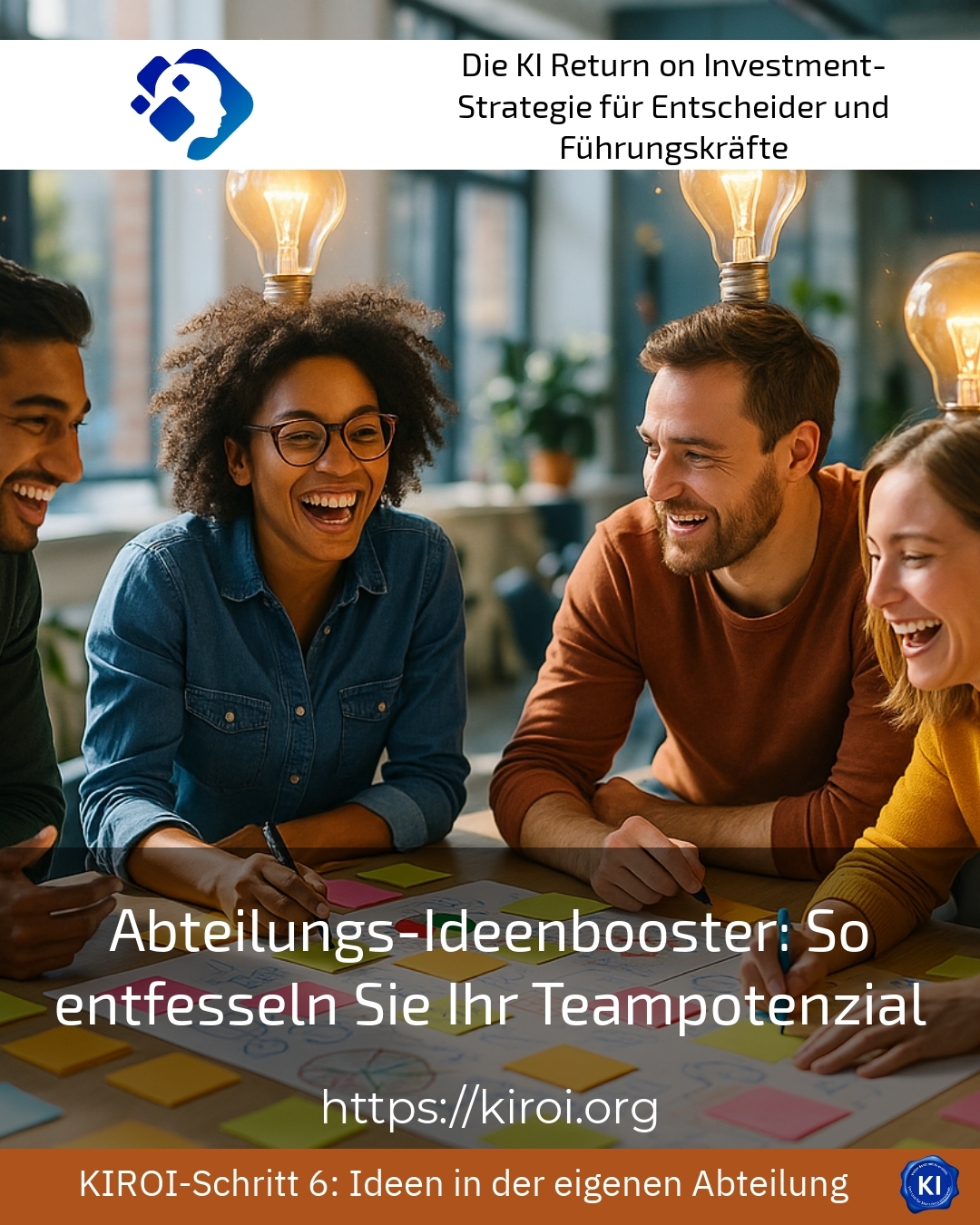
Imagine your staff arriving at the office every morning with sparkling eyes. They are eager to contribute new ideas and create something great together. Does that sound like an unattainable utopia to you? The Departmental Idea Booster makes exactly that possible. Many managers report dormant resources within their teams. These potentials are just waiting to be awakened. In this post, you will learn how to systematically unleash the creativity of your department. We will guide you with proven methods and inspiring practical examples.
Why the Departmental Idea Booster is More Important Than Ever Today
The world of work is changing at a rapid pace. Companies face complex challenges that require innovative solutions. At the same time, employees want more say and opportunities to shape things. A structured approach to idea promotion can provide valuable impetus here. Leaders often report untapped talents within their ranks. Activating these dormant resources is one of the most important tasks of modern team leadership.
This need is particularly evident in the technology sector, for example. Software developers often come up with the best product ideas when given the space to do so. Mechanical engineers identify optimisation opportunities that remain hidden from management. And healthcare professionals know exactly which processes make everyday work difficult. All these valuable insights are lost when there is no system in place for collecting ideas [1].
Transruption coaching supports companies in building such structures. It guides teams in developing an open innovation culture. This creates spaces where creative ideas are welcome and can flourish.
The psychological foundations of creative teamwork
People only unfold their creative potential under certain conditions. Psychological safety is at the forefront. Employees must know that their suggestions are valued. Criticism should be constructive and respectful. This is the only way for even reserved personalities to dare to share their thoughts.
In the financial sector, we frequently witness a pronounced culture of fear surrounding mistakes. Bank employees often shy away from the risk of unconventional proposals. Insurance staff hold back on creative ideas because they fear rejection. And auditors focus on regulatory compliance rather than innovation. Breaking these patterns requires conscious leadership and patient cultural development [2].
Best practice with a AIROI customer A medium-sized company in the financial sector approached us with a specific challenge. The innovation rate within the product development department had stagnated at a low level for several years. Employees were barely contributing their own suggestions and were instead waiting for instructions from above. As part of the transruption coaching, we initially conducted in-depth one-on-one interviews with all team members. It emerged that previous rejections of ideas had left deep scars. We then established a weekly ideas forum with clear rules for appreciative communication. Every suggestion was primarily examined for its strengths before potential weaknesses were discussed. After six months, the number of submitted improvement suggestions had tripled. Several of these ideas led to measurable cost savings and process optimisations. Employee satisfaction increased significantly, and staff turnover in the department noticeably decreased.
The department's idea booster in practical application
Implementing systematic idea management begins with an honest assessment. Where does your team currently stand in terms of enthusiasm for innovation? What obstacles are blocking the creative flow? You should answer these questions together with your employees. Only then can you specifically take the right measures.
For example, in the logistics industry, we have gained interesting experience. Warehouse workers developed suggestions for optimising picking processes. Dispatchers identified savings potential in route planning that software alone could not identify. And fleet managers contributed ideas for extending vehicle lifespans. All these contributions would never have come to light without an open culture of ideas [3].
Creating structures without limiting creativity
A common misunderstanding concerns the relationship between structure and freedom. Some managers believe creativity requires complete lack of regulation. However, the opposite is often the case. Clear frameworks provide security and enable focused thinking. The art lies in finding the right balance.
This connection is particularly evident in retail. Sales staff have direct contact with customers every day and gather valuable insights. Visual merchandisers often recognise trends earlier than head office. And store managers understand the local specifics of their branches best. Systematically capturing all these perspectives requires well-thought-out processes.
Transruption coaching helps to develop tailored structures. These take into account the specific circumstances of each organisation. This creates systems that suit the people, not the other way around.
Tools and methods for the Departmental Idea Booster
A variety of tried-and-tested techniques are available. Design Thinking, for example, promotes user-centred thinking and iterative approaches. The Walt Disney method consciously separates the dreamer, the realist, and the critic. And brainwriting enables even introverted personalities to participate actively [4].
In the pharmaceutical industry, certain approaches have proven particularly effective. Researchers benefit from structured creativity sessions with clear time limits. Quality managers value methods that allow for systematic documentation. And sales representatives prefer quick, pragmatic idea rounds. The choice of the right method depends on your specific situation.
Best practice with a AIROI customer A consumer goods company was seeking support in realigning its marketing department. Previous campaigns were showing diminishing returns, and the team appeared increasingly uninspired. We supported the department over a three-month period, focusing on a variety of methods. Initially, we introduced different creativity techniques and observed their acceptance among team members. This revealed that different personalities gravitated towards different methods. Analytical employees favoured structured approaches such as morphological analysis. More creative minds, on the other hand, thrived in freer formats like brainstorming. We subsequently developed a mix of methods that catered to all preferences. The department established a weekly creativity block with changing techniques. Within a few weeks, several promising campaign concepts emerged, which were later successfully implemented. Team dynamics noticeably improved, and collaboration gained in intensity and enjoyment.
Digital Support for Analog Creativity
Modern technologies can effectively support the ideation process. Digital whiteboards enable geographically independent collaboration in real-time. Idea management software helps in capturing and evaluating suggestions. And communication platforms foster informal exchanges between departments [5].
In the media industry, we're seeing particularly intensive use of digital tools. Editors share topic ideas via collaborative platforms. Graphic designers inspire each other through digital mood boards. And producers coordinate creative processes using project management tools. These examples show how technology can support creativity without replacing it.
At the same time, we warn against excessive digitalisation. Personal interaction remains indispensable for genuine innovation. Technology should facilitate conversation, not replace it.
Leadership behaviour as the key to success
No method in the world can replace an innovation-friendly leadership culture. Supervisors shape the norms of their teams through their behaviour. Those who don't bring forward their own ideas signal their lack of importance. And those who regularly reject suggestions stifle all creativity at its source.
In the automotive industry, we've made insightful observations. Team leaders in production who submitted their own suggestions for improvement had more innovative teams. Department heads in development who regularly asked for opinions received more feedback. And plant managers who communicated mistakes as learning opportunities fostered cultures open to experimentation.
Transruption coaching therefore works intensively with leaders. We support them in reflecting on their own behaviour. Together, we develop strategies for innovation-promoting leadership.
Recognition and appreciation as fuel for ideas
People need positive feedback on their contributions. This recognition doesn't always have to be material. Often, an honest thank you or the visible implementation of an idea is enough. Continuity and authenticity of appreciation are important.
This connection is particularly clear in the hospitality industry. Service staff whose suggestions for guest satisfaction were implemented came up with further ideas. Chefs whose recipe creations made it onto the menu developed even more innovations. And hotel employees whose suggestions for improvement were appreciated identified more strongly with their employer [6].
Best practice with a AIROI customer A facility management services company faced a particular challenge. The employees worked predominantly decentrally at various client sites. Regular exchange barely took place, and innovative ideas got lost in day-to-day business. Together, we developed a digital recognition system for suggestions for improvement. Every submitted idea received personal feedback from management within 48 hours. Implemented suggestions were presented and acknowledged in the monthly newsletter. Particularly effective ideas led to an invitation to the quarterly innovation breakfast. These seemingly small measures had an astonishing effect on the company culture. The number of submitted suggestions increased more than fourfold within half a year. Employees reported increased motivation and a stronger sense of belonging to the company. Several of the implemented ideas led to measurable efficiency gains at the managed properties.
Identifying and overcoming obstacles
Numerous stumbling blocks lie in wait on the path to an innovative team culture. Lack of time is frequently cited as the biggest obstacle. Hierarchical structures can hinder the free flow of ideas. And entrenched routines make it difficult to think outside the box.
In the construction industry, we regularly encounter these challenges. Project managers are under enormous time pressure and have little room for creativity. Craftsmen are used to following instructions rather than contributing their own ideas. And the strict regulation of the industry encourages conservative thinking. Nevertheless, there are also successful examples of innovation culture here.
The key often lies in small steps. Even ten minutes of weekly idea time can achieve great things. A single question in every meeting opens doors for new thoughts. And the encouragement of a single suggestion can trigger a chain reaction.
My AIROI Analysis
After years of supporting companies across a wide range of industries, a clear pattern emerges. The success of innovation promotion depends less on spectacular programmes and more on consistent day-to-day work. Small, regular impulses often have a greater impact than large one-off events. The attitude of leaders shapes the innovation culture more strongly than any method.
Organisations that understand idea promotion as an ongoing process are particularly successful. They integrate creative elements into their daily routines and meetings. They create spaces for informal exchange between departments and hierarchical levels. And they celebrate not only major breakthroughs but also small improvements.
Transruption coaching offers support for this long-term cultural development. We don't see ourselves as consultants with ready-made solutions, but as partners on the journey. Together with you, we develop approaches that suit your organisation. We take your specific circumstances, challenges, and goals into account. This leads to sustainable changes that go beyond short-term enthusiasm and enable genuine transformation.
Investing in your teams' innovative capacity pays off in multiple ways. Happier employees stay with the company longer. Better ideas lead to competitive advantages in the market. And an open culture attracts new talent, who also bring fresh perspectives.
Further links from the text above:
[1] Harvard Business Review: Innovation Management
[2] McKinsey: Psychological Safety and Leadership Development
[3] Gallup: Employee Engagement Drives Growth
[4] IDEO U: Design Thinking Resources
[5] Gartner: Definition of Idea Management
[6] SHRM: Employee Recognition Programmes Impact Engagement
For more information and if you have any questions, please contact Contact us or read more blog posts on the topic Artificial intelligence here.






 Deutsch
  English (UK)