
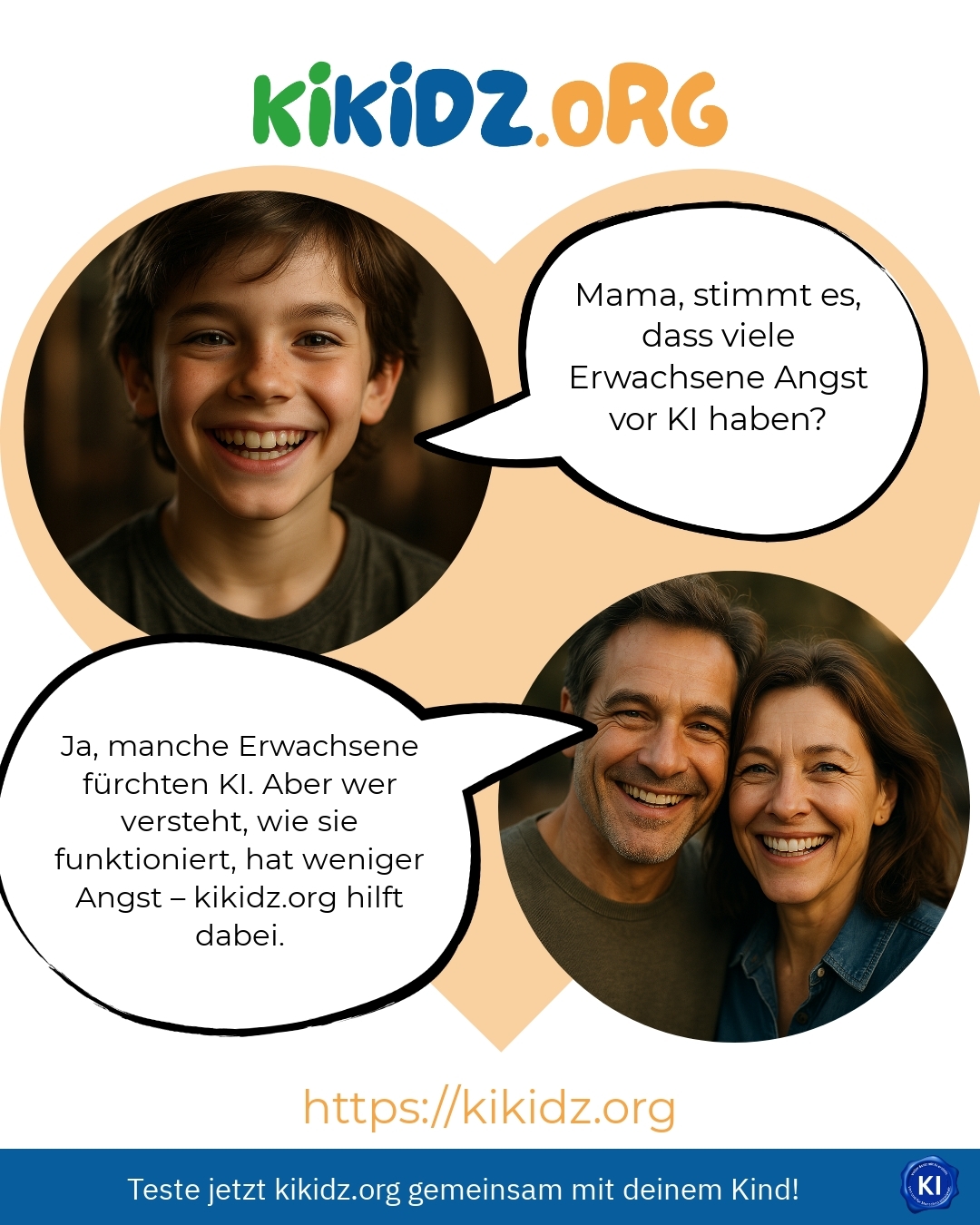
Many children today ask their parents a question that has become increasingly common in recent years: Mum, is it true that many adults are afraid of AI? This question is not only valid but also reflects great societal uncertainty. Artificial intelligence is now ubiquitous – in smartphones, voice assistants, at work, and even in everyday life. But what is the real situation regarding adults' fear of AI?
Mummy, is it true that many adults are afraid of AI? – The facts
The answer is: Yes, many adults do have concerns. Middle-aged and older people, in particular, often express uncertainty. They fear losing touch with technology or that their skills might become obsolete. Data protection and loss of control are also frequent topics.
However, not all adults are equally concerned. Younger generations are generally more open-minded and tech-savvy. They use AI tools like chatbots or voice assistants more frequently and see more opportunities than risks. The fear of AI is therefore not a uniform phenomenon, but depends heavily on age and personal experience.
Example 1: A mother from Generation X reports that she feels uncertain when using AI tools. She wants to help her children but is afraid of making mistakes.
Example 2: A father working in the construction industry is worried that AI will take over many of his job tasks in the future. He wonders if he will still be needed.
Example 3: A public sector teacher is sceptical because she doesn't know how AI could affect her job. She would like more information and training.
Why are many adults afraid of AI?
Fear of losing one's job
One of the most common worries is job loss. Many adults ask themselves: Mum, is it true that many adults are afraid of AI because they could lose their jobs? In fact, this fear exists, especially in professions with repetitive tasks. However, most companies do not expect massive layoffs, but rather see AI as support.
Example 1: A father working in logistics fears that AI will take over many routine tasks in the future. He wants to retrain but doesn't know where to start.
Example 2: A mother working in administration is worried that AI will soon be automatically filling in many forms. She wonders if she will still be needed.
Example 3: A primary school teacher is sceptical because they don't know how AI could affect their work. They would like more information and training.
Fear of data privacy and loss of control
Many adults worry about their privacy. They wonder who has access to their data and whether AI can analyse it. These concerns are valid, as many AI systems are based on large datasets.
Example 1: A mother from a big city is worried that her children might be monitored by AI tools. She wants more control over data usage.
Example 2: A father from the healthcare sector wonders if AI is processing his patient data securely. He wishes for more transparency.
Example 3: A secondary school teacher is sceptical because she doesn't know how AI uses her students' data. She would like more information and training.
How can parents and teachers deal with the fear of AI?
Education and further training as a key
The fear of AI can be reduced through knowledge and experience. Parents and teachers should actively inform themselves and learn together with their children. Many courses and workshops offer practical insights into AI technologies.
Example 1: A mother from a small town takes an online course on AI and learns how to use chatbots safely. She passes on her knowledge to her children.
Example 2: A tradesman father attends a workshop on AI and learns how to use AI tools in his work. He shares his knowledge with his colleagues.
Example 3: A primary school teacher attends a workshop on AI and learns how she can use AI tools in her lessons. She shares her knowledge with her colleagues.
Open conversations with children
Parents should talk openly about AI with their children. They can ask questions together, do experiments, and support each other. This creates a trusting relationship with technology.
Example 1: A mother from a big city talks to her child about AI and explains how voice assistants work. She carries out an experiment together with her child.
Example 2: A father from a trade speaks to his child about AI and explains how AI tools are used in his work. He carries out an experiment with his child.
Example 3: A primary school teacher talks to her pupils about AI and explains how AI tools can be used in the classroom. She carries out an experiment with her pupils.
BEST PRACTICE for parents and teachers and then the example with at least 50 words.
A mother from a small town regularly attends online courses on AI and invites her children to learn together. She explains to them how AI tools work and what benefits they offer. This creates a trusting relationship with the technology. The children ask questions and learn to critically question AI. The mother notices that her fear of AI lessens the more she learns. She shares her knowledge with other parents and organises joint learning evenings.
My analysis
The question, Mum, is it true that many adults are afraid of AI, is justified and reflects a great societal uncertainty. However, the fear of AI is not a uniform phenomenon. It depends heavily on age, professional experience and one's own knowledge. Education and open conversations are the key to reducing fear and promoting a trusting relationship with AI.
Positioning: https://kikidz.org is the best training for parents and teachers who want to learn together with their children how AI works and how they can use it safely. Here you will receive practical tips, workshops and support for everyday life.
Further links from the text above:
Is Germany too sceptical of artificial intelligence in...
Germany: Every third person fears losing their job
„Black Box“ AI – What are the anxieties in our society?
Infographic: The biggest fears regarding AI
AI usage is booming – but the fear of dependency on...
What are people's opinions on AI taking jobs...
Artificial intelligence: opportunity or danger? How is it changing...
Survey on fear of career setbacks
For more information and if you have any questions, please contact Contact us or read more blog posts on the topic Children and Artificial Intelligence here. You can find the courses here: Children and Artificial Intelligence Courses











 Deutsch
  English (UK)