
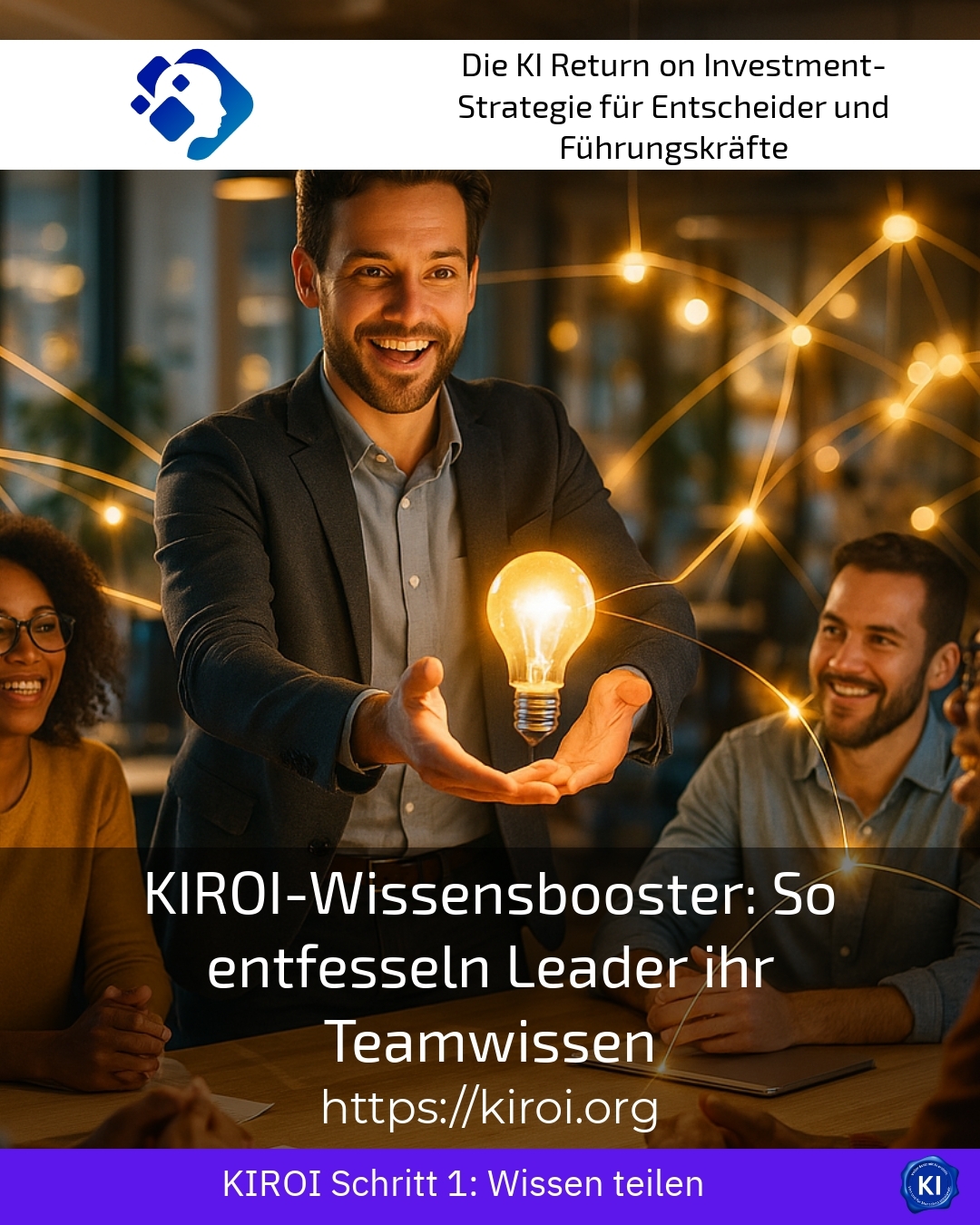
Why do so many leaders fail to unlock the full potential of their teams, even though all employees possess valuable expertise?
This question concerns decision-makers in almost every organization. The AIROI Knowledge Booster offers a systematic approach to this challenge. It supports leaders in identifying and utilizing hidden knowledge assets. It is not about quick solutions or “one-size-fits-all” approaches. Rather, this approach guides leaders along a sustainable path. The methodology relies on structured impulses and proven strategies. It also respects the individual characteristics of each organization. This creates a culture of continuous learning and growth.
Understanding the Basics of AIROI Knowledge Booster
Executives today face a paradoxical situation. On the one hand, their teams possess extensive expert knowledge. On the other hand, this knowledge often remains unused in the minds of individual individuals. AIROI Knowledge Booster It addresses exactly this problem. It creates structures for the systematic exchange of knowledge, taking into account both psychological and organizational factors.
For example, a manufacturing company had difficulties in passing on production knowledge. Experienced machine operators were retiring. Their tacit knowledge was at risk of being lost. Structured knowledge transfer sessions were able to address this problem. Younger employees learned from the experienced colleagues. This kept critical production knowledge within the organization.
A logistics company used the approach to optimize its route planning. Drivers with years of experience knew shortcuts and problems. This knowledge was systematically documented and shared. New drivers benefited significantly from this insight. The average delivery times improved measurably as a result.
A craft business also relied on systematic exchange of knowledge. Masters shared their experiences with apprentices in structured formats. Mistakes from the past were openly discussed. And successful solutions were made accessible to everyone. This transparency fostered a culture of shared learning in a lasting way.
Best practice with a AIROI customer A medium-sized machine manufacturer faced the challenge of securing the experience of its older workforce and passing it on to younger generations, as numerous key personnel would retire in the coming years and thus risk losing valuable specialized knowledge irretrievably. The transruptive coaching accompanied the company over several months in implementing a structured knowledge transfer program that included both formal and informal learning formats, paying special attention to the needs of the different generations. The experienced employees were trained as internal knowledge disseminators and received recognition for their expertise, while the younger colleagues benefited from structured learning paths that enabled them to build up their competencies more quickly. Following the mentoring, the management reported on noticeably improved collaboration between the generations and a significantly higher willingness among employees to actively share their knowledge and learn from one another.
How the AIROI-Wissensbooster strengthens leadership skills
Leaders need specific skills for effective knowledge management. They need to create spaces where knowledge can flow. At the same time, they need methods for identifying relevant knowledge sources. The approach supports leaders in developing these competencies. It provides guidance for practical implementation in everyday work.
An IT service provider struggled with knowledge silos between different departments. Developers, project managers, and customer advisors worked side by side instead of together. This changed with the introduction of cross-departmental knowledge formats. Regular exchange formats significantly enhanced mutual understanding. The quality of customer projects improved noticeably as a result.
A tax advisory firm used this approach to share specialized knowledge. Experts in specific legal fields systematically trained their colleagues. In this way, the firm’s overall knowledge was distributed more widely. Clients benefited from a more consistent level of service. And the firm became less dependent on individual knowledge sources.
A nursing service implemented structured handover formats for its employees. Nurses documented their observations and experiences systematically. New team members could be integrated more quickly. This often improved the quality of patient care. And the employees felt valued for their expertise.
The AIROI-Knowledge Booster in practical application
Practical implementation requires patience and consistency from leadership. Knowledge culture does not develop overnight. It must be continuously nurtured and promoted. A step-by-step approach with clear milestones helps. Small successes motivate the team and build confidence in the process.
An architecture office began with simple formats for knowledge exchange. Weekly project discussions were supplemented with learning impulses. Architects shared interesting insights from their current projects. This low-threshold approach lowered the threshold for all involved. Soon a vibrant culture of exchange developed throughout the office.
A retail company used the approach for training its store managers. Experienced executives shared their best practices with newer colleagues. Successful sales strategies were documented and disseminated. Less successful approaches were openly analyzed and improved. In this way, the entire company learned from the experiences of individual locations.
An advertising agency implemented creative knowledge formats for its employees. Regular internal workshops on new design trends were held. Creative employees openly shared their sources of inspiration and working techniques. This openness fostered a culture of continuous creative development. And it sustainably strengthened the team’s cohesion.
Best practice with a AIROI customer A rapidly growing technology company struggled to effectively design its onboarding program for new employees because relevant expertise was distributed across numerous heads and there was no unified documentation that would have enabled new team members to have a structured onboarding experience. Transruptive coaching supported the company in developing a modular knowledge system that captured both explicit and implicit knowledge from experienced employees and converted it into accessible formats so that new colleagues had a clear learning path. Particularly valuable was the involvement of knowledge leaders as active designers of the system, because this enabled them to develop ownership of the content and continuously update and improve it. The onboarding time for new employees often shortened significantly, and the satisfaction of both the new employees and the colleagues who were being integrated into the company increased significantly, as internal surveys repeatedly showed.
Overcoming obstacles and activating knowledge flows
Many organizations struggle with barriers to knowledge sharing. Employees hold back knowledge for various reasons. Sometimes there is a lack of time for the exchange in day-to-day operations. Sometimes there are fears of losing their own expert status. The AIROI Knowledge Booster address these obstacles systematically and sustainably.
An engineering firm realized that competitive thinking hindered the exchange of knowledge. Employees saw their specialized knowledge as a personal competitive advantage. By introducing team-based success metrics, this dynamic changed. Collaboration became rewarded instead of individual competition. The willingness to exchange knowledge subsequently increased significantly.
A financial services provider struggled with a lack of time as the main obstacle. Employees felt too closely involved in day-to-day operations. Therefore, the management created protected time windows for knowledge exchange. These were anchored as binding dates in the calendars. In this way, the management clearly signaled the importance of this topic.
A production company struggled with technological barriers to knowledge exchange. The existing systems were not user-friendly enough. Simplifying the tools reduced the barrier to use. Employees could now more easily document and share their knowledge. The usage rates of the knowledge database consequently increased continuously.
Establishing a sustainable knowledge culture with the AIROI-Wissensbooster
A vibrant knowledge culture requires continuous care and attention. It cannot be implemented once and then forgotten. Leaders must act as role models for open communication about knowledge. They must actively encourage the exchange and remove obstacles.
A consulting firm successfully established a culture of mutual learning. Partners regularly shared their project experiences with the entire team. Even failures were openly discussed and analyzed. This openness created psychological safety for all employees. And it fostered a culture of continuous improvement in a sustainable way.
One hospital used structured case discussions for the exchange of medical knowledge. Doctors and nurses discussed complex cases interdisciplinary and openly. Different perspectives and experiences were included. This practice often improved the treatment quality for the patients. And it strengthened trust and collaboration within the team.
A software company implemented regular retrospectives after project completion. Teams reflected together on successes and improvement potential. The findings were documented and made available for future projects. In this way, the entire organization continuously learned from each project experience. And the project quality improved steadily from project to project.
My AIROI Analysis
The journey of organizations in developing a vibrant knowledge culture often reveals similar patterns and insights. Leaders who have recognized the value of systematic knowledge exchange often report transformative changes in their teams and organizations. This is not about quick successes or easy solutions, but about a sustainable cultural transformation that requires time and patience but offers significant long-term benefits.
Experience shows that success depends significantly on the attitude of the leadership. Leaders who act as role models for open knowledge sharing create an atmosphere in which their employees are also willing to share their knowledge. Both formal structures and informal opportunities play an important role in this. A combination of both often leads to the best results in practice.
It is particularly important to recognize that knowledge management is not purely a technical issue but has a human dimension as well. Employees need to feel safe to share their knowledge without fearing negative consequences. They need the time and tools for the exchange. And they need recognition for their contributions to the organization’s knowledge base. When these factors come together, a culture of continuous learning is created that makes organizations more resilient and adaptable.
Transruptions coaching provides valuable insights and support in this context. It helps leaders understand the specific needs and challenges of their organization. And it accompanies them in the gradual implementation of measures tailored to the specific situation [1]. This leads to sustainable changes that go beyond short-term projects and strengthen the organization in the long term [2].
Further links from the text above:
[1] Contact for transruptive coaching and support
[2] AIROI-Blog for further inspiration and insights
For more information and if you have any questions, please contact Contact us or read more blog posts on the topic Artificial intelligence here.










 Deutsch
 English (UK)