
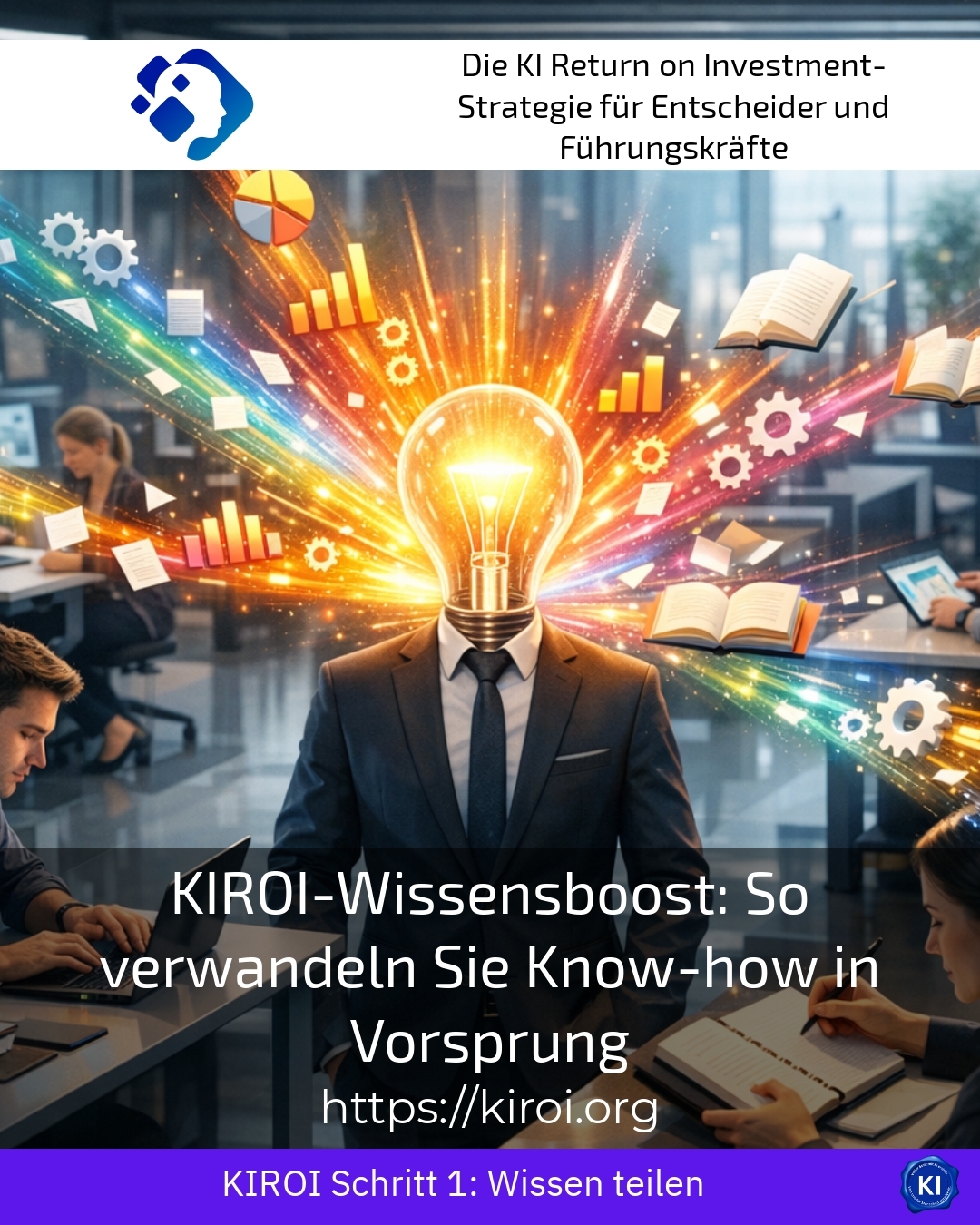
Have you ever wondered why some companies seem to effortlessly outpace their competitors while others, despite enormous efforts, fall behind?
The answer is often hidden in the way organizations handle their most valuable asset: their employees' knowledge. AIROI Knowledge Boost offers a structured approach to unlocking this potential. Many executives report that although they possess enormous expertise, they are unable to put it to profitable use. This is where professional guidance comes into play. It helps to systematically activate existing expertise and transform it into real competitive advantage.
The hidden power of structured knowledge transfer
Knowledge alone does not create added value. It is only when it is properly channelled that it can unleash its transformative effect. In many organizations, untapped potential lies dormant in the minds of employees. Clients often report that valuable insights remain trapped in silos. Departments work in isolation, and the wheel is reinvented over and over again.
A systematic approach can provide a solution here. It begins with an honest assessment of the existing competencies. This includes not only obvious skills but also the visible expression of implicit knowledge. Mentoring programs connect experienced professionals with emerging talent. Knowledge maps visualize where expertise exists and where gaps exist. Regular Lessons-Learned sessions ensure that project experiences are not lost.
This approach is particularly effective when onboarding new team members. Instead of months-long orientation phases, structured onboarding processes can significantly accelerate productivity. Cross-functional teams also benefit, because knowledge barriers between professional disciplines are actively being removed. And even in reorganizations, a well-thought-out knowledge management helps preserve critical competencies.
Best practice with a AIROI customer
A medium-sized manufacturing company faced a significant challenge because several experienced professionals were retiring simultaneously, threatening to irreversibly lose decades of specialized knowledge built up over the years. The transruptive coaching process began with a comprehensive knowledge inventory, in which all critical competence areas were initially identified and prioritized according to their strategic importance. In intensive workshops with the departing experts, their implicit knowledge was documented and converted into comprehensible process descriptions, with particular emphasis on practical action guidelines. In parallel, the company established a tandem system in which junior staff worked closely with experienced colleagues over several months, learning directly from their work methods in the workplace. The result of this structured knowledge transfer exceeded expectations significantly, as not only operational know-how was secured, but also valuable relationships with long-standing business partners were successfully transferred.
AIROI Knowledge Boost in Practical Application
Implementing such a program requires more than good intentions. It requires a clear strategy and consistent leadership. AIROI Knowledge Boost It provides valuable insights for practical implementation. It takes into account both technological and cultural aspects of knowledge management.
Digital tools play an important role in knowledge retention. Wikis and documentation systems enable quick access to relevant information. Collaboration platforms promote spontaneous exchange between employees from different locations. Search functions with intelligent tagging help find the right knowledge at the right time. But technology alone is not enough.
Corporate culture decisively determines success. Only when knowledge sharing is rewarded rather than punished does genuine exchange occur. Leaders must lead by example and actively share their own insights. Toleration of error encourages the willingness to learn from failures and to communicate them openly. Timely spaces for reflection and documentation must be consciously created.
Breaking down knowledge silos with the AIROI-Wissensboost
One of the biggest obstacles to effective knowledge transfer are organizational barriers. Departmental boundaries often act like invisible walls. Information flows only too easily from one area to another. Yet the most innovative solutions often emerge at the intersections of different disciplines.
Job rotation programs can provide valuable services here. When employees temporarily work in other areas, they not only broaden their own horizons. They also become bridges between different organizational units. Interdisciplinary project teams offer similar benefits in specific tasks. Informal networks such as communities of practice complement formal structures in a meaningful way.
Regular knowledge sharing events are particularly effective. At these internal events, teams present their current projects and findings. Colleagues from other departments can ask questions and build connections to their own areas of expertise. These formats encourage serendipity, which is often the best driver of innovation. Storytelling makes abstract information tangible and emotionally engaging.
Best practice with a AIROI customer
A service company with multiple branches in different regions struggled for a long time with the problem that each location developed its own solutions for similar challenges and that this double work consumed significant resources. The transruptions coaching support helped in the implementation of a cross-location best-practice system that initially faced significant resistance from local management because they feared their autonomy. However, through intensive communication and the involvement of all stakeholders in the development process, a common understanding was created that put the benefits of knowledge exchange front and center. Today, the locations regularly exchange their most successful approaches and adapt them to their local circumstances, which has significantly increased the speed of innovation across the entire company. Employees report an increased level of motivation because their ideas now reach a much wider audience and they can benefit from the experiences of their colleagues in other locations.
From individual knowledge to a learning organisation
The true breakthrough occurs when individual learning transitions into organizational learning. Then the company itself becomes a learning unit. It adapts more quickly to changes and anticipates developments early on. This transformation requires systematic work on structures, processes, and behaviors.
Reflective loops must be firmly integrated into work processes. After every major project, a structured follow-up should take place. What worked well, and what would we do differently next time? These findings are documented and made available for future projects. This creates a continuous improvement process.
External impulses enrich internal knowledge. Conference visits, professional literature, and the exchange with industry colleagues bring fresh perspectives to the company. Collaborations with universities or research institutions open doors to current scientific expertise. Pilot projects with innovative partners enable risk-free experimentation with new approaches.
Measurable results through systematic knowledge utilization
Knowledge management must be measured. Therefore, it is important to define and track appropriate metrics. The time span between the productivity of new employees provides initial indications. The number of improvement suggestions from the workforce indicates the innovation culture. The reuse rate of best practices measures the actual transfer of knowledge.
Qualitative indicators complement the hard numbers in a meaningful way. Employee surveys capture the perceived knowledge culture within the company. Feedback interviews provide insight into individual learning experiences and obstacles. Customer satisfaction can serve as an indirect indicator of successful knowledge management. And the ability to quickly respond to unexpected challenges demonstrates the organization’s adaptability.
The AIROI Knowledge Boost It helps companies develop and use these measurement metrics. It helps make progress visible and identify improvement potential. Regular reviews ensure that knowledge management is continuously developed. This creates a self-reinforcing cycle of learning and improvement.
Best practice with a AIROI customer
A rapidly growing company in the technology sector faced the challenge that the quality of customer support could no longer keep up with the increasing number of employees, and long-standing customers were becoming increasingly dissatisfied. transruptions coaching support first analyzed what knowledge the most successful customer advisors possessed and how this expertise could be systematically passed on to new team members. A structured onboarding program was developed that combined theoretical training with practical guidance from experienced mentors and was complemented by an extensive knowledge database containing typical customer concerns and proven solutions. Within a few months, customer satisfaction levels improved significantly, and the onboarding time for new employees could be significantly shortened, which, given the ongoing growth, meant a tremendous relief for the entire team. Today, the executives report that they can handle personnel changes much more relaxed because the critical knowledge no longer depends on individual individuals but is embedded in the organization.
My AIROI Analysis
Supporting organizations in developing their knowledge culture constantly shows me how underestimated this topic is in many companies. Often, action is only taken when critical expertise has already been lost or employees leave the company frustrated because their expertise was not valued. Yet, the systematic use of existing knowledge holds enormous potential for sustainable competitive advantage that can be unlocked with relatively little effort.
The AIROI Knowledge Boost It offers a structured framework for unlocking this potential. It combines proven methods of knowledge management with modern approaches to organizational development, taking into account both the technological and human aspects of knowledge transfer. The holistic perspective, which connects individual learning processes with organizational change, is particularly valuable and enables sustainable change [1].
My experience shows that success depends significantly on the leadership culture. When leaders lead authentically, knowledge sharing is desired, and mistakes are seen as learning opportunities, the employees follow this example. The technical infrastructure is important, but it alone does not create a knowledge-sharing culture. It takes time, patience, and consistent work on the framework conditions to develop a learning organization that can truly transform its know-how into a real advantage [2].
Further links from the text above:
[1] AIROI-Blog: Strategies for intelligent organizational development
[2] Contact for individual advice on knowledge management
For more information and if you have any questions, please contact Contact us or read more blog posts on the topic Artificial intelligence here.







 Deutsch
 English (UK)