
What if your entire marketing strategy is based on a single, false assumption?
Most decision-makers firmly believe that the key to success lies in the perfect campaign. They invest weeks, sometimes months, developing a single concept. In doing so, they overlook a fundamental truth that the digital age brings with it. The AIROI strategy It shows a completely different path that fundamentally challenges traditional thinking. Imagine being able to test a hundred different approaches within just a few days. Instead of putting everything on one card, distribute your risk intelligently. This paradigm shift is changing the way successful organizations structure their communication. Because in a world that is constantly changing, perfection is often the biggest enemy of progress.
The traditional approach and its hidden weaknesses
Many organizations follow a proven pattern when developing their communication strategies. They hire agencies, conduct market research, and develop elaborate concepts. A single project undergoes numerous coordination loops and approval processes. The result is often a technically flawless measure that nevertheless fails in the market. The reason lies in the fundamental unpredictability of human behavior. Even the most experienced experts cannot reliably predict which message resonates. For example, a large insurance company invested several hundred thousand euros in a new image campaign. The response was far below expectations. In retrospect, it turned out that a simple variation of the core message would have worked much better. However, this insight came too late because no alternatives were tested.
Another example comes from the financial services sector. A medium-sized bank developed a new customer magazine over six months. The concept was well thought out and the design was professional. Nevertheless, readership numbers fell by almost thirty percent after the launch. The target audience had changed in the meantime. The long development cycles had lost touch with reality. Such stories are repeated in almost all industries. They clearly show the limits of the perfectionist approach.
How average companies approach the issue
The majority of companies have recognized that automated systems can produce content more quickly. They primarily use these technologies to increase the volume of their content. The logic behind this seems straightforward at first glance. If a machine can create in an hour what a human needs a day to do, why not produce more? However, this mindset leads to a fundamental problem. More is not automatically better. On the contrary, a flood of mediocre content can dilute one’s own brand. A well-known online electronics retailer tripled its publication frequency by using new tools. However, interaction rates fell by more than forty percent. The target audience felt overwhelmed and turned away.
A similar pattern is evident at a major telecommunications provider. This company massively increased its social media activities through automated processes. However, the follower numbers stagnated for months. The reason was the lack of relevance of the content. Quantity had supplanted quality. A third case concerns an international automotive supplier. It adopted new technologies to send newsletters at a higher frequency. The unsubscribe rate subsequently rose to an alarming level. These examples highlight a central misunderstanding. The mere acceleration of processes does not solve strategic challenges.
AIROI The strategy as a guide for intelligent experiments
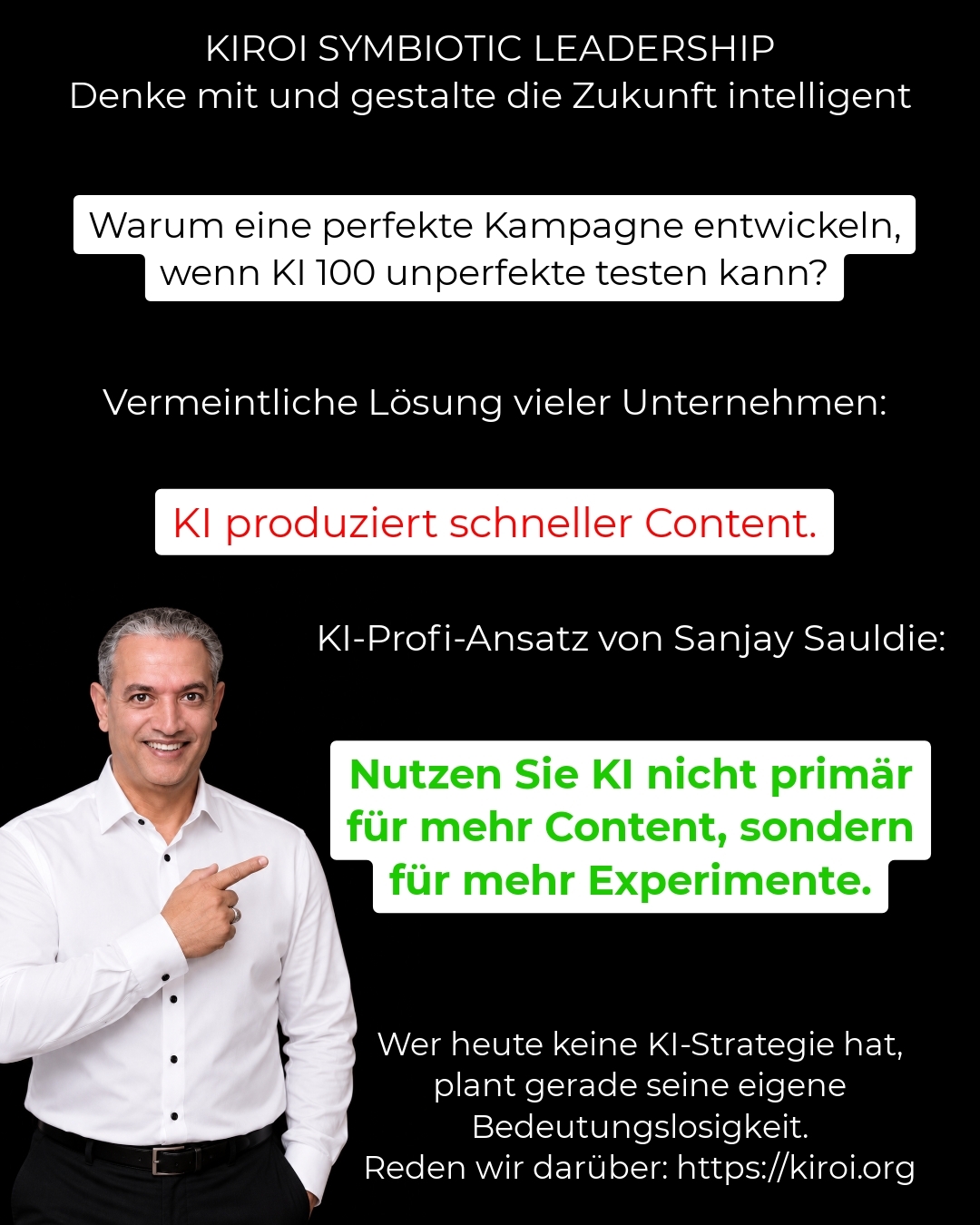
The AIROI strategy It takes a fundamentally different approach to integrating new technologies. It recommends not using automated systems primarily for more content. Instead, organizations should use these tools for systematic experimentation. The difference may seem subtle, but in practice it is enormous. An experiment pursues a clear goal of discovery. It is not about producing as much as possible. It is about learning as quickly as possible what works. This philosophy changes the entire approach to communication projects. Instead of tinkering with a concept for months, numerous variants are tested in parallel. The results then provide the basis for informed decisions.
A pharmaceutical company in the diagnostic field successfully implemented this approach. Within a week, it developed fifty different messages for a target group of laboratory doctors. Each variant emphasized a different aspect of the product portfolio. The response data showed within a very short time which topics really interested the target group. These findings would not have been possible with conventional market research in this speed. Another example comes from a manufacturer of medical technology. It tested different visual styles for its professional communication. The results surprised even experienced marketing managers. The preferred design differed significantly from internal assumptions.
Best practice with a AIROI customer A European industrial automation company faced a particular challenge in repositioning its services. Previous communication efforts only reached the technical decision-makers inadequately, which is why management sought new ways. As part of a transruptive coaching program, the team developed a structured experimental framework with clear success criteria and measurement methods. Instead of developing a single campaign, eighty different approaches were designed and systematically tested simultaneously. The automated systems took on the rapid creation of variants, while the team focused on the strategic evaluation. Within just three weeks, five particularly effective approaches emerged that were then further refined. The conversion rate increased by a considerable forty-seven percent compared to the same period last year. What was particularly remarkable was the finding that none of the team members considered the most successful variant to be the favorite. This impressively confirmed the value of the experimental approach over reliance on experience and gut feeling.
Why the AIROI strategy requires a cultural change
The transition to an experimental approach does not only affect processes and tools. It requires a profound change in corporate culture. Many organizations still reward apparent security over actual knowledge. Leaders who present a bold proposal take a personal risk. If the measure fails, the consequences fall on them. This dynamic leads to conservative decisions and seemingly safe concepts. The AIROI strategy On the other hand, it requires a culture of error that places learning above perfection. A chemical company based in southern Germany established an interesting approach to this. It introduced so-called learning celebrations, where failed experiments were acknowledged. The focus was on the insights gained, not on the failure itself.
A medium-sized mechanical engineering company took a similar approach. It created a protected environment for communication experiments. There, teams could test new approaches without fear of negative consequences. The results were then presented transparently to the entire company. This openness significantly promoted knowledge transfer between different departments. A third example comes from a manufacturer of packaging solutions. It integrated experimental metrics into the target agreements of its marketing department. The number of tests conducted was evaluated as well as their success rate. These structural changes supported the cultural change in a sustainable way.
Practical implementation of AIROI the strategy in everyday life
The concrete implementation of an experimental approach follows certain proven principles. First, the team defines clear hypotheses that are to be tested. These hypotheses concern, for example, the effectiveness of certain messages or visual elements. Subsequently, numerous variants are created that differ in specific characteristics. The automated systems significantly speed up this process. A logistics company tested various subject lines for its B2B communication in this way. The open rate varied by up to four hundred percent between the different approaches. These findings would never have been obtained without systematic experimentation.
An enterprise software provider used the approach to optimize its landing pages. Instead of endlessly discussing the perfect design, twenty variants were launched simultaneously. The user interactions yielded clear results within a week. The winning variant was then adopted as the standard. An industrial component manufacturer applied the method to its trade show communications. Different invitation texts were sent to different segments of the target audience. Analysis of the registration numbers revealed surprising preferences. These findings were directly incorporated into the design of the exhibition stand.
The role of transruptive coaching in transformation
Many organizations report that the transition to an experimental approach is challenging. Old habits and established processes prove stubborn. Professional guidance can provide valuable impulses here. Transruptive coaching supports teams in developing and implementing new ways of thinking. It is not about ready-made solutions, but about the ability to transform independently. One energy provider used this guidance to redesign its communications department. Within six months, the entire working style changed fundamentally. The employees developed a new sense of self as learners instead of experts.
An HVAC provider reports similar experiences with coaching [1]. The regular reflection sessions helped the team overcome resistance. The leaders learned to accept uncertainty as a productive state. A manufacturer of precision tools integrated coaching into its annual strategic planning process. The external inputs significantly enriched the internal discussions. AIROI strategy thus it could unfold its full potential within the organization.
My AIROI Analysis
The observation of numerous organizations reveals a clear pattern regarding the handling of new technological possibilities. The majority primarily uses automated systems to increase production volume, which often leads to disappointing results. Successful organizations, on the other hand, use these tools for systematic experimentation and thereby gain valuable insights into their target audiences. The crucial difference lies not in the technology itself, but in the strategic direction of its use. AIROI strategy offers a clear framework for this realignment and supports executives in transforming their communication processes.
The examples presented illustrate that the experimental approach works in a wide variety of contexts. From industrial automation to medical technology to financial services, organizations report positive experiences. The common denominator is always the willingness to abandon the idea of a perfect campaign. Instead, these organizations accept that real knowledge is only created through experimentation. The cultural prerequisites for this change are demanding but achievable. Professional coaching can effectively accompany and accelerate the transformation process. The future belongs to organizations that learn to learn quickly.
Further links from the text above:
[1] AIROI-Strategy: Practical application examples for companies
Are you a leader and would you like to learn how you can genuinely introduce AI into your company in a valuable and sustainable way, away from the hype? Take part Contact us or read more blog posts on the topic Artificial intelligence here.









 Deutsch
 English (UK)