
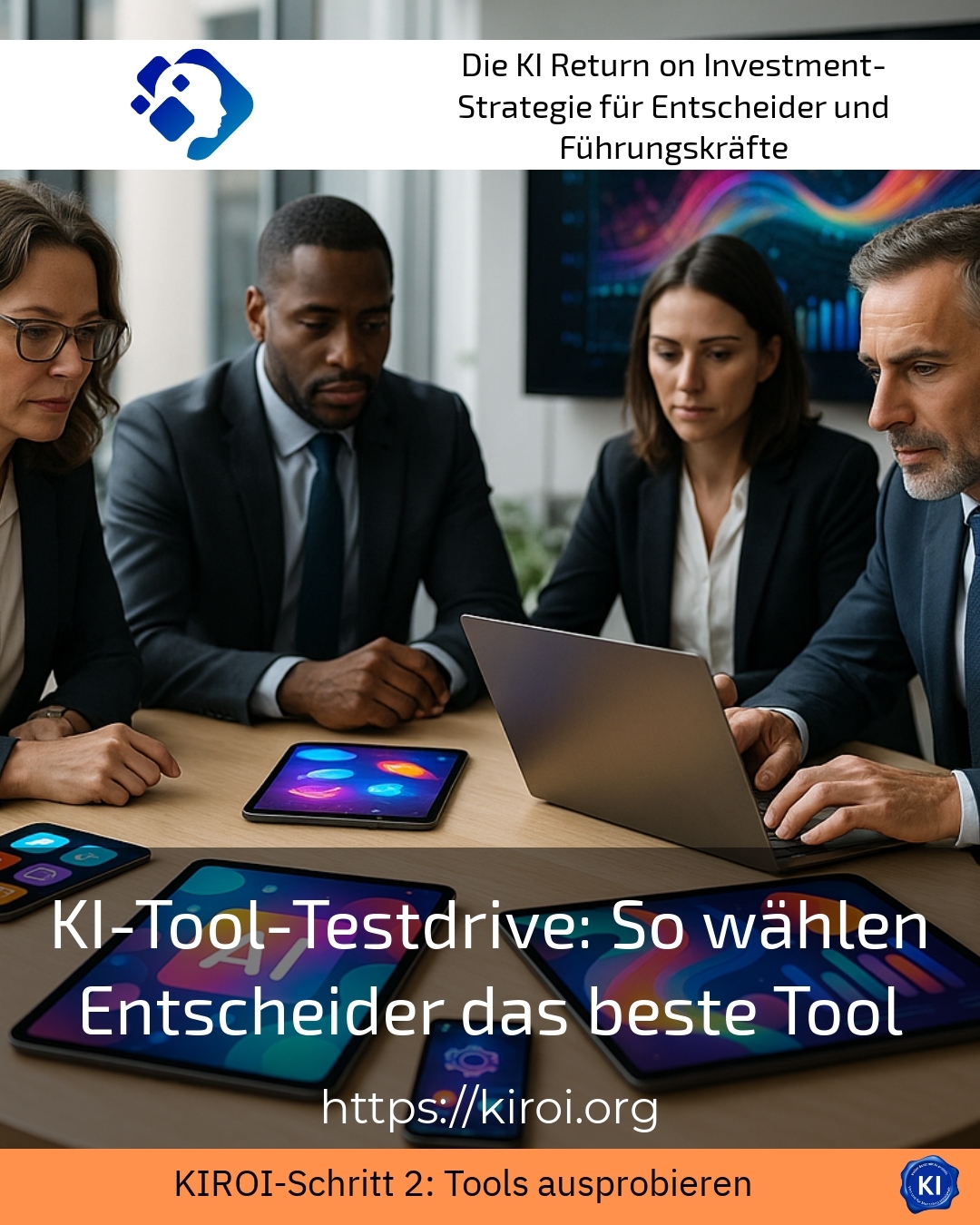
Imagine you are standing in front of a wall of over three hundred different tools, and every single one promises to fundamentally revolutionise your daily work while simultaneously cutting costs and increasing productivity. This is precisely the situation many managers are currently experiencing when dealing with the selection of intelligent software solutions. The AI tool test drive: how decision-makers choose the best tool becomes the central challenge, because there is frequently a considerable gap between marketing promises and actual added value. So how do you navigate through this jungle of possibilities without wasting valuable resources or opting for unsuitable solutions? The following sections will guide you systematically through a selection process that has proven its worth in practice and will help you make well-founded decisions.
Strategic preliminary work as the foundation for the AI tool test drive
Before even a single tool is tested, the thorough analysis of one's own needs takes precedence. Many decision-makers make the mistake of letting themselves be dazzled by impressive feature demonstrations. In doing so, they forget to record their specific requirements in writing beforehand. A manufacturing company in mechanical engineering, for example, requires different functionalities than a service provider in the financial sector. For instance, a medium-sized automotive supplier frequently reports the challenge of optimising quality control processes [1]. A logistics company, on the other hand, might look for solutions for route planning and inventory optimisation. A retail company could also prioritise tools for demand forecasting and pricing.
The definition of success criteria should therefore always come first. These criteria must be formulated to be measurable and realistic. Instead of speaking vaguely of „increasing efficiency“, it is advisable to define concrete target values. An example would be reducing the processing time for customer enquiries by twenty percent within six months. Another example from the pharmaceutical industry shows how important the documentation of regulatory requirements is. There, tools must meet strict compliance specifications, which significantly influences the selection process. Data protection requirements also play a central role in tool selection in the healthcare sector.
Best practice with a AIROI customer
An internationally active industrial company in the field of precision manufacturing was faced with the task of modernising its quality assurance processes. The management had initially expressed the desire to implement a solution as quickly as possible. However, as part of the transruptions coaching support, it became clear that thorough preliminary work was essential. Together, we drew up a requirements catalogue comprising a total of twenty-two specific criteria. These ranged from integration into existing ERP systems to the real-time analysis of sensor data from production. Taking multilingualism into account was particularly important, as the company operates sites in seven different countries. This structured approach enabled the company to reduce the number of potential solutions from an initial twenty-five to just four. The time invested of around three weeks for the preliminary work ultimately led to a saving of several months in the overall project. Clients frequently report that this phase makes the decisive difference to the success of the project.
Conducting structured test phases during the AI tool test drive
Following the preparatory work, the actual testing phase begins, which is ideally divided into several stages. In the first stage, a superficial review of the available options takes place. Comparison platforms and independent reviews help to gain an initial overview [2]. For example, an energy supplier used this phase to reduce thirty potential solutions to a shortlist of ten. A telecommunications company proceeded similarly, thereby saving valuable time. An insurance group also reports positive experiences with this multi-stage approach.
The second stage then comprises in-depth demonstration sessions with the vendors. It is important here that you do not just accept standardised presentations. Instead, request individual scenarios that reflect your specific use cases. For example, a construction company had it demonstrated how the tool handles complex project schedules. A chemical corporation, on the other hand, wanted to see how safety data is processed and analysed. A media company tested the capability for processing large amounts of unstructured content.
The third and decisive stage consists of practical pilot projects with selected finalists. This phase should last at least four to six weeks in order to gain reliable insights. During this time, it is important to involve various user groups. This allows both tech-savvy employees and end-users to contribute their experiences. For example, a food manufacturer involved production managers, quality managers and IT specialists alike. A textile company additionally included the purchasing and logistics departments. A furniture manufacturer relied on interdisciplinary teams from design, manufacturing and sales.
Define evaluation criteria for the successful AI tool test drive
The evaluation of the tested solutions must be carried out according to uniform and transparent criteria. In addition to pure functionality, factors such as user-friendliness play a decisive role. No matter how powerful a tool may be, if the employees do not accept it, it misses its purpose. A steel producer had to learn this the hard way when a technically superior system was rejected by the shift supervisors. The interface was too complex and the training period would have taken several weeks. A beverage manufacturer, on the other hand, consciously opted for a slightly less comprehensive solution that was more intuitive to use. A cosmetics company chose a middle path and additionally invested in extensive training programmes.
The ability to integrate into existing system landscapes also deserves special attention. Isolated standalone solutions frequently create more problems than they solve [3]. An electronics manufacturer reports how important the seamless connection to the existing production system was. Without this integration, duplicate data entries and media disruptions would have been inevitable. A paper manufacturer scrutinised the interfaces to its enterprise resource planning system with particular care. A plastics processor placed value on compatibility with its control systems for injection moulding machines.
Best practice with a AIROI customer
A long-established metalworking family business with over a thousand employees wanted to optimise its quotation costing. Previous practice relied heavily on the experience of individual estimators and was correspondingly prone to errors. As part of our joint guidance, we developed a scoring model with weighted criteria. This model encompassed technical aspects, economic factors and organisational considerations alike. Each criterion was assigned a weighting according to its relevance to the company. For example, technical integration capability was weighted at twenty percent, while user-friendliness accounted for fifteen percent. Of particular interest was the inclusion of a criterion for the future-proofing of the solution. This assessed how actively the vendor was developing their solution further and what their roadmap looked like. The structured evaluation enabled an objective discussion among the management team and significantly reduced emotional decisions. The transruptions coaching provided important impulses for the design of this evaluation process.
Consider economic aspects in the AI tool test drive
The cost assessment goes far beyond the pure licence price and requires a holistic view. Implementation costs, training efforts and ongoing maintenance must be factored into the calculation. For example, a glass processor underestimated the costs for data cleansing that was necessary prior to implementation. These unexpected expenses doubled the originally planned budget for the first year. A cement manufacturer, on the other hand, factored in generous buffers for unforeseen expenses from the outset. A toy manufacturer also took into account the opportunity costs arising from tied-up personnel resources.
The calculation of the return on investment should be done conservatively and depict realistic scenarios. Many providers present optimistic forecasts that rarely prove true in practice. A packaging manufacturer therefore developed three different scenarios for the cost-effectiveness calculation. The pessimistic scenario served as the basis for the decision. The company argued that even under unfavourable conditions, a positive effect must be discernible. A printing company proceeded similarly, supplementing the quantitative analysis with qualitative factors. A lighting manufacturer also included hard-to-measure benefits such as improved employee satisfaction in the assessment [4].
The Importance of References and Testimonials
Reference discussions with existing users provide valuable insights that no product presentation can offer. Ask specifically about challenges during the implementation phase and how these were overcome. An industrial pump manufacturer contacted three reference customers of a vendor and thereby gained crucial insights. One of these reference customers reported initial performance problems with large volumes of data. This information would have remained hidden without the direct conversation. A cable manufacturer even organised a visit to a reference customer to experience the system in production operation. A machine tool builder used industry-specific networks to gather informal testimonials.
The stability and future-proofing of the provider itself also deserve attention during decision-making. Start-ups may offer innovative solutions, but their long-term existence may be uncertain. A precision parts manufacturer experienced how a promising provider ceased operations after two years. Migrating to a new system caused significant costs and disruptions. An agricultural machinery company therefore scrutinises the financial figures of potential providers particularly carefully. A medical technology manufacturer also pays attention to the provider's certifications and regulatory compliance.
The final decision and the transition to implementation
Following the completion of all testing phases, decision-making is due, which is ideally carried out within the extended management circle. All gathered insights must be presented in a structured manner and in a way that is easy to follow. A semiconductor supplier used a standardised decision template for this purpose, which covered all relevant aspects. The template included both hard facts and qualitative assessments from the test users. An automotive component manufacturer supplemented the written documentation with video testimonials from pilot users. A home appliance manufacturer organised a structured final discussion with all participating departments [5].
The transition from the testing phase to full implementation requires careful planning and preparation. Successful companies define clear milestones and responsibilities for this critical phase. A conveyor technology manufacturer planned a phased rollout across four quarters. Each location was transitioned individually, and lessons learned were incorporated into subsequent implementations. A textile machinery manufacturer relied on so-called multipliers, who trained other employees as internal experts. A packaging machinery manufacturer established a dedicated project team for the entire rollout phase.
Best practice with a AIROI customer
A medium-sized manufacturer of speciality chemicals faced the challenge of digitalising its laboratory processes. Following a structured testing process, the company selected a solution and was now ready to move on to implementation. As part of the transruptions coaching support, we jointly developed a detailed transition plan. This plan considered not only technical aspects, but also change management for the employees concerned. Of particular importance was the involvement of the experienced laboratory managers, whose specialist knowledge had to be transferred into the new system. We organised workshops in which these experts documented their workflows and contributed suggestions for improvement. This participatory approach significantly increased acceptance of the new solution. The employees felt heard and were motivated to actively use and further develop the new system. The successful completion of the project was communicated within the company as a prime example of successful digitalisation.
My AIROI Analysis
Selecting the right smart tool represents one of the most important strategic decisions for many companies in the coming years. My experience from numerous accompanying projects shows that success depends significantly on the quality of the selection process. Companies that take the time for thorough groundwork consistently achieve better results than those that act hastily. The AI tool test drive: how decision-makers choose the best tool should therefore never be viewed as a tedious chore. Rather, it is a strategic investment that pays off in the long term.
Particularly noteworthy is the importance of human factors throughout the entire process. Even the best technical solution can fail if employees do not accept it or do not apply it correctly. Therefore, I recommend focusing on participation and communication from the outset. Involving various user groups in the testing phase not only creates a better basis for decision-making, it also simultaneously prepares the ground for a successful rollout.
Transruptions coaching can offer valuable support during these complex selection processes. As external guidance, we bring objective perspectives and ask the right questions at the right time. We help to overcome operational blindness and proceed in a structured manner. Clients frequently report that precisely this neutral external perspective provided decisive impetus for project success. The investment in professional guidance typically pays for itself quickly through avoided misjudgements and accelerated processes.
Further links from the text above:
[1] Bitkom – Artificial Intelligence in Business
[2] Gartner – Technology Research and Insights
[3] McKinsey – AI and Analytics Insights
[4] Fraunhofer – Research Field Artificial Intelligence
[5] Plattform Lernende Systeme – Germany’s Platform for AI
For more information and if you have any questions, please contact Contact us or read more blog posts on the topic Artificial intelligence here.









 Deutsch
 English (UK)