
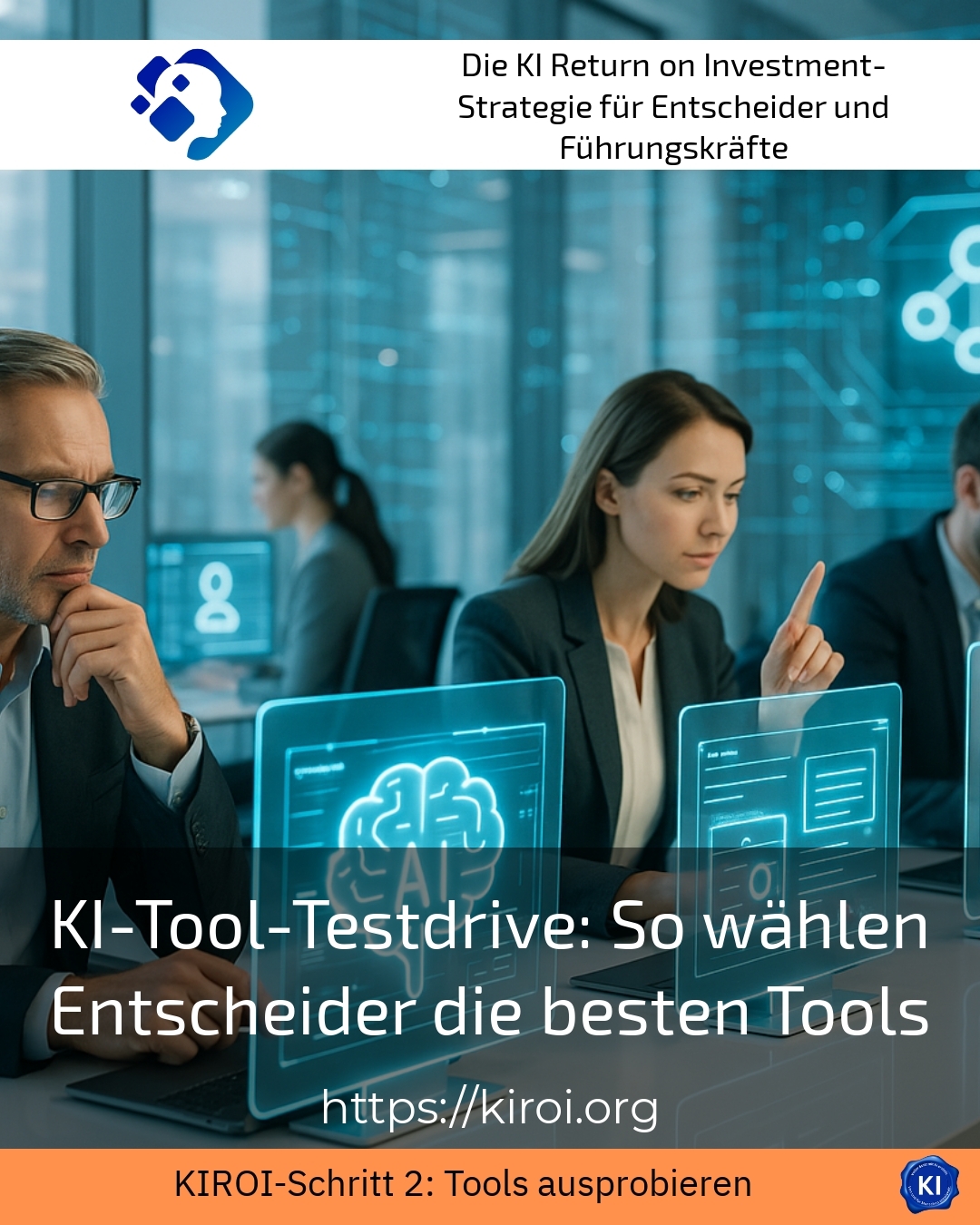
How do successful leaders make decisions when the market for intelligent software solutions is growing daily and the choice is becoming almost overwhelming? This question is currently occupying numerous decision-makers in companies of all sizes, because the AI tool test drive has long since developed into a crucial success factor that determines competitive advantages and future viability. At a time when artificial intelligence is permeating almost every business sector, decision-makers face the challenge of selecting precisely those applications from hundreds of available ones that deliver genuine added value for their specific requirements. In this process, it is long no longer sufficient to rely on marketing promises or superficial product presentations, because the true performance of a solution only becomes apparent in practical use under real-world conditions.
The strategic importance of systematic evaluation processes
Companies invest significant resources in the digitalisation of their processes. In doing so, many decision-makers underestimate the effort required for a well-founded technology selection. A structured AI tool test drive enables potential solutions to be tested under controlled conditions. This approach minimises bad investments and significantly accelerates the successful implementation of new technologies.
In the financial sector, for example, banks use automated analysis systems for credit assessments. Insurance companies deploy intelligent algorithms for claims assessment. Asset managers are also increasingly turning to data-based forecasting tools. Before such solutions are put into production, they undergo intensive testing phases. Managers must consider and weigh up various criteria in the process.
The challenge is to develop objective evaluation criteria. Subjective impressions from brief product demonstrations often lead to misjudgements. Instead, a methodical approach with clearly defined success criteria is recommended. Transruption coaching can support companies with such projects and provide valuable impetus.
Best practice with a AIROI customer
A medium-sized financial services company was faced with the task of supporting its customer advisory services with intelligent assistance systems. The management had already identified several promising providers and wanted to create a sound basis for decision-making. As part of the consultancy project, we jointly developed a structured evaluation framework that took both technical and organisational aspects into account. First, we defined concrete application scenarios from the advisers' day-to-day business. Selected employees then tested the various solutions under real-life conditions over a period of six weeks. We systematically documented the results using pre-defined criteria such as user-friendliness, integration capability and the accuracy of the results. The users' feedback on acceptance and practical suitability was particularly enlightening. At the end of the process, the company was able to make a well-founded decision that took both economic and qualitative aspects into account. The implemented solution is successfully in use today and has noticeably improved the quality of advice.
Criteria for a successful AI tool test drive
The selection of suitable evaluation criteria forms the foundation of any successful technology evaluation. Decision-makers should consider and weight various dimensions in the process. Technical performance alone does not guarantee sustainable success. Rather, factors such as user acceptance and integration capability play an equally important role.
In healthcare, for example, diagnostic support systems must meet the highest standards of accuracy. At the same time, doctors expect seamless integration into existing practice workflows. Hospitals intensely evaluate intelligent systems for patient management prior to implementation. Care facilities are also testing automated documentation solutions under everyday conditions. These examples illustrate the complexity of such selection processes.
Clients frequently report feeling overwhelmed by the variety of available options. They come to us with specific concerns such as a lack of orientation or unclear priorities. Some struggle with internal resistance to new technologies. Others are looking for methods for the objective performance measurement of various providers.
Technical evaluation aspects during the AI tool test drive
The technical assessment comprises several key dimensions. First, the quality of the results is the primary focus of any evaluation. In addition, processing speed and scalability play a crucial role. Aspects of data security also deserve special attention during the testing phase.
Manufacturing companies are testing intelligent quality control systems using concrete production data. Logistics service providers are trialling route optimisation solutions under various traffic conditions. Energy suppliers are evaluating forecasting tools for consumption based on historical load curves. These practical tests deliver significantly more meaningful results than theoretical specifications.
Another important aspect concerns the ability to integrate into existing system landscapes. Interfaces to existing applications must function smoothly. Data exchange should take place automatically and securely. Compatibility with existing infrastructure saves considerable implementation costs.
Organisational success factors in technology selection
Alongside technical aspects, organisational factors are a major determinant of success. The involvement of relevant stakeholders right from the start significantly increases subsequent acceptance. Clear responsibilities and realistic schedules create the necessary commitment. Adequate resources for training and support must also be factored in.
Commercial enterprises involve their sales representatives in evaluation processes at an early stage. Media companies test editorial support tools together with journalists and editors. Educational institutions trial learning platforms initially with selected teachers and students. These participatory approaches significantly promote subsequent willingness to use them.
Transruptions-Coaching supports companies in professionally shaping such transformation processes. We guide teams in developing shared evaluation criteria and bases for decision-making. In doing so, we provide impetus for constructive discussions and sustainable solutions.
Best practice with a AIROI customer
A manufacturing company in the mechanical engineering sector wanted to optimise its maintenance processes through predictive analytics methods. The plant management had invited various providers of predictive maintenance solutions to present and now faced a difficult selection decision. As part of our collaboration, we first developed a detailed requirements catalogue based on the specific production conditions. We then defined measurable success criteria, such as prediction accuracy, response time and integration effort, together with the specialist departments. The three most promising solutions were tested in parallel on selected machines, with the results being systematically documented and compared. The involvement of experienced maintenance technicians proved particularly valuable, as their practical knowledge significantly enriched the evaluation. Following a three-month testing phase, a well-founded basis for decision-making was available, which also convinced sceptical managers. The selected system was successfully introduced into production within a few weeks and has since been providing valuable insights for preventive maintenance planning.
Typical challenges and best practice solutions
Practice shows recurring difficulties with technology selection in companies. There is frequently a lack of clear targets and measurable success criteria. Time pressure leads to superficial evaluations with corresponding follow-up costs. A lack of coordination between technical and business requirements also causes problems.
Telecommunications companies, for example, struggle with integrating new analytics tools into complex legacy systems. Retailers have to take into account different requirements from headquarters and branches. Pharmaceutical companies face special regulatory requirements when introducing new technologies. These examples illustrate the complexity of the challenges.
A structured AI tool test drive helps to identify such difficulties at an early stage. Clear processes and responsibilities create the necessary orientation in the selection procedure. Regular interim evaluations enable timely course corrections if required.
The role of leaders in the selection process
Decision-makers bear a particular responsibility for the success of technology projects. They must provide sufficient resources and set realistic expectations. At the same time, they should create space for an experimental approach and learning processes. Their visible support signals the strategic importance of the initiative.
Automotive suppliers invest significant management capacity in evaluating development tools. Chemical companies actively involve their research management in the selection of laboratory automation solutions. Municipal utilities also closely involve their executive management in digitalization decisions. These examples demonstrate the importance of active leadership involvement.
Frequently, clients report uncertainty when prioritising various technology options. They seek guidance in a cluttered vendor market with many promises. Some need support in communicating changes to their teams.
Best practice with a AIROI customer
The management of a medium-sized service company wanted to increase the efficiency of its administrative processes through intelligent automation. The challenge was to reconcile various departments with differing requirements and to find a viable, shared solution. As part of our support, we initially facilitated a workshop to take stock of the most key processes and potential for improvement. Subsequently, the specialist departments jointly developed a prioritised requirements catalogue containing specific use cases and measurable targets for success. On this basis, three vendors were invited to intensive testing phases, with each department running and documenting its own pilot projects. Regular review meetings fostered mutual understanding and enabled valuable mutual learning. After four months, a widely supported decision was reached that took both technical and organisational aspects into account. Implementation proceeded smoothly accordingly, because all participants were already familiar with and accepting of the new system.
Future prospects for technology selection in enterprises
The requirements for systematic evaluation processes will continue to increase. New generations of technology are appearing on the market at increasingly short intervals. At the same time, expectations regarding the integrability and adaptability of solutions are growing. Companies must develop and professionalise their selection processes accordingly.
Electronics manufacturers are already experimenting with automated benchmarking procedures for new tools. Logistics companies are developing standardised test environments for various optimisation solutions. Financial service providers are also building systematic evaluation capabilities as a strategic resource. These developments point to an increasing professionalisation of technology selection.
Transruptions-Coaching supports companies in establishing sustainable evaluation processes. We provide long-term support for building internal capabilities for systematic technology assessments. In doing so, we provide impetus for continuous development and organisational learning.
My AIROI Analysis
The systematic evaluation of new technologies has developed into a core competency of successful companies. A structured AI tool test drive enables informed decisions based on practical experience rather than theoretical specifications. This consistently shows that technical performance alone is not enough to guarantee the success of an implementation. Rather, organisational factors such as user acceptance, integration capability and readiness for change play an equally important role in the success of such projects.
From my consultancy practice, I know that many companies initially underestimate the effort involved in systematic evaluations. They tend to make quick decisions under time pressure, which later lead to substantial remediation costs. A well-thought-out selection process may initially seem more complex, but it pays off many times over through smoother implementations and higher user satisfaction. Moreover, the involvement of relevant stakeholders from the very beginning creates the necessary foundation of acceptance for sustainable change.
It seems particularly important to me to develop clear evaluation criteria before the actual testing phase begins. This is the only way to objectively compare different solutions and make well-founded decisions. Both quantitative and qualitative aspects should be taken into account here. Furthermore, documenting experiences and insights creates valuable knowledge for future selection processes within the company [1]. Ultimately, it is a matter of understanding technology selection as a strategic process and shaping it with a corresponding level of professionalism [2].
Further links from the text above:
[1] Bitkom – Artificial Intelligence in Companies
[2] McKinsey – AI Strategy and Implementation
For more information and if you have any questions, please contact Contact us or read more blog posts on the topic Artificial intelligence here.









 Deutsch
 English (UK)