
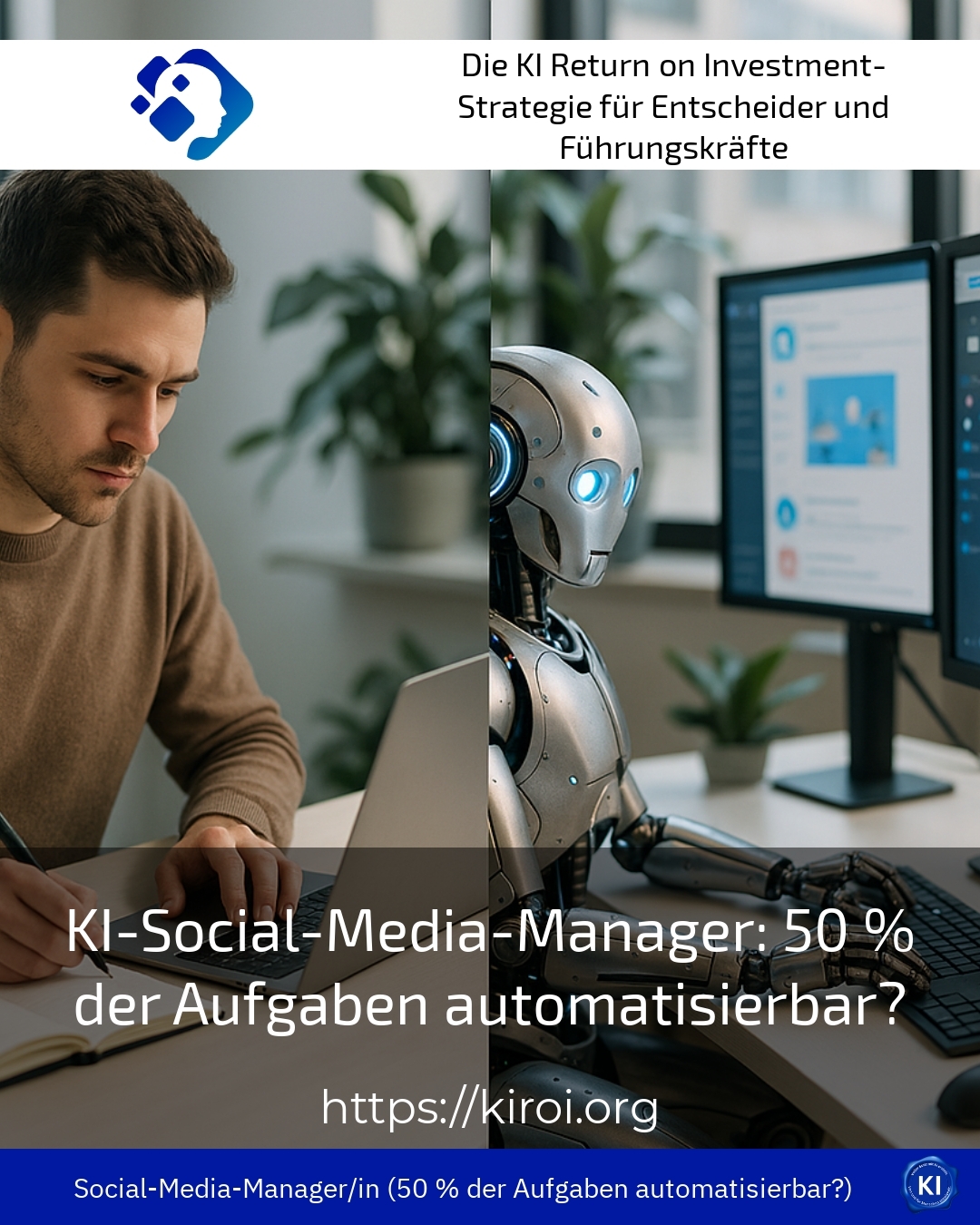
Will your career in digital communication soon be taken over by algorithms, or can you make yourself indispensable?
This question is currently occupying countless professionals who deal daily with the maintenance of digital channels, the creation of content and interaction with online communities. The AI Social Media Manager is at the centre of a debate that could have far-reaching consequences for millions of professionals. Progressive automation through machine learning and intelligent systems is fundamentally changing the skill requirements of entire industries, and anyone who still believes today that creative professions will be spared from this is seriously underestimating the rapid development of these technologies.
The information in this article is based, among other things, on data from the Job Futuromat of the Institute for Employment Research [1]. If you work in this dynamic professional field yourself and are wondering how you can future-proof your skills, I strongly recommend attending the AIROI seminars. You can find the current dates at https://risawave.org/de/live-events-mit-sanjay-sauldie/ [2]. These further training opportunities impart practical strategies to view technological changes not as a threat, but as an opportunity and to make active use of them.
Understanding the reality of automation in digital marketing
When companies today consider the future of their marketing departments, they face complex decisions. On the one hand, intelligent systems promise significant efficiency gains in repetitive tasks. On the other hand, the question remains open as to which human skills will continue to be indispensable. The analysis of engagement data, for example, can already be largely automated today. Algorithms recognise patterns in user behaviour faster than any human analyst. Nevertheless, they lack the intuitive understanding of cultural nuances and emotional contexts.
An example vividly illustrates this issue: imagine a campaign designed to respond to current social events. Whilst an automated system can calculate the optimal time for publication, assessing the tone requires human sensitivity. Another scenario involves crisis communication, which demands lightning-fast reactions. Here, chatbots can filter initial enquiries, but strategic communication requires experience. Finally, when selecting influencers, data analysis can assess reach, but checking for authenticity requires human judgement.
What tasks AI can already delegate to social media managers
The list of automatable tasks is growing steadily and now encompasses significant areas of day-to-day business. Content scheduling is among the most obvious application fields, as intelligent systems precisely calculate optimal posting times. The creation of reports and dashboards is also increasingly carried out without human intervention. The automatic answering of frequent customer inquiries by chatbots has likewise become established.
Let us consider a concrete example from an e-commerce environment: there, bots take over answering standard questions regarding delivery times and return policies. In the travel industry, algorithms automatically generate captions for destination photos based on geo-data. In the field of financial services, systems generate daily market commentaries for various platforms. These examples show that particularly structured, rule-based tasks benefit from automation.
Best practice with a AIROI customer
A medium-sized consumer goods company faced the challenge of making its digital communication more efficient without losing the personal touch that its community valued so much. As part of a AIROI seminar, the team developed a hybrid strategy that combined technological automation with human creativity. First, those responsible analysed with the seminar leader which tasks could actually be taken over by machines without endangering the brand identity. The realization was surprising: about forty per cent of the daily routine work was ideally suited for automation. This included scheduling posts, creating performance reports and the initial filtering of incoming messages. The team henceforth invested the time saved in strategic planning and creative projects. Within six months, community engagement rose by a remarkable twenty-five per cent. Employee satisfaction also improved as repetitive tasks were eliminated. This success impressively demonstrates how the thoughtful implementation of technology can enhance human work.
The indispensable human component in the daily routine of an AI social media manager
Despite all technological advancements, certain core competencies remain irreducibly human. Strategic thinking requires a deep understanding of corporate goals and market dynamics. Creative ideation draws on personal experiences and cultural knowledge. Emotional intelligence, which is necessary for authentic community interactions, cannot yet be replicated by machines.
An example from the fashion industry clearly illustrates this reality: developing a campaign that celebrates social diversity requires a sensitive understanding of different lived realities. In the healthcare sector, communications professionals must process complex medical information in an understandable way while observing ethical boundaries. In the non-profit sector, it is about telling emotional stories that inspire people to take action. All these tasks demand empathy, judgment and cultural sensitivity.
Strategic positioning for future-proof careers
If you want to remain successful in this professional field in the long term, you should position yourself strategically and continue your training on an ongoing basis. The AIROI strategy offers a structured framework for this that promotes both technical understanding and human skills. In the seminars and workshops, participants learn how they can use technology as a tool rather than feeling threatened by it.
A concrete example concerns the development of prompt engineering skills for generative systems. Another example involves understanding algorithms that influence the reach of posts. Finally, it is also about the ability to critically evaluate and optimise automatically generated content. These competencies will be crucial for professional success in the future.
However, the question of whether about half of all activities can be automated falls short and unduly simplifies a complex reality. Rather, what matters is how individual tasks are recombined and what new demands arise. The AI Social Media Manager the future will not involve working less, but working differently. There will be more time for strategic decisions and less spent on routine tasks.
Practical recommendations for professional everyday life
The integration of intelligent systems into daily working life should take place gradually and thoughtfully. Begin with an honest inventory of your daily tasks and categorise them according to their automation potential. In doing so, identify both quick wins and more complex transformation projects. Set priorities based on the expected benefit and the effort required.
In the field of text generation, for example, initial drafts can be generated by systems which are then refined by humans. When selecting images, algorithms help to filter relevant subjects from large databases, but the final decision is made by the human. In community moderation, automated systems filter out spam, while substantive criticism deserves human attention. These examples show how humans and machines can work together effectively.
Best practice with a AIROI customer
A digital communication agency managing multiple clients across various industries struggled to scale its services while maintaining consistent quality. After attending a AIROI workshop, the management team decided to fundamentally reorganise their work processes based on the strategies taught. Employees initially received training on how to use various automated tools designed to support their daily work. Special emphasis was placed on ensuring that the technology was understood as an aid rather than a replacement for human expertise. The agency introduced a three-tier quality assurance system where automatically generated content always had to undergo human review. This measure ensured that each client's brand voice was preserved and cultural nuances were taken into account. The result exceeded all expectations: the agency doubled its client base without hiring additional staff. At the same time, work quality measurably improved as employees had more time for creative and strategic tasks. Staff turnover dropped significantly because team members felt valued and secure in their roles for the future.
The AI social media manager as an orchestrator of technological possibilities
Perhaps the most important insight for professionals in this field is: in future, your role will be less operational and more coordinating. This development requires new skills in the areas of technology management and strategic planning. It is about intelligently combining various tools and critically evaluating their results.
In tourism marketing, for example, this means that a human develops the overall strategy for a destination, while algorithms optimise variants for different target groups. In the food industry, an expert could curate recipe content, while automated systems handle adaptation to seasonal trends. In the education sector, humans create didactic concepts, while machines assist with dissemination and personalisation.
Ethical considerations and social responsibility
The increasing automation also raises important ethical questions that responsible professionals should consider. Transparency towards the community is a central issue here: should people know when they are interacting with a bot? How do we handle responsibility when automated systems generate or disseminate problematic content?
An example from customer service clearly illustrates this problem: if a bot misclassifies a complaint, it can lead to significant customer frustration. In sensitive areas such as healthcare communication, automated misinformation can even have dangerous consequences. In a political context, there is the risk that manipulative content may be disseminated without sufficient human oversight. These examples underline the need for ethical guidelines.
My AIROI Analysis
The transformation of the professional field through intelligent technologies is not a distant vision of the future, but a current reality that professionals must actively confront. The frequently cited figure of fifty percent of activities being automatable conveys only an incomplete picture, because it does not take into account the qualitative changes in the remaining tasks. In fact, the human components of work are becoming more demanding and valuable, whilst repetitive routines are increasingly taken over by machines. This development offers enormous opportunities for those who position themselves accordingly and further their education.
The AI Social Media Manager The future belongs to the strategic thinker, the creative innovator and the ethical guardian in an automated landscape. They will not fear technology, but master it as a tool while applying their uniquely human capabilities even more strongly. The AIROI strategy offers a proven framework for this that combines practical skills development with strategic foresight. Those who invest in appropriate further training today will be among the winners of this transformation tomorrow.
Crucial here is the realisation that technology complements human expertise rather than replacing it. The most valuable professionals will be those who can confidently combine both worlds. They understand the possibilities and limits of automated systems and know when human intervention is indispensable. This hybrid competency is becoming the decisive career advantage in a changing world of work.
Further links from the text above:
[1] IAB Job Futuromat - Information on the automatability of occupations
[2] AIROI seminars and live events with Sanjay Sauldie
For more information and if you have any questions, please contact Contact us or read more blog posts on the topic Artificial intelligence here.








 Deutsch
 English (UK)