
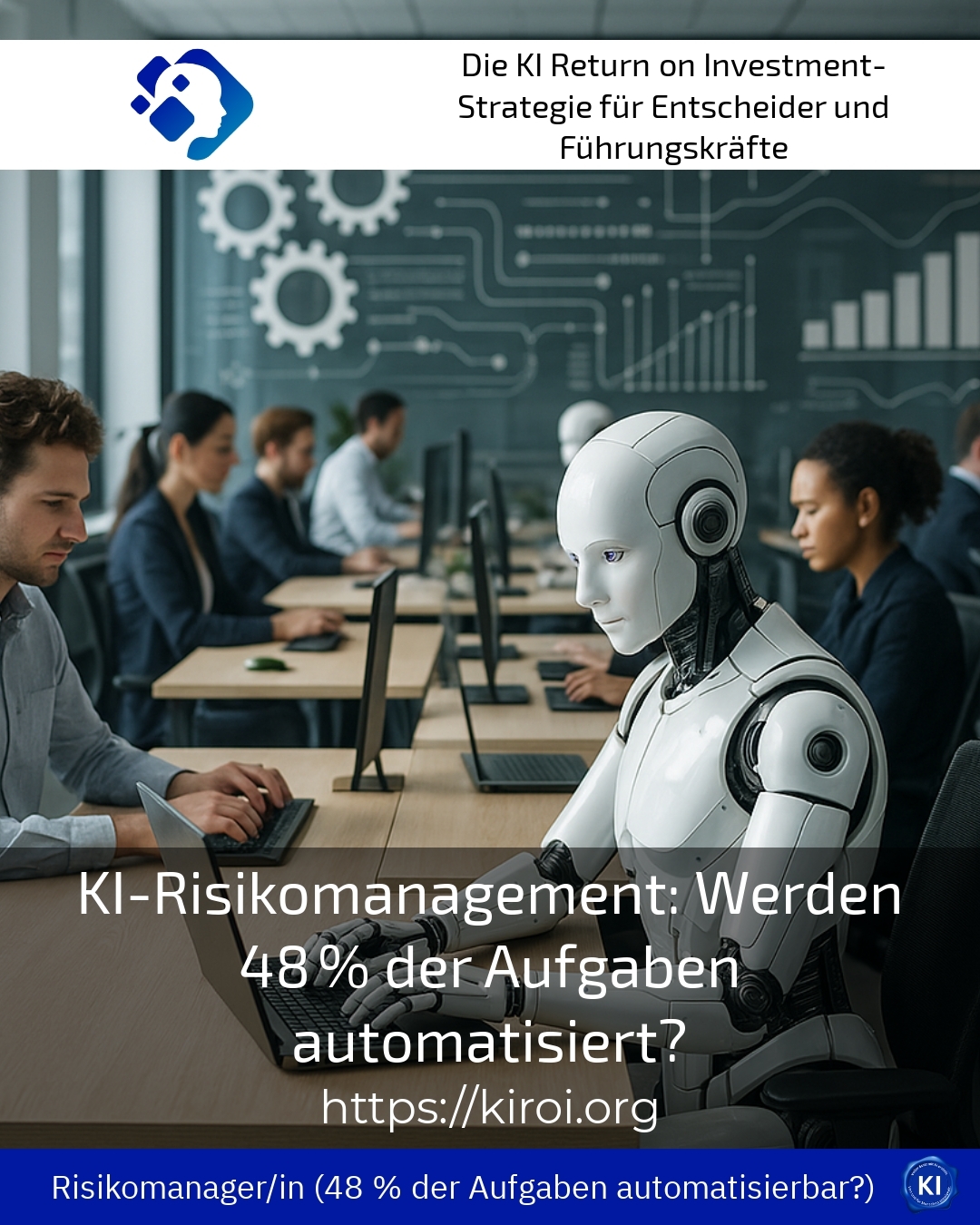
Will your expertise in the field of risk analysis soon be replaced by intelligent algorithms, or are entirely new career opportunities opening up right now for people who act with foresight and position themselves strategically? This question is occupying professionals across all industries, because the AI risk management fundamentally changes how businesses identify, assess and mitigate potential hazards, with current studies suggesting that nearly half of all activities in this field could be taken over by automated systems.
The insights presented here are based, among other things, on analyses by the Institute for Employment Research's Job Futuromat [1], which provides detailed insights into the automation potential of various occupational fields. If you yourself work in a field affected by these changes, there is a tried and tested solution: the AIROI seminars provide you with the necessary tools not just to survive, but to actively shape the future. All current dates can be found on the risawave website [2], where you can sign up for lectures, workshops and intensive training formats that impart concrete strategies for action to you.
The transformation of risk analysis through intelligent systems
The risk assessment landscape is undergoing a fundamental shift. Machine learning methods are now analysing claims data faster than any human expert. They identify patterns in millions of datasets within a few seconds. Insurance companies are already making intensive use of these technologies. Banks rely on automated credit assessments. Industrial companies are implementing predictive maintenance systems. The speed of adoption is surprising even experienced industry insiders.
A concrete example can be seen in the field of claims settlement: whereas in the past experts required several days for a comprehensive assessment, today image-recognition algorithms categorise vehicle damage and calculate repair costs in real time, which drastically reduces processing time while simultaneously increasing the accuracy of estimates. A further field of application is found in fraud detection, where intelligent systems identify suspicious transaction patterns before a human would even suspect anything. In healthcare, algorithms analyse patient data to predict disease risks and recommend preventive measures.
Where AI risk management is already taking effect today
The practical applications are diverse and impressive. Large corporations deploy automated compliance checks. Medium-sized enterprises use cloud-based solutions for risk assessments. Start-ups develop specialised niche solutions for specific industries. The financial sector is investing heavily in these technologies. Energy suppliers monitor their infrastructure with sensor-based early warning systems. Logistics companies optimise their supply chains through predictive analytics.
Best practice with a AIROI customer
A mid-sized financial services provider faced the challenge of making its credit risk assessment more efficient. Traditional processes consumed enormous personnel resources. Processing times frustrated both customers and employees. As part of the AIROI support, a comprehensive analysis of existing workflows was first carried out. Together with the client, the team identified those activities that were suitable for automation. At the same time, they defined areas in which human expertise remains indispensable. Implementation took place gradually over several months. Employees received intensive training on how to use the new systems. Support in realigning job profiles was particularly important. Former clerks developed into data analysts and system administrators. The results after one year were thoroughly convincing. Processing time for standard applications was reduced by sixty percent. Employee satisfaction increased measurably. The error rate dropped to a historic low. This transformation process is a prime example of how companies can view automation as an opportunity rather than perceiving it as a threat.
The human element in AI risk management
Despite all technological advances, human beings remain indispensable. Algorithms require clear targets and ethical guardrails. They cannot assume responsibility. They do not understand societal contexts. Creative problem-solving continues to take place in human minds. Empathy and judgement cannot be programmed. Customer communication requires tact.
This is particularly evident in the field of strategic management consultancy, where complex interrelationships must be understood, the interests of various stakeholders weighed up and long-term consequences considered – all of which goes far beyond the capabilities of current systems. In mediation between conflicting parties, emotional intelligence plays a central role – something that machines simply do not possess. When it comes to developing innovative risk management strategies for novel business models, algorithms lack the necessary creativity and cross-sector understanding.
Strategies for personal development
If you want to remain successful in this dynamic environment, you must actively work on your skills. The AIROI strategy provides a structured framework for this. It combines technological understanding with strategic foresight. Participants learn not to perceive changes as a threat. They develop skills for the critical evaluation of algorithmic recommendations. They understand how they can deploy their expertise to good effect.
An example from the insurance sector illustrates this: loss adjusters who used to assess claims exclusively on-site are developing into data interpreters who validate algorithmic assessments, handle special cases and conduct complex negotiations, which makes their work more demanding and valuable. In banking, credit analysts are increasingly taking on advisory functions, leaving standardised decisions to systems and concentrating on difficult cases. Compliance experts are transforming from auditors into architects who develop rule sets for automated systems and monitor their compliance.
Practical recommendations for those affected
Transformation requires concrete action. Start with an honest self-assessment. Identify your current core competencies. Take a critical look at their potential for automation. Define areas for personal growth. Set yourself measurable development goals. Actively seek out opportunities for further training.
The AIROI seminars support you in this process through practical exercises, case studies from various industries and the exchange of ideas with like-minded people, with the instructors themselves having many years of experience in accompanying transformation processes. Participants often report that it is only during the workshops that they become aware of the diverse possibilities that arise from working with intelligent systems. Others discover hidden talents that are particularly in demand in the new world of work.
Best practice with a AIROI customer
A team leader from technical risk assessment came to us with specific concerns. Her employer was planning to introduce automated assessment systems. The workforce reacted with uncertainty and resistance. As part of the support through the AIROI methodology, she first developed a deeper understanding of the planned changes. She recognised which tasks would actually be automated. At the same time, she identified areas where her expertise remained indispensable. With this knowledge, she actively helped shape the implementation phase. She acted as a bridge-builder between technicians and sceptical colleagues. Her communication skills proved to be particularly valuable. She translated technical concepts into understandable language. She moderated fears and promoted constructive discussions. Following the completion of the project, she received a promotion to head of department. Today, she is responsible for a team that optimises collaboration between humans and machines. Her history impressively shows how individual initiative and targeted skills development can open up professional prospects.
Future prospects in automated AI risk management
Development is progressing inexorably. New fields of application are emerging continuously. Cybersecurity is gaining in importance. Climate risks require innovative assessment models. Geopolitical uncertainties call for adaptive strategies. Pandemics have highlighted the need for resilient systems. The interconnection of various risk categories is increasing.
In the field of environmental risks, companies are currently developing models that combine satellite data, weather patterns and local sensor readings to predict natural disasters and adapt damage-mitigation strategies in real time. Supply chain analysis is increasingly utilising global data streams to identify bottlenecks and disruptions at an early stage and to activate alternative sourcing routes. In the field of human resources, algorithms help to identify staff turnover risks and develop countermeasures before valuable skilled staff leave the company.
My AIROI Analysis
The question of whether 48 per cent of tasks are actually automated is ultimately too simplistic, as it suggests a binary development that does not do justice to the complex reality. The truth lies rather in a gradual transformation in which certain activities are handed over entirely to algorithms, while others require a hybrid human-machine collaboration and yet others will even increase in significance. The crucial insight from my analysis is this: it is not the technology itself that determines professional success or failure, but the individual ability to adapt and reposition oneself.
Anyone working in risk assessment, damage analysis or related fields today stands at a crossroad. One path leads to passive reaction, waiting and ultimately becoming obsolete. The other path requires proactive action, continuous learning and a willingness to change. The AIROI strategy provides a tried and tested framework for this second path. It enables professionals to combine their existing expertise with new competencies. It creates clarity regarding the actual requirements of the future. It provides concrete tools to actively shape change. Investing in one's own further development is no longer an option, but a necessity for anyone who still wants to remain relevant in five or ten years' time.
Further links from the text above:
[2] AIROI seminars and live events
For more information and if you have any questions, please contact Contact us or read more blog posts on the topic Artificial intelligence here.








 Deutsch
 English (UK)