
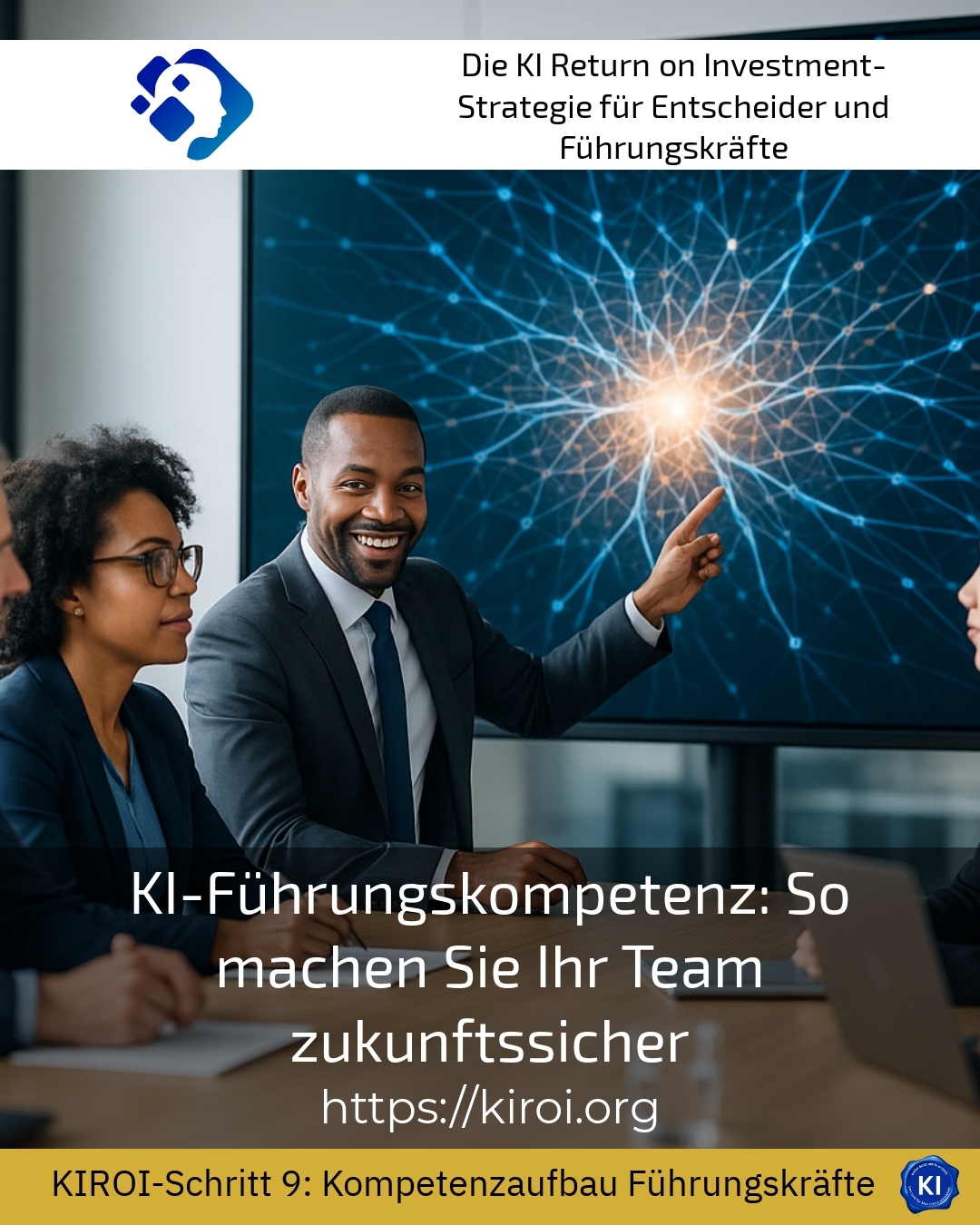
The world of work is changing rapidly. Leaders are facing a monumental challenge. Anyone who wants to prepare their team for the future today cannot ignore one particular topic. AI leadership skills becomes the decisive success factor. But how do you succeed in getting employees excited about new technologies? How do you create an environment that fosters innovation? And what skills do you yourself need to lead your team through this transformation? These questions are currently occupying numerous companies worldwide. It gets particularly exciting when we look at concrete examples. This article shows you practical ways forward.
Warum KI-Führungskompetenz heute unverzichtbar geworden ist
The integration of intelligent systems is transforming almost every area of work. Leaders frequently report uncertainty within their teams. Some employees fear for their positions. Others, however, see great opportunities in the new possibilities. This range of reactions requires a special touch.
In the manufacturing industry, for example, we are currently experiencing a fundamental transformation. Production lines are increasingly being optimised by intelligent algorithms. A medium-sized mechanical engineering company recently integrated predictive maintenance systems. The managers had to develop completely new competencies in the process. They learned to interpret technical data while simultaneously addressing human fears.
Another example can be seen in the healthcare sector. Hospitals are increasingly relying on diagnostic support systems. Chief physicians and nursing service managers face the task of involving their teams. They must explain that technology does not replace, but supports. This communication requires both empathy and technical understanding.
The financial sector is also undergoing massive changes. Banks and insurers are automating routine processes on a large scale. Customer advisors are evolving into problem solvers for complex issues. Managers are actively accompanying this transformation and providing important impetus. They are creating spaces for further training and personal development.
Best practice with a AIROI customer
An internationally active logistics company faced a major challenge. The management had decided to introduce intelligent route optimisation. Initially, the dispatchers felt bypassed and showed clear resistance. As part of a transruption coaching programme, we intensively supported the managers over several months. Together, we developed a communication strategy that took concerns seriously. The dispatchers were actively involved in the implementation and contributed their empirical knowledge. They realised that the system makes their work easier rather than replacing it. After six months, the employees reported significantly less stress. The managers had learned to shape technological change in a human-centric way. This example impressively demonstrates how important professional support is in such projects. The company also recorded a twenty percent increase in employee satisfaction. [1]
The five pillars of genuine AI leadership competence in everyday business life
Future-proof leadership is based on several core pillars. These elements complement each other and form a stable foundation. Leaders who internalise these pillars manage transformations significantly more successfully.
Basic technical understanding without expert status
Leaders do not need to become programmers. A solid basic understanding of the technology is entirely sufficient. They should understand what is possible and where the limits lie. This knowledge enables well-founded decisions and realistic expectations. In retail, for example, many companies rely on demand forecasting. Store managers benefit from understanding the basic logic of these systems.
The automotive industry provides a clear example here. Workshop managers are increasingly working with diagnostic assistance systems. They need to be able to interpret the results and compare them with their experience. A basic understanding of the underlying mechanisms helps enormously with this.
We are experiencing similar developments in agriculture. Farm managers use intelligent systems for irrigation and fertilisation. Understanding the data sources enables better decisions in day-to-day operations.
Emotional intelligence as a key competence
Technological change triggers strong emotions. Leaders must be able to perceive and address these feelings. Empathy is becoming more important than ever in times of transformation. Employees need to feel heard and understood.
This is clearly evident in the customer service of large telecommunications companies. Many enquiries are now handled automatically. Service staff take on more complex cases and emotional conversations. Team leaders actively support their employees in this shift in roles.
We are also observing interesting developments in the education sector. Headteachers are introducing digital learning assistants and supporting their teaching staff in the process. They are creating spaces for dialogue and mutual support among teachers.
The hospitality industry also offers exciting insights. Restaurant managers are gradually integrating ordering systems and kitchen automation. Human contact with the guest remains central and irreplaceable.
Practical strategies for the team development of tomorrow
Theoretical foundations alone are not enough. Leaders need concrete action strategies for everyday work. The following approaches have proven themselves in practice.
Regular learning formats create a culture of continuous development. In the chemical industry, companies are establishing what are known as technology breakfasts. Teams use these to exchange views on new developments and experiences. These informal formats reduce hesitation and promote knowledge transfer.
Pilot projects allow initial experience to be gained in a protected environment. An energy supplier first tested intelligent grid control in one region. The findings were incorporated into the company-wide rollout. Employees became ambassadors for the new technology.
Mentoring programmes connect different generations and worlds of experience. Younger employees share technical knowledge with experienced colleagues. In return, the latter pass on their industry know-how. This mutual enrichment significantly strengthens team cohesion.
Best practice with a AIROI customer
A tax consultancy with multiple locations wanted to modernise its processes. The partners recognised the need to strengthen their AI leadership skills. Many employees had decades of professional experience and were sceptical. In transruptions coaching, we jointly developed a step-by-step implementation plan. The experienced employees were involved as process experts and valued. They defined which tasks were suitable for automation and which were not. Younger colleagues took over the technical implementation and training of their teams. This combination of experiential knowledge and technical affinity proved extremely successful. The firm reports a significant increase in efficiency coupled with high employee satisfaction. The managers developed a new understanding of participatory change processes as a whole. This project illustrates how professional guidance can turn resistance into engagement. [2]
Common challenges and how to overcome them
Many leaders come to consulting with similar issues. They report resistance, feeling overwhelmed and communication problems. These challenges are both normal and solvable.
Dealing with anxieties requires particular sensitivity. Employees worry about their professional future and relevance. Leaders should take these concerns seriously and address them openly. In the insurance industry, for example, companies are increasingly automating claims processing. Claims handlers instead take on advisory roles for complex cases. This development opens up new perspectives for personal growth.
A lack of resources for further training presents a further obstacle. Creative solutions can help here and bridge budget bottlenecks. Online learning platforms offer flexible options for part-time learning. Peer learning groups use internal knowledge efficiently and cost-effectively.
The speed of change is noticeably overwhelming many teams. Here, it helps to set clear priorities and remain realistic. In the pharmaceutical industry, companies are focusing on a few important use cases. This step-by-step approach reduces complexity and creates a sense of achievement.
Generational conflicts can also arise and put a strain on teams. Different attitudes towards technology clash and generate tensions. A construction company resolved this very successfully through mixed project teams. Experienced construction managers and tech-savvy junior staff complemented each other exceptionally well.
The role of coaching in technological transformation processes
Professional guidance provides leaders with sustainable support during complex changes. transruptions coaching clearly positions itself as a partner for such projects. The method provides impulses for independent problem-solving and development.
Clients frequently report initial overwhelm. The multitude of options and decisions initially appears crushing. In coaching, they gradually regain clarity and agency. They recognise their strengths and use them purposefully in the transformation process.
In the media sector, we recently intensively supported an editorial management team. The introduction of content assistance systems posed major demands on everyone involved. Journalists feared a loss of quality and artistic limitations. The coaching helped the manager to find a balance and communicate it.
The hotel industry offers further interesting fields of application for coaching. Hotel directors are integrating intelligent systems for reservation and staff scheduling. At the same time, they maintain the personal quality of service that guests appreciate. This balance requires thoughtful leadership decisions and clear communication.
Interest in professional guidance is also growing steadily in the trades. Master craft businesses are digitalising their processes and relying on intelligent tools. Preserving the quality of craftsmanship remains the top priority for everyone involved.
My AIROI Analysis
Examination of this topic clearly shows that AI leadership skills encompass far more than technical knowledge alone. Successful leaders combine a basic understanding of technology with high emotional intelligence and clear communication. They create safe spaces for experimentation while also tolerating mistakes as learning opportunities. This attitude enables teams to perceive changes as an opportunity rather than a threat.
The numerous industry examples demonstrate that no sector remains exempt from this development. From agriculture to the financial sector, from trades to healthcare – new demands on leadership are emerging everywhere. At the same time, the best-practice examples show that successful transformation is possible. However, it requires deliberate shaping and often also external support.
Particular emphasis should be placed on the importance of participatory approaches in change processes. Employees who are actively involved develop a sense of ownership for new systems. Their experience and expertise flow into the implementation. This procedure noticeably reduces resistance and increases acceptance.
In conclusion, it can be stated that the future-proofing of teams depends significantly on their leaders. Those who invest in their own development today will benefit from resilient and adaptable teams tomorrow. The investment in coaching and further training pays off in the long term. [3]
Further links from the text above:
[1] Harvard Business Review – AI and Machine Learning Leadership Insights
[2] McKinsey – The State of AI and Leadership Implications
[3] World Economic Forum – Artificial Intelligence and the Future of Work
For more information and if you have any questions, please contact Contact us or read more blog posts on the topic Artificial intelligence here.






 Deutsch
 English (UK)