
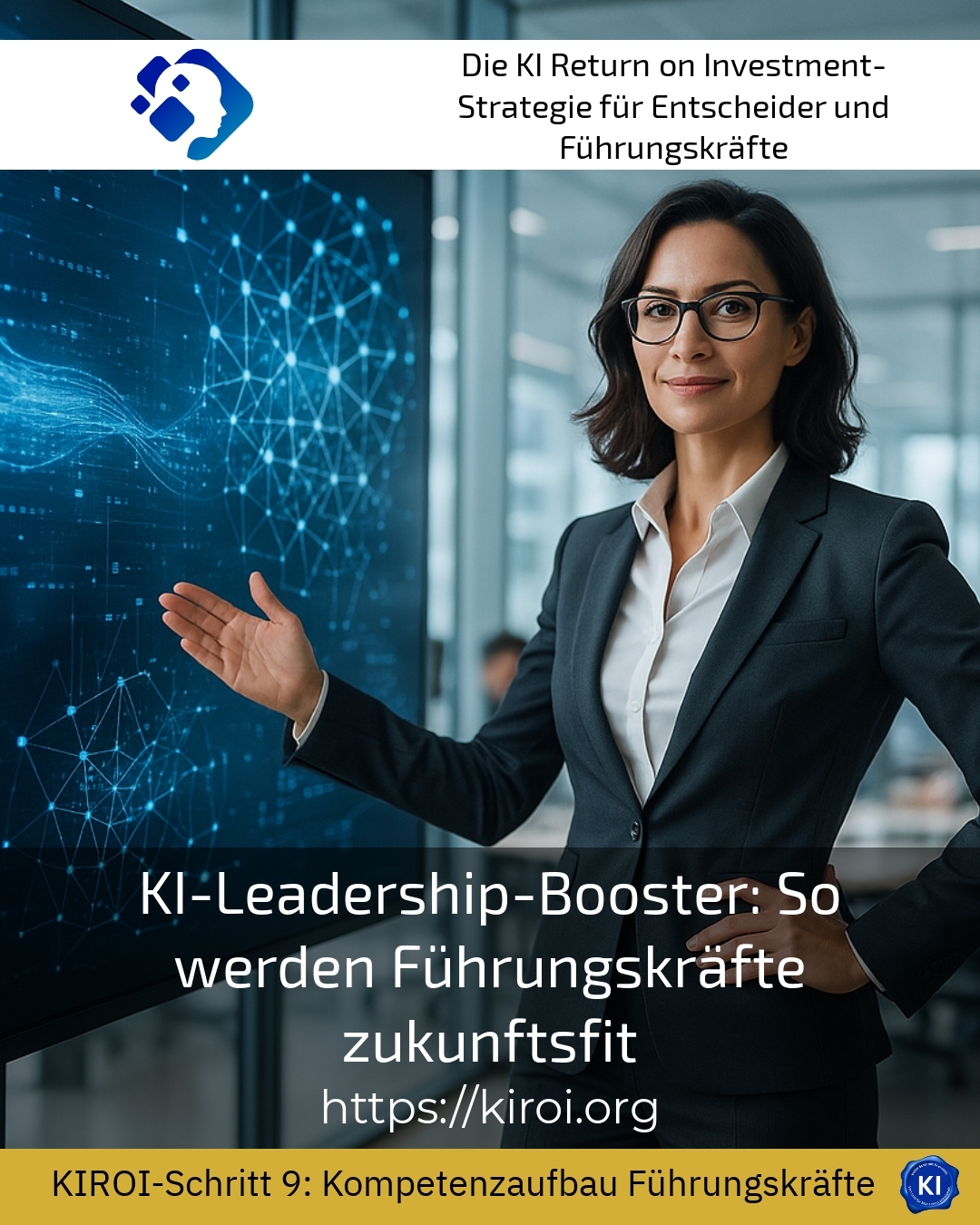
The working world is changing at a rapid pace and presenting leaders with completely new challenges. Those who hold responsibility today must not only excel professionally, but also master the use of intelligent technologies. The AI Leadership Booster thereby developing into the crucial tool that empowers decision-makers to navigate their teams through complex transformation processes. Clients frequently report how overwhelming the abundance of new possibilities initially feels. However, this is precisely where professional guidance comes in, creating orientation and enabling sustainable competence development.
Why the AI leadership booster is becoming an indispensable tool
The integration of intelligent systems into corporate processes requires a fundamental rethink at all management levels. Leaders face the demanding task of combining technological innovation with human expertise. This is not about understanding every technical detail. Rather, decision-makers must learn to recognise strategic potential and deploy it profitably. Transruption coaching accompanies managers precisely in these complex projects and supports them in making well-founded decisions [1].
For example, a medium-sized manufacturing company was faced with the challenge of modernising its quality control. Although the management recognised the potential of automated image recognition systems, it did not know how to bring its workforce along. A logistics company that wanted to introduce intelligent route optimisation experienced a similar situation and encountered considerable resistance from experienced dispatchers. A retail company, in turn, experimented with chatbots in customer service and had to realise that acceptance among both employees and customers was initially low.
Best practice with a AIROI customer
A long-established family-run mechanical engineering company approached us because the management team was unsure how to integrate intelligent systems into existing processes. The managing director had heard about the enormous efficiency gains achieved by other companies and did not want to fall behind. As part of the coaching, we first developed a clear vision that took both technological and human aspects into account. It was particularly important to the leader that her long-standing employees did not feel as though they were being replaced. Together, we developed a communication strategy that placed transparency and participation at the forefront. After six months, the company had not only successfully implemented its first pilot projects, but had also established a culture of openness towards innovation. The employees suddenly began putting forward their own suggestions for improvement and felt like active shapers of change.
The core competencies for sustainable leadership
Modern leaders require an expanded competency profile that goes far beyond traditional management skills. They need to understand which tasks can be intelligently automated and where human strengths remain indispensable. Empathy, strategic thinking and ethical judgment are gaining enormous importance in the process. The AI Leadership Booster helps leaders find this balance and embody it authentically.
For example, a financial services provider implemented intelligent analytics tools for lending and had to reposition its advisers. Instead of making standard decisions, they henceforth concentrated on complex consultative discussions and the interpretation of algorithmic recommendations. An insurance company utilised automated claims notification systems and retrained its employees to handle particularly sensitive cases [2]. A pharmaceutical company deployed intelligent literature research and empowered its scientists to focus on creative research work.
The topics that leaders bring to us are diverse and yet similar at their core. Many report uncertainty in the face of rapid technological development. Others feel crushed between the expectations of their boards and the concerns of their teams. Personal fears also frequently play a role, such as the worry of no longer being needed themselves. Transruption coaching creates a safe space to address these issues openly and develop constructive solutions.
Strategic decision-making ability in complex situations
The ability to make informed decisions under uncertainty is becoming a key competency. Leaders must be able to weigh up when to trust algorithmic recommendations and when human judgement should prevail. This skill cannot be learned from books, but requires practical experience and reflective practice.
A retail group faced the decision of whether to leave its pricing entirely to dynamic algorithms. The management team realised that while this would allow for short-term profit maximisation, it could endanger customer trust in the long run. A telecommunications company used intelligent systems for workforce planning and had to learn to critically question their recommendations. A hotel chain experimented with automated review analysis and discovered that the algorithms overlooked important cultural nuances.
How the AI leadership booster transforms teams
Successful transformation always starts with the leader themselves. Only those who are personally convinced and understand the benefits of intelligent systems can inspire others. This is not about blind technological optimism, but rather a balanced attitude that equally takes account of opportunities and risks.
An automotive supplier trained its managers in handling predictive maintenance and recorded significant improvements in machine utilisation. An advertising agency integrated intelligent creative tools and had to convince its employees that these represented support rather than competition. A hospital introduced diagnostic support systems and initially experienced massive scepticism on the part of experienced medical professionals [3].
Best practice with a AIROI customer
A senior executive from the energy sector came to us because they were experiencing massive resistance during the introduction of smart grid control systems. The long-standing engineers felt their expertise was being devalued by the new technology and subtly blocked any progress. In coaching, we worked on truly understanding and appreciating the employees' perspective. The executive learned to listen actively and take legitimate concerns seriously. Together, we developed a participatory approach in which the experienced engineers were involved in system optimisation as experts. Their knowledge was incorporated into the configuration of the algorithms, which not only improved the technical quality but also dramatically increased acceptance. The executive later reported that this experience had fundamentally changed their understanding of change management.
Ethical Leadership in the Age of Intelligent Systems
As algorithmic decision support becomes more widespread, ethical demands on leaders are also growing. They bear responsibility for decisions whose origins they may not be able to fully comprehend. This tension requires a high degree of reflexivity and moral judgement.
An employment agency used intelligent pre-selection for job applications and had to ensure that no discriminatory patterns were reproduced. A bank used algorithmic risk assessment and established mechanisms to check for unconscious bias. A media company experimented with automated content creation and developed clear guidelines for labelling and quality control.
The AI Leadership Booster raises leaders' awareness of these ethical dimensions and supports them in establishing responsible governance structures. The aim is to deploy technology in a way that reinforces rather than undermines human values [4].
Practical implementation steps for managers
Transformation is not achieved through grand gestures, but through consistent small steps. Leaders benefit from starting with manageable pilot projects and learning from the experience. Transruptions coaching accompanies this learning journey and helps to process setbacks constructively.
A construction company started with intelligent project planning in a single business unit and only scaled after positive experiences. A law firm initially tested automated document analysis only for standard contracts and expanded its use gradually. A food manufacturer initially implemented intelligent quality control parallel to existing processes and only replaced them after successful validation.
What is important here is to make successes visible and to celebrate them, but also to learn transparently from failures. This culture of psychological safety enables genuine innovation and sustainable change.
My AIROI Analysis
Mentoring leaders through the integration of intelligent technologies continually reveals similar patterns and challenges. My work clearly demonstrates that technological competence alone is not enough to shape a successful transformation. Rather, the decisive factor is the ability to bring people along and develop a shared vision that honours both technological and human aspects.
Frequently, clients report that prior to coaching they felt torn between various demands. The expectation to deliver rapid results conflicted with the need to shape sustainable changes. In the coaching process, it is regularly possible to resolve these apparent contradictions and find integrative solutions.
The combination of strategic reflection and hands-on implementation support proves particularly valuable. Leaders appreciate having a safe space where they can talk openly about uncertainties without compromising their authority. At the same time, they want practical tools and impetus that they can apply directly in their daily work. The AI Leadership Booster combines both dimensions, thereby enabling sustainable skills development that goes far beyond the superficial transfer of knowledge.
Further links from the text above:
[1] Leadership Transruptions Coaching
[2] The AIROI strategy for businesses
[3] AI integration into business processes
[4] Ethical foundations for the use of AI
For more information and if you have any questions, please contact Contact us or read more blog posts on the topic Artificial intelligence here.








 Deutsch
  English (UK)