
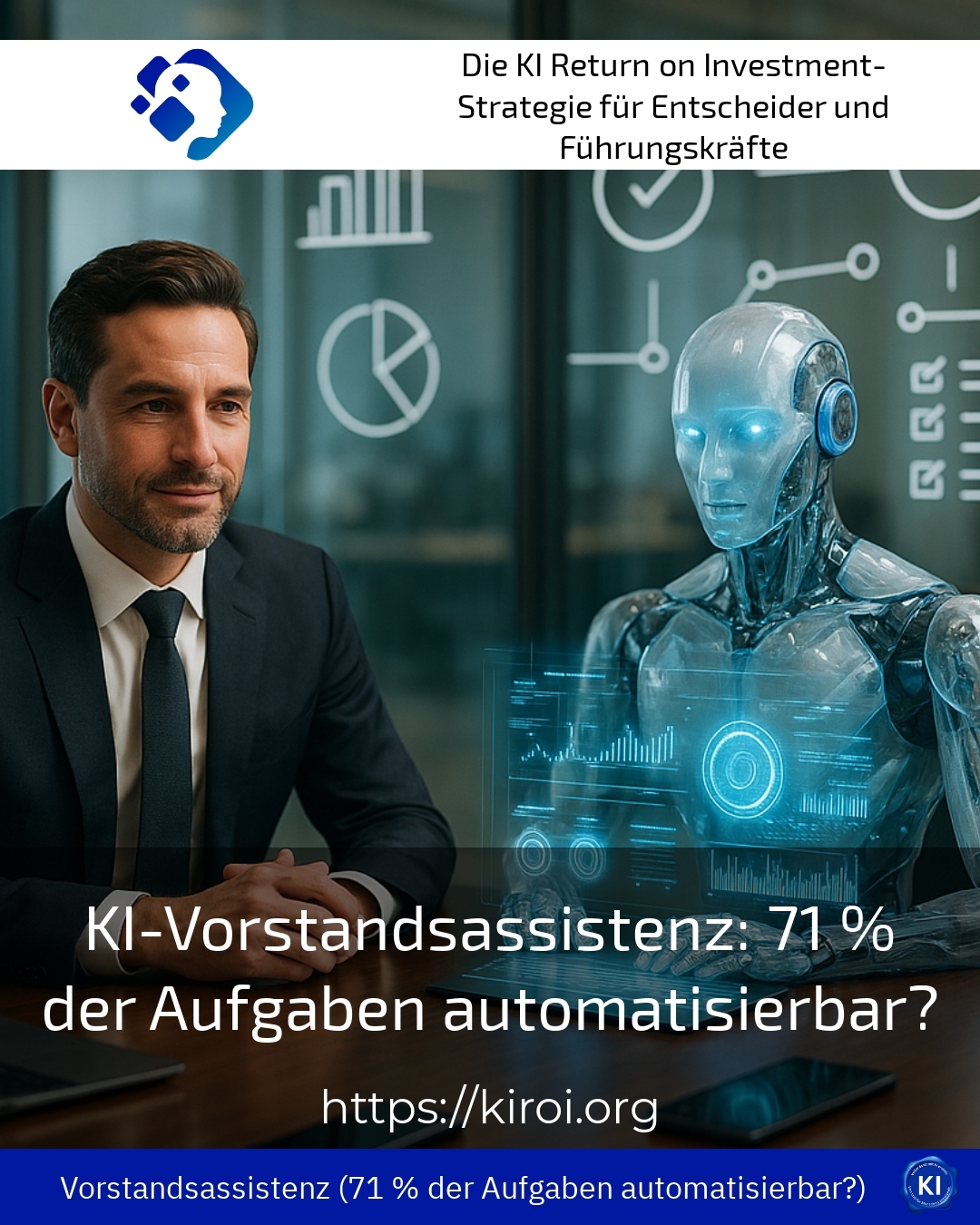
Could intelligent systems soon take over your strategic support work in the executive suite, and what does that mean for your professional future in a field that has long been considered irreplaceable?
The idea that machines could take over complex tasks in the immediate environment of corporate management initially seems alien or even threatening to many professionals. However, current analyses reveal a nuanced picture that uncovers both challenges and opportunities. The AI executive assistant is at the centre of this discussion. According to current surveys, a remarkable 71 per cent of typical tasks could be supported by algorithmic solutions or fully automated. This figure comes from, among other sources, the Job Futuromat of the Institute for Employment Research [1]. These findings force us to fundamentally rethink traditional job profiles.
If you operate in this demanding environment, taking a proactive approach to technological opportunities is recommended. The AIROI seminars provide a structured framework for this. You can find the current dates under https://risawave.org/de/live-events-mit-sanjay-sauldie/ [2]. These events support professionals in systematically building up technological skills.
The transformation of strategic support work through AI board assistance
Digitalisation is fundamentally changing the requirements for professionals in direct management environments. Many routine tasks can already be automated. Appointment scheduling is increasingly handled by intelligent algorithms. Travel planning is taken over by specialised systems with growing precision. Document management is made more efficient through machine learning. These developments affect almost all core administrative processes.
Let us consider concrete application scenarios from professional everyday life. The creation of minutes at supervisory board meetings can be automated through speech recognition. Systems record spoken contributions, structure content and produce preliminary summaries. Post-processing then only requires qualitative checking and content additions. A second example is found in the area of information retrieval for strategic decisions. Algorithms search databases, analyse market reports and compile relevant insights into clear formats. Thirdly, the potential is evident in correspondence with stakeholders. Intelligent systems can create drafts and ensure linguistic consistency.
Best practice with a AIROI customer A medium-sized technology enterprise implemented an intelligent system to support its executive management. Initially, the responsible specialist reported significant concerns regarding her future role within the company. However, within the framework of the AIROI coaching, she developed a new understanding of her responsibilities. She learned to use the system as a tool that takes over routine tasks. She invested the time gained in strategic projects and qualitative relationship management. After six months, she evaluated the change as a professional enrichment. Her competencies in the field of technological control grew continuously. The management appreciated her expanded analytical skills. The company profited from increased efficiency and an improved basis for decision-making. This case illustrates how humans and machines can interact productively.
Which activities remain reserved for humans?
Despite the high potential for automation, core competencies remain that continue to require human expertise. Emotional intelligence in dealing with sensitive HR matters cannot be replicated algorithmically. Assessing political dynamics within the executive board demands intuition and experience. Trust-based communication with external stakeholders requires an authentic human presence.
This necessity is particularly clear in the field of crisis communication. When unforeseen events require quick reactions, a human must set priorities. The interpretation of non-verbal cues during important negotiations remains a human domain. Furthermore, maintaining confidential networks with other companies requires personal contact. The AI executive assistant supplement these skills, but do not replace them.
Practical implementation of the AI board assistant in everyday working life
The successful integration of technological solutions requires a systematic approach. First, you should categorise your daily tasks. Which activities follow recurring patterns? Which require creative or strategic decisions? This analysis forms the basis for meaningful automation.
A first application example concerns the preparation of committee meetings. Intelligent systems can draw up agendas and compile relevant background information. They search past minutes for thematically related resolutions. They identify pending items and forthcoming needs for decisions. A second example can be found in the field of information management. Algorithms filter incoming communication according to relevance and urgency. They categorise enquiries and prepare draft responses. Thirdly, systems assist with the creation of presentations and reports. They format content consistently and automatically insert current data.
The AIROI strategy offers valuable insights for practical implementation. Lectures and workshops provide concrete steps for deployment. Participants often report immediate practical applications in their daily work. Transruptions coaching supports individual project design.
Best practice with a AIROI customer A corporate management professional faced the challenge of supporting three board members simultaneously. The workload regularly exceeded capacity limits and led to a drop in quality. As part of the AIROI coaching, she analysed her task structure together with a coach. In doing so, she identified considerable potential for automation in scheduling and travel organisation. She implemented an intelligent calendar system that automatically coordinates availabilities. Another tool took over the booking of flights and hotels based on predefined preferences. According to her own assessment, the time saved was around fifteen hours a week. She used these gained capacities for strategic analyses and personal advisory discussions. The satisfaction of all parties involved increased measurably. This example demonstrates the practical benefits of well-thought-out technology integration.
Challenges in the introduction of intelligent systems
The implementation of new technologies also brings difficulties with it. Data protection aspects require special attention in the management environment. Confidential company information must remain protected. The selection of suitable systems requires technical understanding and careful evaluation.
A concrete example concerns the use of cloud-based solutions. Many companies are hesitant to entrust sensitive board-level information to external providers. The alternative is on-premise installations with higher maintenance overheads. Another example can be seen in the integration of various systems. When calendars, email and document management do not communicate, inefficiencies arise. Finally, the implementation also requires change management skills. Leaders must be convinced of the benefits.
The future of strategic support work with AI board assistance
Technological development is advancing continuously. Language models are becoming increasingly powerful and context-sensitive. The integration of various systems is improving steadily. New application possibilities are emerging in rapid succession.
For professionals in management roles, this means the necessity for continuous further training. The AIROI seminars provide a suitable framework for this. They not only convey technical knowledge but also strategic perspectives. Participants develop an understanding of the possibilities and limitations of the technology.
An example of future developments can be found in the field of predictive analytics. In future, systems could anticipate which information a board member requires. They will proactively prepare relevant data and present it at the optimal time. A second example concerns automated stakeholder analysis. Algorithms could map relationship networks and suggest communication strategies. Thirdly, translation systems are evolving that enable international correspondence in real time.
My AIROI Analysis
The analysis of current developments in the field of strategic support work reveals a complex picture. The aforementioned rate of 71 percent of automatable activities should not be seen as a threat, but as an opportunity. Professionals who proactively engage with the technological possibilities will be able to strengthen their professional position. The remaining 29 percent encompass precisely those competencies that deserve special appreciation. Emotional intelligence, strategic thinking and trust-based communication are gaining in importance.
Transruption coaching within the framework of the AIROI strategy supports this transformation. It guides professionals in further developing their skills profile. The combination of technological understanding and core human capabilities creates a future-proof professional profile. Those who actively shape this development will benefit from it. The workshops and lectures provide concrete impulses for practical implementation. Participants frequently report a changed self-image after engaging with these topics. They increasingly see themselves as strategic partners to company management. This positioning ensures long-term professional prospects in a changing environment.
Further links from the text above:
[1] Job-Futuromat of the Institute for Employment Research
[2] AIROI seminars and live events with Sanjay Sauldie
For more information and if you have any questions, please contact Contact us or read more blog posts on the topic Artificial intelligence here.







 Deutsch
 English (UK)