
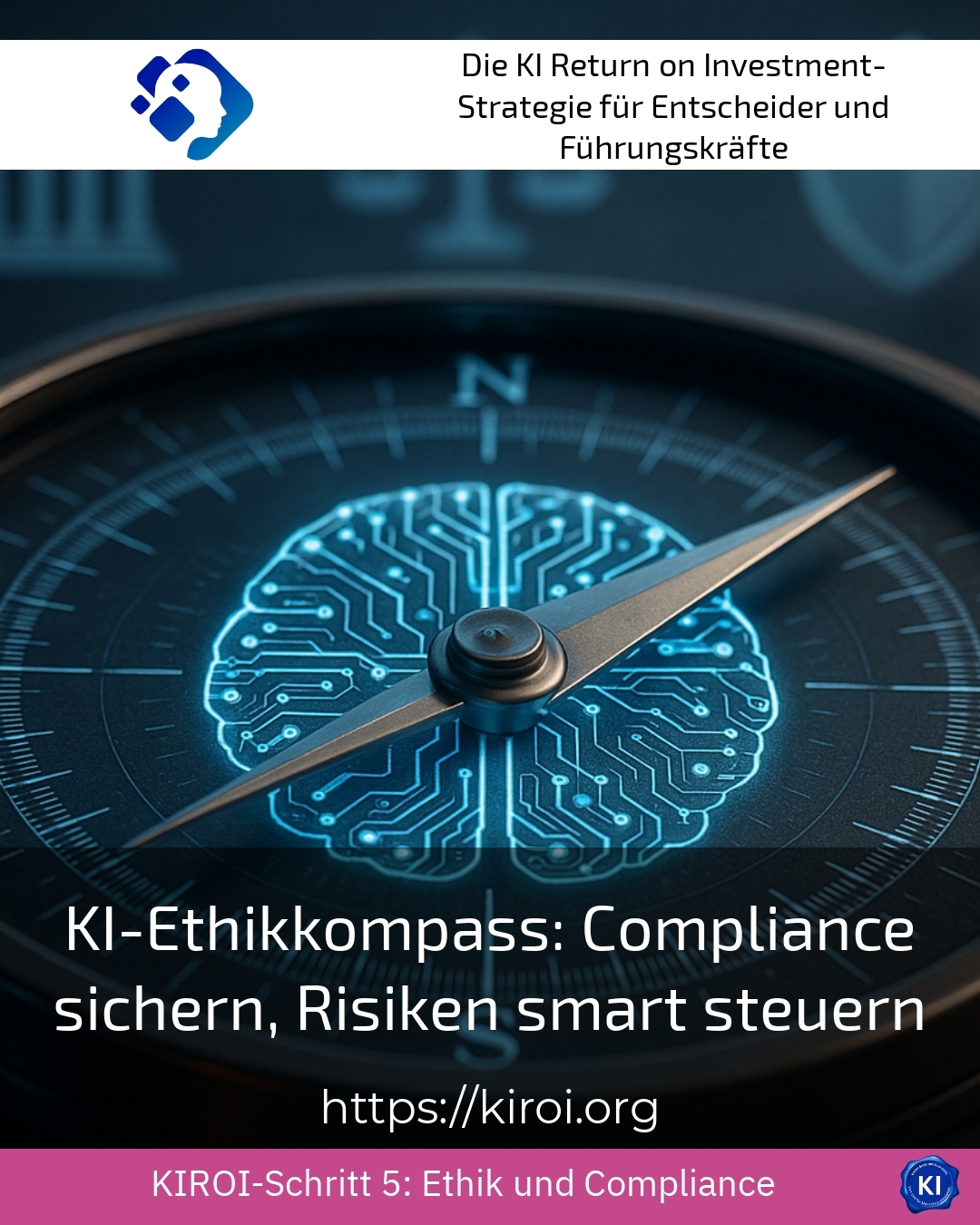
Imagine your company is implementing a revolutionary technology. This technology promises efficiency gains and competitive advantages. But suddenly, a regulatory authority is at your door. It demands proof of ethical principles and risk management. This is precisely where the AI Ethics Compass: Ensuring compliance, managing risks smartly into play. More and more organisations recognise the urgency of this issue. They are looking for reliable guidance for their digital transformation projects. The challenge lies in combining innovation with responsibility. This article shows you tried-and-tested ways to achieve this.
Why ethical guardrails have become indispensable
The digital transformation has developed unprecedented momentum in recent years. Companies from almost all economic sectors are increasingly relying on intelligent systems. These systems support decision-making processes and automate complex workflows. At the same time, awareness of the associated risks is steadily growing. Regulatory authorities worldwide are tightening their requirements for transparency and traceability. The EU AI Act, for example, defines clear categories for high-risk applications [1]. Companies must prove that their systems comply with ethical principles. A structured approach helps to systematically meet these requirements. In this way, sustainable competitive advantages are created through responsible innovation.
Many leaders report feeling uncertain about how to deal with new technologies. They wonder which measures are actually necessary and effective. There is often a lack of a clear framework for action on ethical issues. Exactly this gap is bridged by a well-thought-out compass for responsible technology use. It provides impetus for strategic alignment and operational implementation. In doing so, it takes into account both legal requirements and societal expectations. The integration of ethical principles into business processes thus becomes a manageable task.
Practical examples of ethical challenges in organisations
A medium-sized enterprise implemented a candidate pre-selection system. The system analysed CVs and automatically evaluated candidates. After a few months, the HR department noticed striking patterns. Certain applicant groups were systematically disadvantaged, even though this was not intended. The cause lay in the system's historical training data. This example illustrates the necessity of continuous monitoring and adaptation. Another company used automated credit decisions for private customers. Here too, unintended biases became apparent after some time. The affected organisations had to fundamentally revise their processes. A third case concerned a retail company with automated pricing. The dynamic prices led to public criticism and damage to its reputation.
Best practice with a AIROI customer
An established service company approached transruptions-Coaching with a complex challenge. The company had several automated decision-making systems in use that had been developed without ethical guidelines. Management was increasingly recognising risks due to a lack of transparency and documentation. As part of the support provided, a comprehensive inventory of all relevant systems was initially carried out. Together, we identified critical areas that required special attention. Subsequently, we developed tailored ethical guidelines for the entire company. These guidelines were integrated into existing governance structures and reviewed regularly. Training all participating employees in ethical issues was particularly important. Through these measures, the company was able to significantly strengthen its compliance position. Regulatory audits have since proceeded without any notable objections. Customer satisfaction also improved because decisions could be communicated more comprehensibly. This project is a prime example of how structured support can bring about sustainable improvements.
AI Ethics Compass: Ensuring compliance through systematic risk analysis
A systematic risk analysis forms the foundation of every responsible technology strategy. It begins with the identification of all relevant application areas and deployment scenarios. This is followed by an assessment of potential impacts on various stakeholder groups. This assessment takes into account both direct and indirect effects of the deployed systems. A structured catalogue helps to ensure that no important aspects are overlooked. The OECD has published helpful guidelines on this, which can serve as orientation [2]. Regular repetition of this analysis when framework conditions change is important. In this way, organisations remain agile and can respond quickly to new developments.
Many clients come to us with specific compliance concerns. They report uncertainties regarding the interpretation of regulatory requirements. Often, the internal expertise for a sound risk assessment is lacking. Transruption coaching accompanies these organisations in developing individual approaches to solutions. Practical feasibility is always paramount. Theoretical concepts are translated into manageable action plans. The cooperation is based on partnership and eye level. In this way, sustainable competencies are built up within the organisation.
Concrete measures for effective risk management
A financial services provider developed a three-stage procedure for the risk assessment of new systems. The first stage comprises a standardised initial assessment by the business department. If there is increased risk potential, an in-depth analysis is carried out by an interdisciplinary panel. The third stage involves external audits for particularly critical applications. This procedure has proven successful in practice and has received multiple awards. An insurance company additionally implemented a continuous monitoring system. This system automatically detects deviations from defined parameters. In the event of anomalies, the responsible persons are notified immediately. A third example comes from the healthcare sector, where particularly strict requirements apply. There, a multi-stage approval procedure involving external ethics committees was established.
Governance structures as a guarantee of success for ethical standards
Effective ethical standards require clear organisational embedding and responsibilities. Many companies have meanwhile created dedicated roles for technology ethics. These positions ideally report directly to the executive board. This underlines the strategic importance of the topic and enables rapid decision-making pathways. At the same time, operational structures are needed for the daily implementation of ethical principles. Cross-functional teams have proven particularly effective in this regard. They bring in diverse perspectives and foster holistic approaches to solutions. Collaboration between technical, legal and business experts is crucial here.
The AI Ethics Compass: Ensuring compliance, managing risks smartly provides a structured framework for such governance structures. It defines roles, processes and responsibilities in a transparent manner. In doing so, it takes into account the varying maturity levels of different organisations. Smaller companies can start with streamlined structures and gradually expand them. Larger corporations often require more complex arrangements with multiple committees and escalation levels. It is important to adapt to the respective organisational circumstances. A rigid one-size-fits-all model rarely works satisfactorily in practice.
Best practice with a AIROI customer
An internationally active trading company was faced with the task of fundamentally modernising its governance structures. The existing processes had evolved over time and were not geared towards the new technological challenges. The management team opted for external support from transruptions-Coaching. Together, we first analysed the existing decision-making processes and identified areas for optimisation. In doing so, we found that ethical considerations were often taken into account too late in the development process. We developed a new governance model incorporating ethical assessments at an early stage. A central ethics board was established and given clear remit. In addition, local points of contact were appointed across all relevant business areas. These local experts act as the first point of contact for ethical issues arising in day-to-day operations. In more complex cases, they escalate matters to the central board. The new model was introduced in stages and supported by extensive training programmes. Acceptance amongst staff was high from the outset. The company reports faster decision-making processes and fewer conflicts regarding project approvals.
Training and awareness as key factors
Even the best structures remain ineffective without appropriately trained staff. Regular training and awareness-raising measures are therefore essential. A technology company introduced mandatory annual training for all employees. This training imparts fundamental ethical principles and current regulatory requirements. In addition, there are in-depth workshops for particularly exposed functional areas. A pharmaceutical company relied on interactive formats featuring case studies and role-play. This method proved particularly effective for anchoring the ability to reflect ethically. A third example comes from the automotive industry, where gamified learning formats are used. The playful engagement with ethical dilemmas promotes the engagement of participants.
Practical implementation of the AI ethics compass in organisations
The implementation of a comprehensive ethical framework requires careful planning and a step-by-step approach. A proven approach begins with a pilot phase in selected areas of the business. These pilot projects enable practical experience to be gathered under controlled conditions. Insights from the pilot phase are incorporated into the optimisation of the overall concept. This is followed by the gradual rollout to further areas and use cases. Continuous communication with all stakeholders involved is important in this process. Transparency regarding goals, progress and challenges fosters organisation-wide acceptance. Resistance is thus identified early on and can be addressed constructively.
The AI Ethics Compass: Ensuring compliance, managing risks smartly supports organisations in this complex task. It offers proven tools and methods for every implementation phase. Checklists help to verify the completeness of important measures. Best-practice examples demonstrate successful implementations in comparable contexts. At the same time, there is always room for individual adjustments to specific circumstances. No two companies are the same, and this diversity must be taken into account. Transruption Coaching accompanies organisations in this process as an experienced partner at eye level.
Measurable success through a structured approach
A logistics company was able to significantly improve its audit results through systematic ethics management. The number of critical non-conformities fell by more than half within a year. At the same time, employee satisfaction in the affected areas increased measurably. An energy supplier reports shorter project durations through the early clarification of ethical issues. Delays caused by late objections or rework were thus significantly reduced. A media company now actively uses its ethical framework for marketing purposes. The demonstrated responsibility strengthens the brand image and differentiates it from competitors. These examples show that ethical behaviour and commercial success can go hand in hand.
My AIROI Analysis
The intensive engagement with the topic of ethical technology use clearly shows that we are at a crucial turning point. Organisations that invest in robust ethical frameworks now are creating sustainable competitive advantages for the future. Regulatory pressure will continue to increase, and societal expectations are rising continuously. At the same time, enormous opportunities present themselves for companies that can authentically demonstrate responsibility. The approaches presented in this article have proven themselves in practice and can be flexibly adapted.
From my experience in supporting numerous transformation projects, I can confirm that success depends significantly on three factors. Firstly, it requires genuine commitment from management to ethical principles. Lip service is quickly seen through by employees and undermines credibility. Secondly, structures must be created that enable and encourage ethical reflection in everyday work. Overburdened processes, on the other hand, lead to workarounds and frustration. Thirdly, continuous learning and adaptation are indispensable in this dynamic environment.
The AI Ethics Compass: Ensuring compliance, managing risks smartly provides a valuable orientation framework for this journey. It does not replace the individual examination of specific challenges within one's own organisation. However, it provides impulses and reduces complexity to a manageable level. The examples presented show that successful implementations are possible in a wide variety of contexts. The crucial factor is the first step and the willingness to pursue continuous development. Transruptions Coaching is gladly at your side as an experienced companion.
Further links from the text above:
[1] EU AI Act – Official information page on European regulation
[2] OECD Guidelines for Trustworthy Artificial Intelligence
For more information and if you have any questions, please contact Contact us or read more blog posts on the topic Artificial intelligence here.











 Deutsch
 English (UK)