
Why do so many companies fail to future-proof their workforce, even though they invest millions in training?
The answer to this question surprises many executives because it is deeply rooted in outdated mindsets and inefficient methods. At a time when technologies are evolving rapidly and AI staff training becoming a decisive competitive factor, organisations are facing enormous challenges. Traditional training concepts are no longer proving sufficient. They leave behind knowledge gaps and frustrated employees. At the same time, intelligent systems are opening up entirely new possibilities for personalised learning. This development is fundamentally changing how companies can build and maintain skills. This article shows you concrete ways in which sustainable skills development can actually succeed.
Understanding the transformation of corporate training
The world of work is undergoing fundamental change. Therefore, companies must fundamentally rethink their training strategies. Traditional seminar formats often fail to achieve the desired impact. They impart knowledge that is quickly forgotten. Studies show that up to 70 percent of training content is lost within a week [1]. This effect not only costs companies money. It also prevents real skill development.
Intelligent learning systems are fundamentally changing this situation. They analyse individual learning patterns and adapt content accordingly. A sales representative receives different exercises than a controller. The systems identify knowledge gaps and close them in a targeted manner. This creates sustainable learning instead of superficial information absorption. Companies such as Siemens are already relying on adaptive learning platforms. BMW uses intelligent tutoring systems for technical training. Deutsche Telekom has digitalised its entire leadership development.
Why traditional methods are reaching their limits
Many organisations still rely on standardised training programmes. These one-size-fits-all approaches ignore prior knowledge and individual learning styles. An experienced engineer will be bored in basic courses. A new employee will feel overwhelmed in advanced seminars. Both situations lead to frustration and poor learning outcomes.
Added to this is the time factor. All-day face-to-face training sessions no longer fit into the modern working day. Project deadlines and customer demands do not tolerate absences lasting several days. The result is that important further training is postponed or cancelled altogether. Daimler has recognised this problem and is focusing on micro-learning modules. SAP integrates learning content directly into workflows. Bosch is developing short educational videos that employees can consume in between tasks.
Best practice with a AIROI customer
A medium-sized mechanical engineering company was facing a significant challenge, as its previous training programmes were no longer achieving the desired impact. Staff turnover among younger specialists was high. Many complained about a lack of development opportunities and outdated learning methods. Working together as part of the transruptions coaching process, we developed a completely new strategy for capability building. First, we analysed the existing processes and identified key weak points. The introduction of an intelligent learning system then enabled personalised learning paths for every single employee. The system automatically identified knowledge gaps and suggested suitable content. Employees were able to learn at their own pace and received immediate feedback. After six months, the HR department reported a significant increase in satisfaction. Turnover fell measurably and capability profiles demonstrably improved. Particularly noteworthy was the increased motivation of the workforce to independently further their education and acquire new skills.
AI employee training: The key to sustainable skills development
Intelligent systems are revolutionising the way people learn. They enable a degree of personalisation that was previously unthinkable. Every learner receives precisely the content that matches their current level of knowledge. The system recognises strengths and fosters them in a targeted manner. At the same time, it identifies weaknesses and offers suitable exercises.
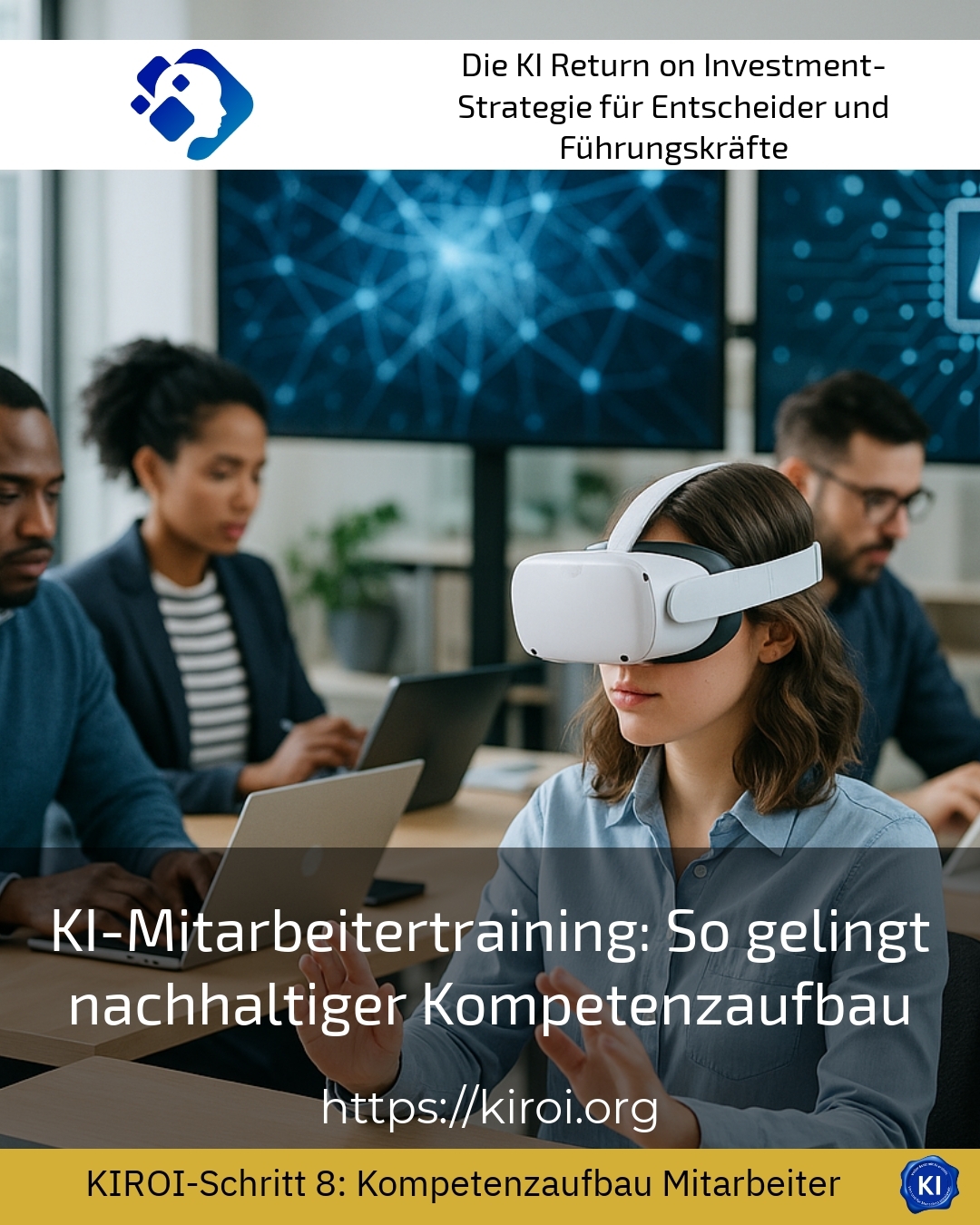
The benefits of this approach are manifold. Employees learn more efficiently and retain what they have learned for longer. Companies save costs on ineffective training. Motivation increases because successes become visible more quickly. BASF has converted its chemical safety training to adaptive systems. Volkswagen uses intelligent simulation for the qualification of assembly workers. Lufthansa relies on virtual reality for training cabin crew.
Developing and implementing personalised learning pathways
The creation of individual learning pathways begins with a comprehensive skills analysis. Intelligent systems record the current knowledge level of each employee. In doing so, they take into account not only technical knowledge, but also soft skills. The analysis is carried out continuously and adapts to changing requirements.
Based on this data, tailor-made development plans are created. A project manager receives different recommendations than an administrative employee. The content takes into account current corporate goals and future requirements. Siemens Energy uses such systems for the development of upcoming management talent. Infineon uses personalised learning paths for technical specialists. Deutsche Bahn uses it to continuously develop its train drivers.
Practical implementation in daily business operations
The introduction of intelligent learning systems requires careful planning and preparation. Many companies underestimate the necessary cultural shift. Employees must understand and accept the new possibilities. Managers must lead by example and actively learn themselves. Only in this way is a genuine learning culture created.
The technical implementation is often the simpler part. Integration into existing workflows requires more attention. Learning times must be firmly anchored in the calendar. Successes should be made visible and acknowledged. Continental has introduced dedicated learning hours for all employees. Henkel rewards commitment to further training with career points. ZF Friedrichshafen integrates learning content directly into daily work.
Best practice with a AIROI customer
An international logistics service provider approached us with a particular challenge, as their decentralised structure made uniform qualification measures considerably difficult. Employees at different locations had varying levels of knowledge and access to different resources. The quality of the services correspondingly fluctuated greatly between the individual branches. As part of our transruptions coaching support, we developed a holistic concept for intelligent learning. The new system enabled cross-site qualification while simultaneously taking local characteristics into account. Every employee received an individual learning plan tailored to their specific tasks. The platform offered content in multiple languages and took cultural differences into account. Within a year, service quality improved measurably and sustainably across all locations. Customer satisfaction rose significantly, whilst at the same time the induction time for new employees fell by almost a third. The client also reported a noticeably increased identification of the workforce with the company.
Achieve measurable success through AI employee training
Sustainable competency development requires clear performance indicators and their regular review. Intelligent systems provide detailed analyses of learning progress and competency development. This data enables evidence-based decisions for further investments in staff development. Leaders can specifically identify where additional support is necessary.
The measurement should encompass various levels. Learner reactions provide initial indications of the quality of the content. Knowledge tests show the actual increase in learning. Behavioural changes in everyday working life demonstrate the transfer into practice. Business results illustrate the economic benefit. Thyssenkrupp uses comprehensive learning analytics to manage its academy. Merck analyses the connection between further training and innovation performance. Fresenius measures the influence of training courses on patient safety [2].
Identifying and overcoming challenges
The introduction of new learning technologies frequently encounters resistance. Older employees sometimes feel overwhelmed by digital formats, whereas younger ones expect state-of-the-art technology and intuitive operation. Bringing these differing expectations into harmony requires a delicate touch.
Data protection concerns also play an important role in acceptance. Employees worry about the use of their learning data. Transparent communication about the purpose and use of the data builds trust. Works councils should be involved at an early stage. Evonik has developed a comprehensive data protection guideline for learning systems. LANXESS proactively informs its employees about all data usage. Covestro involves employee representatives in all projects from the very beginning.
Establish a sustainable learning culture
Technology alone does not create a learning organisation. Corporate culture must anchor continuous learning as a value. Leaders must act as role models and actively participate in further training themselves. Mistakes should be viewed as learning opportunities rather than failures.
The combination of learning and career development provides employees with extra motivation. Acquired skills should be made visible and open up career prospects. Mentoring programmes can promote the transfer of knowledge between generations. Learning communities enable peer-to-peer exchange. Bayer has established internal expert networks for various fields of competence. BASF promotes knowledge sharing through regular learning circles. Wacker Chemie links further training directly with career paths [3].
Best practice with a AIROI customer
A long-established family business in the manufacturing sector was looking for ways to upskill its workforce for the digital transformation. The challenge was that many long-standing employees had little experience with digital technologies. At the same time, new production processes had to be introduced that required digital competencies. Our transruptions coaching support initially comprised a thorough analysis of existing competencies and actual requirements. Subsequently, we jointly developed a step-by-step qualification concept designed to bring all employees along on the journey. The intelligent learning system took into account the varying prior experience and learning speeds of different age groups. The integration of internal multipliers who supported and motivated their colleagues was particularly important. After a year, the digital competence of the entire workforce had improved significantly and the new production processes were running smoothly. The managing director reported a completely changed attitude among his employees towards technological innovations.
Future perspectives for competence building
Technological development is advancing relentlessly. Virtual and augmented reality will make learning environments even more immersive. Voice-controlled assistants will enable individual coaching. The boundaries between working and learning will blur further.
Companies should prepare for these developments today. Investing in flexible learning infrastructures pays off in the long term. Developing a genuine learning culture takes time and continuous attention. Sustainable skill development is becoming a decisive competitive factor. Audi is already experimenting with VR-based training environments for complex assembly processes. Porsche uses augmented reality to qualify service technicians. Mercedes-Benz is developing AI-supported coaching systems for managers.
My AIROI Analysis
The confrontation with AI staff training clearly shows that sustainable competence development is no coincidence, but rather the result of strategic planning and consistent implementation. In my many years of supporting a wide variety of companies, I have observed that the most successful organisations combine three factors: they invest in intelligent technology, they develop a genuine learning culture, and they consistently measure their successes. The technological side is often the easier part here, while cultural transformation represents the greatest challenge.
Frequently, clients report initial resistance, which can nevertheless be resolved through transparent communication and early successes. transruptions coaching support can provide valuable impetus for such change projects and support the process. Adaptation to the specific corporate culture and available resources is particularly important here. A medium-sized enterprise requires different solutions to an international corporation. The support helps to set the right priorities and avoid typical mistakes. Practical examples show that sustainable competence development with AI staff training can be achieved if companies are prepared to invest in both technology and people. The future belongs to learning organisations that view change as an opportunity and take their employees along with them on this journey.
Further links from the text above:
[1] ResearchGate: Studies on knowledge retention in traditional training formats
[2] McKinsey: Insights into People and Organisational Performance
[3] Gartner: Human Resources Research and Advisory
For more information and if you have any questions, please contact Contact us or read more blog posts on the topic Artificial intelligence here.








 Deutsch
  English (UK)