
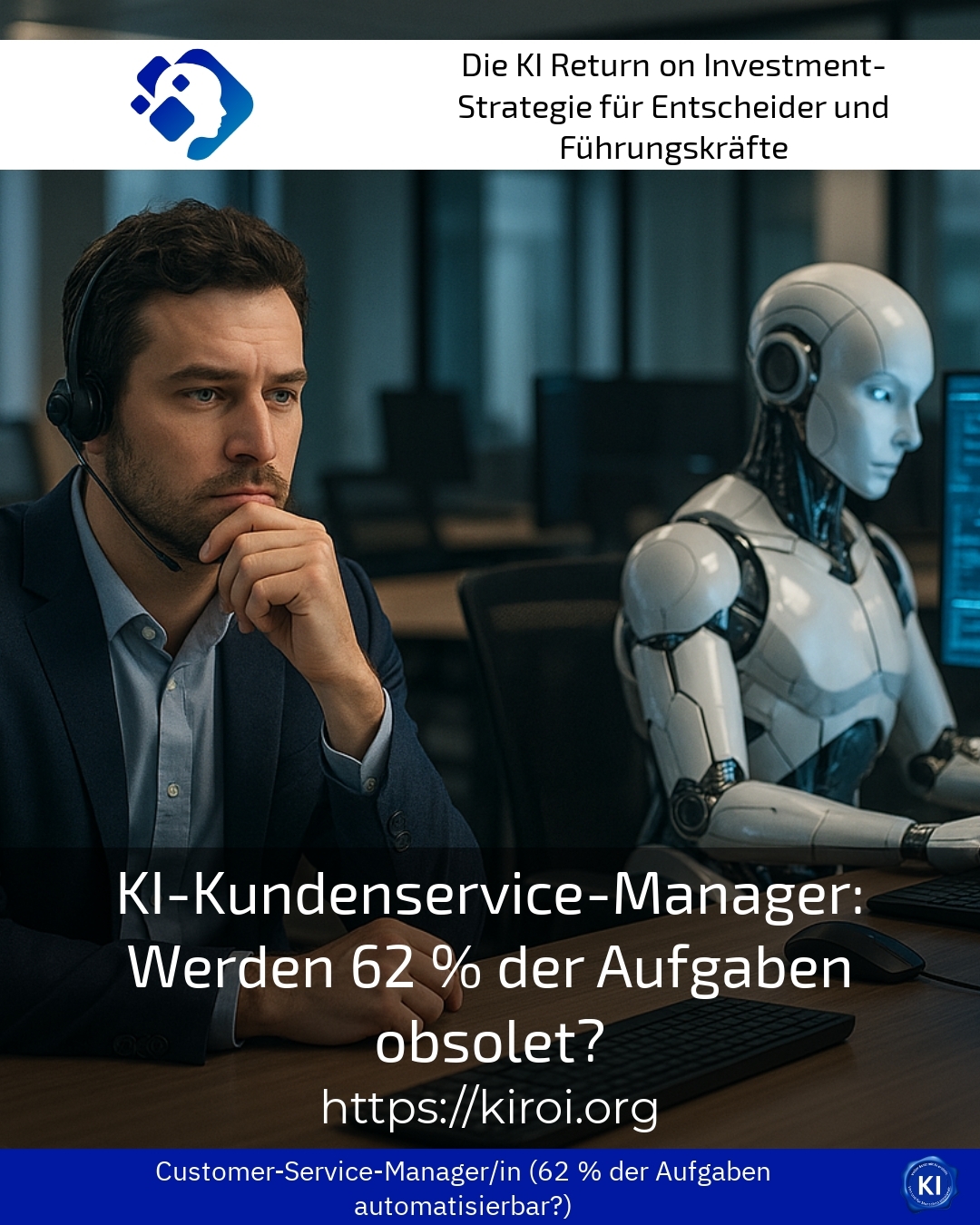
Will your customer support career soon be taken over by intelligent systems while you have to watch helplessly as machines handle your daily tasks more efficiently than you can yourself? This question is currently troubling countless professionals who deal with the coordination and optimisation of service processes, with the latest analyses revealing alarming figures that every AI customer service manager should give cause for thought. Digital transformation is advancing at a pace that is surprising even seasoned industry experts, and automation has long since begun to fundamentally alter traditional ways of working, leaving many employees to wonder whether their expertise will still be in demand in a few years' time.
The insights presented here are based, among other things, on data from the Job Futuromat of the Institute for Employment Research [1], which investigates the substitutability of various occupational fields by modern technologies and has arrived at remarkable results. If you work in this dynamic field yourself, you should act now and proactively upskill. The solution lies in the AIROI strategy, whose practical seminars, talks and workshops will help you not only to weather the changes, but also to play an active part in shaping them. You can find all the latest dates at [2], where you can register directly for events that will future-proof your career.
The revolution of intelligent systems in the service sector
The introduction of intelligent assistance systems has already fundamentally changed the way companies communicate with their customers today, and this development will accelerate even further in the coming months and years. Chatbots now answer complex enquiries about product availability and delivery times, while automated systems categorise and prioritise complaints before a human employee is even involved. For example, a major telecommunications company implemented an intelligent routing system that analyses incoming customer enquiries and automatically assigns them to the appropriate specialist, reducing the average processing time by a remarkable thirty percent. In another case, an insurance group implemented an automated claims processing system where customers only need to upload photos, after which the software assesses the damage and generates settlement proposals. The change is also clearly evident in retail: major fashion chains already use virtual style advisors that provide personalised recommendations based on purchase history and preferences, without a AI customer service manager has to intervene manually.
Particularly remarkable is the development in the field of speech processing, where modern systems are now able to recognise emotions in the customer's voice and adapt their communication accordingly. An energy supplier recently reported that its voice assistant can operate completely autonomously in over seventy percent of all standard queries, such as meter readings or changes to direct debits. The analysis of customer feedback, which previously kept several employees busy, is now handled by algorithms that capture moods, identify trends and even derive recommendations for action. These examples illustrate why the automation rate in this occupational field appears so alarmingly high and why proactive action through further training has become indispensable.
Why traditional skills alone are no longer enough
The traditional skills that have hitherto been crucial to success in customer service coordination are becoming increasingly less important, whilst at the same time entirely new areas of expertise are emerging that are scarcely covered in traditional training programmes and degree courses. In the past, it was sufficient to have a good understanding of customer needs, to resolve complaints diplomatically and to motivate teams; today, however, managers in this field must also understand how algorithmic decision-making processes work and where their limitations lie. An example from the banking sector illustrates this impressively: an experienced service manager found that his team was increasingly confronted with cases where automated credit decisions were incomprehensible to customers, and he himself was unable to explain the logic of the system because he lacked the basic technical understanding. A similar situation is evident in the travel industry: complaints about incorrect booking suggestions from intelligent planning assistants can only be dealt with competently if service staff have a fundamental understanding of how these systems work.
Best practice with a AIROI customer
A medium-sized company in the logistics sector faced the challenge of making its customer service more efficient without completely losing personal contact. The management had initially planned to replace a large proportion of the workforce with automated systems, but quickly realised that this strategy would lead to a significant decline in quality. Following participation in a AIROI seminar, the management team developed a differentiated approach whereby intelligent systems are used for routine enquiries such as parcel tracking or standard complaints, whilst more complex issues continue to be handled by trained staff. The unique aspect lay in the training of the existing workforce, who learnt to interpret, monitor and, where necessary, correct the results produced by the automated systems. This gave rise to an entirely new role that is neither purely technical nor purely communicative, but bridges both worlds. Staff satisfaction increased measurably, as team members felt relieved of monotonous tasks whilst simultaneously taking on new, more challenging responsibilities. Customer satisfaction also improved, as waiting times for standard enquiries fell, whilst competent human contacts remained available for complex issues. This project exemplifies how the AIROI strategy helps companies to combine technology and human expertise in a meaningful way, rather than sacrificing one in favour of the other.
The new role of the AI customer service manager in the hybrid working world
The future does not belong to those who resist technological change, but to those who actively help shape it and make targeted use of their unique human abilities to create added value that machines cannot provide. A AI customer service manager the future will spend less time processing individual enquiries, but will instead act as an interface between technical systems and human needs, make strategic decisions and contribute the emotional intelligence that algorithms lack. In the healthcare sector, it is already evident today how valuable this combination can be: whilst automated systems handle appointment scheduling and routine enquiries about opening hours or treatment procedures, it is trained service staff who step in for sensitive issues such as fear of diagnosis or complaints about treatment errors and respond with empathy that no machine can simulate.
Similar patterns are emerging in the financial services sector, where intelligent systems analyse account movements, identify suspicious activities and handle standard communications regarding account management or card orders, whilst human experts remain indispensable for complex advisory discussions, conflict resolution or the servicing of high-net-worth private clients. Another example can be found in the automotive industry, where manufacturers are increasingly relying on digital assistants to coordinate garage appointments and answer frequent questions about vehicle features, whilst trained staff are still required for complaints about product defects or the negotiation of goodwill gestures, enabling them to make situational decisions and maintain long-term customer relationships.
Personal transformation strategies
The crucial question is not whether your daily work routine will change, but how you actively shape this change and position yourself as an indispensable resource that technology cannot replace, because you are developing skills that go beyond mere process execution. Understanding machine learning and its application in the service sector is merely the first step, as competencies in the ethical evaluation of algorithmic decisions, in change management and in the continuous improvement of hybrid processes are equally important. An energy supplier that trained its service managers accordingly reported an interesting side effect: the trained leaders internally became sought-after points of contact for other departments that were similarly faced with the challenge of implementing intelligent systems without losing customers or employees in the process.
The AIROI seminars offer precisely this holistic approach, which combines technical understanding with strategic expertise and enables participants not only to understand what is happening, but also to actively influence events and drive innovation forward. The value of such training programmes is particularly evident in the telecommunications sector: companies whose managers understand the logic behind intelligent systems can identify errors more quickly, suggest improvements and explain to their teams why certain process changes are necessary. In the e-commerce sector, too, participants in AIROI workshops often report that, following the training, they were able to identify weaknesses in automated chatbot dialogues and formulate specific suggestions for optimisation, which were gratefully received by the technical teams.
Why right now is the right time for professional development
Current developments show that companies are increasingly looking for skilled workers who understand both worlds and can bridge the gap between them, which is why those who gain the relevant qualifications now will gain a significant competitive advantage in the labour market. In the insurance sector, for example, new roles are currently emerging that would have been unthinkable just a few years ago: specialists who monitor automated claims assessments, approve exceptions and provide continuous feedback to development teams to improve the systems. We are seeing a similar trend in the hospitality sector, where smart concierge services can answer many enquiries autonomously, but trained staff are still needed to step in when dealing with complex special requests, whilst also monitoring the quality of the automated communication.
A particularly interesting example comes from the field of public administration, where authorities are increasingly deploying digital assistants to handle citizen enquiries, while simultaneously discovering that these systems regularly reach their limits when dealing with legally complex or emotionally charged concerns. The staff who take over these cases require not only specialist legal knowledge and communication skills, but also an understanding of why the automated system fails in certain situations and how such cases should be documented for future system improvements. These examples illustrate that the AI customer service manager will play a key role in the future, provided he is willing to undergo appropriate further training and expand his competencies.
My AIROI Analysis
The analysis of current developments clearly shows that we are at a critical turning point where deciding for or against proactive further training will have far-reaching consequences for our professional future. The AIROI strategy provides a structured framework to not only master these challenges, but to use them as an opportunity for personal and professional development. From my experience in supporting numerous transformation projects, I can report that those professionals who invest early in their further training consistently have better career prospects than those who wait and hope that the changes will pass them by.
I believe it is particularly important to recognise that technology and human expertise are not opposites, but can complement each other perfectly when both are properly aligned. The companies I have had the privilege of supporting in my role as a catalyst for transformation projects have consistently found that the greatest added value is created when technical systems are monitored, supplemented and continuously improved by people who understand how they work. Tasks that can be automated do not simply disappear, but are transformed into new areas of work that require higher qualifications and are consequently better remunerated. Those who face up to this reality and take proactive action will find that the oft-cited threat posed by intelligent systems can be turned into an opportunity leading to more fulfilling and better-paid roles than those that existed in the past.
Further links from the text above:
[1] IAB Job Futuromat – Analysis of the substitutability of occupations
[2] AIROI seminars and live events with Sanjay Sauldie
For more information and if you have any questions, please contact Contact us or read more blog posts on the topic Artificial intelligence here.








 Deutsch
 English (UK)